
Common Volvo Penta Engine Problems: 12 Warning Signs, Causes & Proven Solutions
Technical guide prepared for Titan Marine Diesel
A Volvo Penta diesel engine rarely gives you a written invitation before something goes wrong.
Instead, it gives you clues.
Maybe the temperature starts running five or ten degrees higher than you are used to seeing. Maybe the engine hesitates before reaching full RPM. Perhaps it starts producing smoke that was not there last season. Or the EVC display suddenly reports a warning and you are left wondering whether you have a minor sensor problem or something capable of ending your trip.
Those changes deserve attention.
But here is the first lesson we want every boat owner to understand:
A symptom is not the same thing as a diagnosis.
A Volvo Penta engine that cannot reach full RPM may have a fuel problem. It may also have a turbocharger issue, restricted air supply, excessive propeller load, hull fouling, driveline resistance, or an electronic condition limiting output.
That is why replacing the first component that seems suspicious is rarely the best troubleshooting strategy.
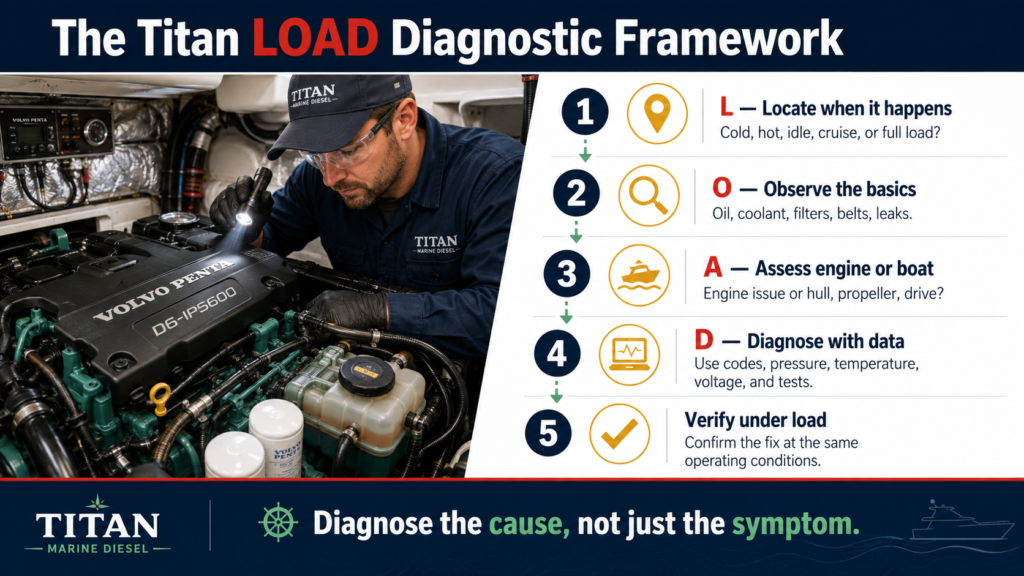
The better process is:
Confirm the symptom → establish when it happens → inspect the basics → test the affected system → verify the repair under load.
This guide covers 12 of the most important common Volvo Penta engine problems, the warning signs owners should recognize, the systems technicians typically investigate, and the point at which professional diagnosis becomes more sensible than further DIY troubleshooting.
One qualification matters before we begin: Volvo Penta produces many different mechanical and electronically controlled marine engines. Specifications, alarms, maintenance requirements, service procedures, and troubleshooting instructions can differ by model, generation, installation and serial number. Volvo Penta therefore directs owners to the maintenance schedule and operator information specific to their engine.
What Are the Most Common Volvo Penta Engine Problems?
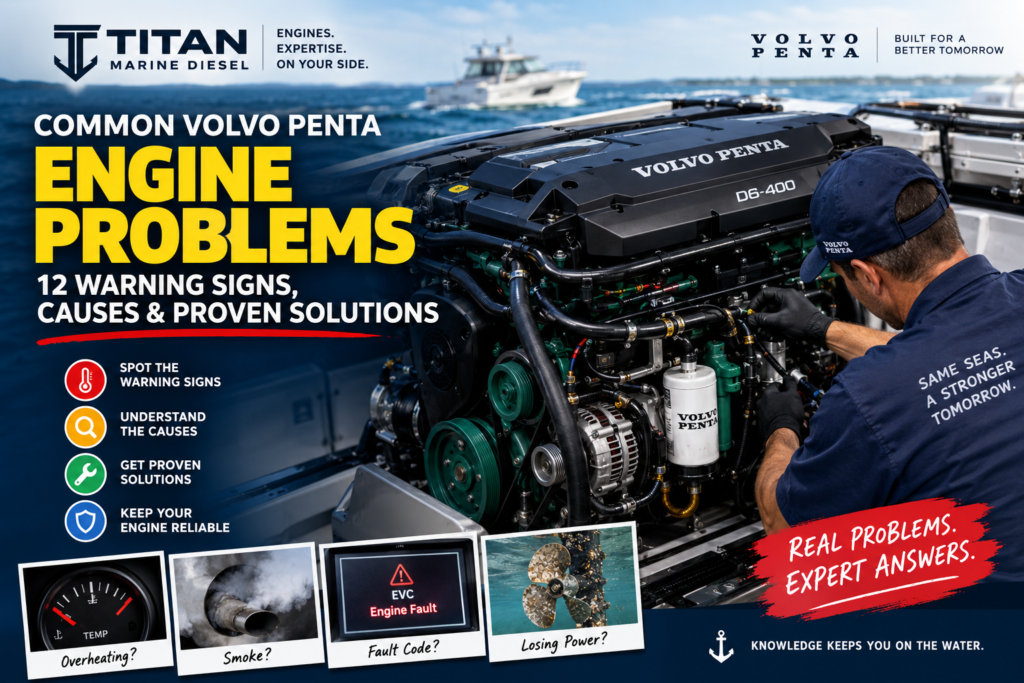
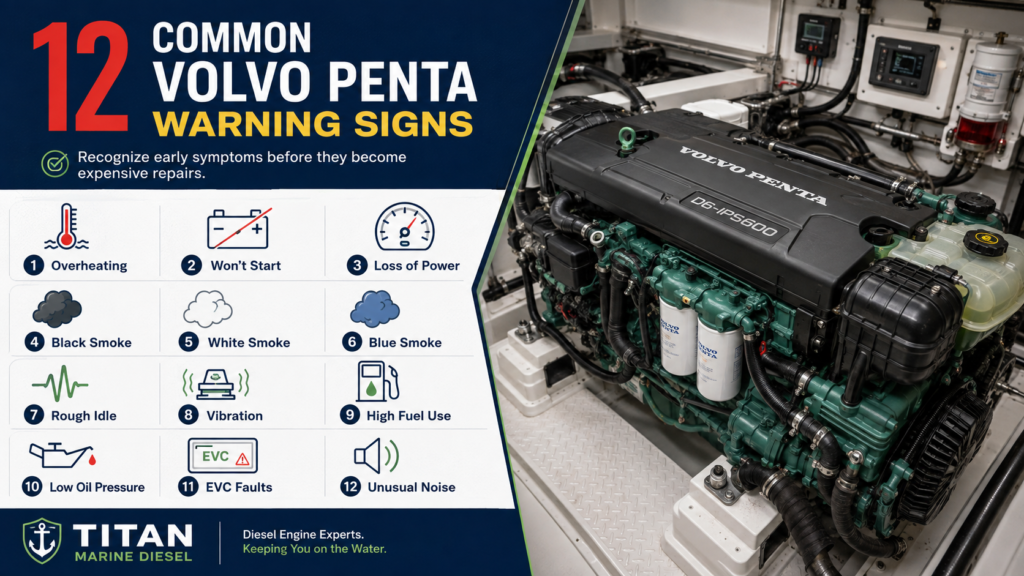
The most important Volvo Penta engine warning signs to investigate are overheating, starting difficulty, inability to reach expected RPM, unusual exhaust smoke, rough running, excessive vibration, increased fuel consumption, low oil pressure, EVC alarms, and new mechanical noises.
Here is the quick diagnostic overview:
| Warning Sign | Systems Worth Investigating First | Priority |
|---|---|---|
| Overheating | Raw-water and closed cooling systems, engine loading | High |
| No crank / no start | Battery, starter, fuel, controls | High |
| Loss of power | Fuel, air, turbo, exhaust, propeller/loading | High |
| Black smoke | Air supply, turbo, injector condition, load | Medium–High |
| White smoke | Combustion quality, injector, compression, coolant | Medium–High |
| Blue smoke | Lubricating oil entering combustion | High |
| Rough idle | Fuel quality, injection, sensors, compression | Medium |
| Excess vibration | Mounts, engine, shaft, propeller or drive | High |
| Increased fuel use | Hull, propeller, load, engine condition | Medium |
| Low oil pressure | Lubrication system, sensor, internal wear | Critical |
| EVC warning | Engine, driveline, electrical or control system | Varies |
| New mechanical noise | Belt drive, turbo, drivetrain or internals | High |
The table is a starting point—not a parts list.
A Better Way to Diagnose Volvo Penta Problems
Before working through the 12 problems, use this five-question diagnostic filter.
1. What Exactly Changed?
Avoid vague descriptions such as:
“The engine isn’t running right.”
Instead document something measurable:
- Maximum RPM fell from 3,400 to 2,900.
- Coolant temperature rises only above 2,500 RPM.
- White smoke lasts for three minutes after a cold start.
- Vibration begins only after shifting into gear.
- An EVC warning appears after twenty minutes at cruise.
Specific symptoms create better diagnoses.
2. When Does It Happen?
This is one of the most valuable pieces of information in marine diesel engine troubleshooting.
Does the problem occur:
- When cold?
- When hot?
- At idle?
- During acceleration?
- At cruise?
- Only at wide-open throttle?
- Immediately?
- After sustained running?
An engine that overheats at idle and an engine that overheats only under heavy load may require very different diagnostic paths.
3. Did Anything Change Recently?
Ask whether the problem appeared after:
- Fueling
- Winter storage
- Propeller work
- Bottom painting
- Maintenance
- Electrical work
- Engine service
- Parts replacement
- A grounding or propeller strike
Never ignore timing.
4. Is It Really an Engine Problem?
Marine propulsion must be diagnosed as a system.
A dirty hull or damaged propeller can make a perfectly healthy engine appear weak.
5. What Evidence Confirms the Diagnosis?
This is the step that separates troubleshooting from guessing.
Depending on the symptom, evidence might include:
- Actual fuel pressure
- Cooling-water flow
- Fault-code information
- Battery voltage under load
- Turbo boost
- Compression
- Injector testing
- Oil-pressure measurement
- Sea-trial RPM
Test before replacing expensive components. Upgrade your Electronic Vessel Control (EVC)
1. Volvo Penta Engine Overheating
Few warnings deserve faster attention than Volvo Penta engine overheating.
Excessive temperature can escalate from a cooling-system fault into serious engine damage if the engine continues operating under heavy load.
Warning Signs
Watch for:
- High-temperature alarm
- Gauge climbing above normal operating range
- Steam
- Coolant odor
- Coolant loss
- Changed exhaust-water flow
- Temperature that rises with RPM
What Should Be Investigated?
A technician may need to examine:
- Seawater intake
- Seacock position
- Raw-water strainer
- Seawater-pump impeller
- Pump condition
- Heat exchanger
- Coolant quantity
- Thermostat
- Belt drive where applicable
- Cooling-system leaks
- Engine loading
The precise procedure should come from the manual applicable to the engine. Volvo Penta specifically directs owners to model-specific operator and maintenance documentation for service and troubleshooting information.
Technician Logic: Idle vs Load
This distinction is valuable.
Suppose the engine remains at normal temperature around the marina but becomes hot after several minutes at cruising RPM.
That tells us the cooling system can handle a relatively small heat load but may be struggling as engine output increases.
That pattern makes flow restriction, heat-transfer performance and excessive propulsion load particularly important areas to investigate.
What Should You Do If the Alarm Appears?
Reduce load and follow the engine’s specified alarm procedure.
If temperature remains excessive, stop the engine when it is safe to do so and investigate before continuing normal operation.
Never remove the cap from a hot pressurized cooling system.
Technician takeaway: Do not simply replace the thermostat because an engine overheats. First establish whether the problem is coolant circulation, raw-water supply, heat transfer, loading or another cause.
2. Volvo Penta Engine Won’t Start
The phrase Volvo Penta engine won’t start actually describes two completely different problems.
Does the Engine Crank?
If the starter does not rotate the engine, investigate the starting side first.
Areas may include:
- Battery charge and condition
- Battery connections
- Isolation switch
- Starter wiring
- Starter motor
- Neutral/start interlock
- Electronic control authorization on applicable engines
One very common diagnostic mistake is assuming a battery is healthy because lights or displays work.
Those loads require much less current than a starter motor.
Battery voltage needs to be evaluated under the appropriate load.
Does It Crank but Fail to Start?
Now the diagnostic direction changes.
Possible systems to investigate include:
- Fuel supply
- Fuel filters
- Air entering the fuel circuit
- Contaminated diesel
- Fuel pressure
- Injection
- Engine-control inputs
- Compression
For current D4 and D6 platforms, fuel diagnosis also involves electronically controlled common-rail systems. Volvo Penta currently identifies the D4 as a 3.7-liter four-cylinder common-rail diesel and the D6 as a 5.5-liter six-cylinder common-rail diesel.
Technician Rule
Start with:
No crank? Think starting/electrical/control system.
Cranks but won’t fire? Think fuel, combustion and control inputs.
That single distinction can eliminate a great deal of unnecessary troubleshooting.
3. Volvo Penta Engine Losing Power Under Load
An engine that runs beautifully with no load at the dock but cannot produce expected RPM underway creates one of the most interesting diagnostic situations.
Why?
Because the engine may not actually be the problem.
Possible Engine-Side Causes
A Volvo Penta engine losing power may justify investigation of:
- Fuel restriction
- Clogged filters
- Air entering the fuel system
- Contaminated fuel
- Injection problems
- Turbocharger performance
- Intake restriction
- Exhaust restriction
- Electronic derate or monitored fault
Possible Boat-Side Causes
Also inspect:
- Hull fouling
- Propeller fouling
- Damaged propeller
- Incorrect propeller specification
- Increased vessel weight
- Shaft/driveline resistance
- Drive condition
This is not a minor detail.
Volvo Penta’s own commissioning material historically includes verification of maximum RPM underway and checks that wide-open-throttle RPM falls within the recommended range under the vessel’s normal load. That reflects an important marine-engine principle: engine performance must be assessed under actual vessel load, not merely while revving at the dock.
A Representative Diagnostic Scenario
Imagine this:
The owner reports that the engine has “lost horsepower.”
No alarming smoke. No starting problem. No obvious fuel leak.
At the dock, the engine revs normally.
Underway, maximum RPM is several hundred revolutions lower than before.
A poor troubleshooting process immediately starts pricing injectors.
A better one asks:
- Has the bottom fouled?
- Were the propellers recently changed?
- Did the vessel gain significant load?
- Is there propulsion damage?
- Is fuel delivery actually restricted?
- Is turbo boost normal?
This is what practical experience looks like in an article: not pretending we already know the failed part, but showing how a technician separates possibilities.
4. Black Smoke From a Volvo Penta Diesel Engine
Persistent black smoke generally means fuel is not being burned as cleanly as expected.
Possible areas include:
- Airflow restriction
- Turbocharger performance
- Fuel injection
- Exhaust restriction
- Excessive engine loading
- Propeller/hull condition
Historically, Volvo Penta has specifically highlighted common-rail electronic control as part of its work to control smoke on D4/D6 engines.
The Key Question: When Does It Smoke?
A small transient puff during aggressive acceleration is a different complaint from continuous heavy black smoke at cruise.
If black smoke is combined with:
- Low maximum RPM
- Poor vessel speed
- High apparent engine load
do not ignore the propeller and hull.
What Not to Do
Do not jump immediately to:
“The injectors are bad.”
Volvo Penta injector problems are one possibility, not the only possibility.
5. White Smoke From a Volvo Penta Diesel
White exhaust can have several meanings.
Possible causes include:
- Incomplete combustion
- Poor cold combustion
- Injection problems
- Low cylinder compression
- Coolant entering combustion in some failure conditions
Ask Better Questions
Does the smoke:
- Occur only when cold?
- Clear after warm-up?
- Continue at operating temperature?
- Accompany rough running?
- Accompany coolant loss?
- Accompany difficult starting?
These clues matter.
Important Trustworthiness Point
White smoke does not automatically mean a failed head gasket.
That conclusion needs evidence.
If coolant is disappearing, the engine is misfiring when warm, or other signs point toward internal leakage, further testing becomes appropriate.
6. Blue Smoke and Oil Consumption
Blue or blue-gray exhaust typically shifts the investigation toward lubricating oil entering the combustion process.
Areas that may need evaluation include:
- Piston rings
- Cylinder condition
- Valve guides/seals on applicable engines
- Turbocharger oil sealing
- Crankcase ventilation
- Oil level
What Matters More Than Color Alone?
Oil-consumption history.
Ask:
- Is the oil level actually dropping?
- How much oil is being consumed per operating hour?
- Did the symptom appear suddenly?
- Is the turbocharger showing signs of oil leakage?
- Is crankcase pressure abnormal?
Persistent blue smoke and measurable oil consumption deserve investigation before the condition becomes more serious.
7. Rough Idle, Misfire or Uneven Running
A healthy diesel should run consistently.
If RPM begins hunting or the engine shakes excessively at idle, the diagnostic areas may include:
- Fuel contamination
- Air entering the fuel system
- Injection imbalance
- Fuel-pressure problems
- Electrical supply
- Sensor inputs
- Cylinder compression
On current D4 and D6 common-rail engines, electronic data can form part of the diagnostic process because fuel injection and engine management are electronically controlled.
The Question We Prefer
Instead of:
Which injector should I replace?
Ask:
What evidence shows that fuel delivery or combustion is different in one or more cylinders?
That question encourages testing rather than expensive guesswork.
8. Excessive Engine Vibration
Marine vibration is especially interesting because the source may sit outside the engine.
Engine-Related Possibilities
Investigate:
- Engine mounts
- Uneven combustion
- Loose accessories or brackets
- Internal mechanical condition
Drivetrain and Vessel Possibilities
Also consider:
- Propeller damage
- Propeller fouling
- Shaft alignment
- Shaft condition
- Cutless/support bearing condition
- Gearbox
- Sterndrive or pod system
Volvo Penta’s commissioning documentation has historically included checks of engine mounting, shaft alignment, drivetrain installation, propeller configuration and sea-trial performance—another indication that correct marine-engine diagnosis extends beyond the engine itself.
Use the Pattern
Does vibration happen:
In neutral?
Investigate engine-side causes first.
Only in gear?
Drivetrain and propulsion become more relevant.
At one narrow RPM range?
Look for resonance, alignment and rotating-component issues.
The pattern often tells you where to begin.
9. Fuel Consumption Has Increased
Owners frequently notice this through range rather than an alarm.
The boat simply starts consuming more diesel to do the same job.
Potential areas include:
- Hull fouling
- Propeller condition
- Increased vessel weight
- Different operating RPM
- Fuel-system deterioration
- Intake restriction
- Turbocharger performance
- Fuel leakage
- Engine loading
Use Data Instead of Memory
Compare:
- Engine RPM
- Boat speed
- Fuel consumption
- Vessel load
- Sea state
- Propeller configuration
If the engine previously produced a certain cruise speed at a given RPM and the same vessel now runs materially slower under similar conditions, investigate what changed.
A Volvo Penta fuel consumption problem may therefore be an engine issue—or a vessel-efficiency problem.
10. Low Oil Pressure Warning
A genuine low-oil-pressure condition can destroy an engine quickly enough that it deserves a different level of caution.
Possible areas include:
- Low oil level
- External leakage
- Oil condition or dilution
- Incorrect lubricant
- Pressure-sensor fault
- Electrical fault
- Oil-pump problem
- Internal bearing wear
The Rule We Want Owners to Remember
Never dismiss low oil pressure as “probably a bad sensor” until pressure has been verified.
Yes, sensors can fail.
Mechanical oil pressure can also genuinely disappear.
The safe approach is to establish which situation exists before normal operation continues.
Appropriate Response
If actual low pressure is suspected:
- Reduce load.
- Shut down when safe.
- Check oil level and obvious leakage.
- Have actual oil pressure verified using the correct procedure.
- Determine the cause before continuing normal operation.
11. Volvo Penta EVC Fault or Alarm
EVC stands for Electronic Vessel Control.
Volvo Penta currently describes EVC as its marine control system connecting helm stations with engines and drives and controlling or monitoring functions including throttle, gearshift, steering and trim.
Depending on the installation and EVC generation, a Volvo Penta EVC fault may therefore relate to:
- Engine-management information
- Fuel or cooling parameters
- Electrical supply
- Throttle and shift
- Communication
- Driveline
- Control hardware
Fault Code ≠ Failed Component
This deserves emphasis.
A fault code tells you what condition the system detected.
It does not necessarily tell you the root cause.
For example, a pressure-related fault may involve:
- Actual inadequate pressure
- Supply restriction
- Sensor problem
- Wiring fault
- Control issue
Volvo Penta advises owners to use the relevant operator documentation for common alarms, possible causes and recommended actions.
That is why our upcoming Volvo Penta Fault Codes guide should complement—not replace—the serial-number-specific Volvo Penta documentation.
12. New Knocking, Whining, Rattling or Turbo Noise
A sudden new mechanical noise should not be normalized simply because the engine still runs.
Squealing
Investigate belt-driven components, tensioners and pulleys.
Whistling or Changed Turbo Noise
Consider the intake/charge-air path and turbocharger system.
Grinding
Treat possible rotating-component or drivetrain problems seriously.
Knocking
The cause may be combustion-related or mechanical and requires diagnosis rather than identification by sound alone.
Rattling
Inspect external brackets and accessories, but do not dismiss persistent noise that appears internal.
Stop and Investigate More Urgently When Noise Is Accompanied By:
- Low oil pressure
- Severe vibration
- Power loss
- Heavy smoke
- Abnormal temperature
- Metallic debris
Multiple symptoms together provide far more useful diagnostic information than one symptom alone.
Volvo Penta D4 vs D6 Problems: Why Exact Model Identification Matters
Generic troubleshooting pages often treat “Volvo Penta” like one engine.
It is not.
The current D4 is an inline four-cylinder, 3.7-liter common-rail diesel, while the current D6 is an inline six-cylinder, 5.5-liter common-rail diesel. Volvo Penta also offers these engine families in different propulsion configurations.
That means two owners can both say:
“I have a Volvo Penta D6.”
and still have meaningful differences in:
- Output rating
- Model generation
- Drive or transmission
- EVC configuration
- Propulsion installation
- Applicable parts
- Applicable service instructions
Before diagnosing Volvo Penta D4 problems or Volvo Penta D6 problems, establish the exact product.
Your Serial Number Is One of the Most Valuable Diagnostic Details
When someone contacts a technician or parts supplier and says:
“I need a sensor for my D6.”
there still may not be enough information to identify the correct component.
Volvo Penta states that the serial number is the product’s unique identifier and describes it as the key to efficient servicing and correct parts ordering.
Before ordering major components, provide:
- Engine model
- Engine serial number
- Drive/transmission model
- Drive/transmission serial number where relevant
- Vessel configuration
This reduces incorrect parts ordering and improves diagnostic accuracy. Find your serial number
Mechanical vs Electronic Volvo Penta Troubleshooting
The fundamentals remain the same, but the tools change.
| Older Mechanical Diesel | Modern Electronic Diesel |
| Mechanical injection diagnosis | Mechanical + electronic diagnosis |
| Few monitored inputs | Multiple sensor inputs |
| Mechanical control | ECU-managed fuel/control functions |
| Basic instrumentation | Electronic alarms and displays |
| Limited stored information | Diagnostic data may be available |
Modern electronics are useful, but they do not repeal the laws of mechanics.
A D4 with sophisticated control electronics can still overheat because raw-water flow is restricted.
A D6 can still fail to reach RPM because the propellers are fouled.
Diagnostic software supplements basic marine-engine reasoning. It does not replace it.
Preventive Maintenance Is Part of Troubleshooting
One of the easiest ways to improve reliability is to prevent known service items from becoming diagnostic problems.
Volvo Penta says engine service recommendations are found in the applicable maintenance schedule and that intervals are determined by engine hours and/or elapsed time.
Depending on the engine, regular attention may involve areas such as:
- Engine oil
- Oil filter
- Fuel filters
- Cooling system
- Seawater system
- Belts
- Batteries
- Drive or transmission
- Applicable anodes and other service components
Do not copy the schedule from another engine family.
Use the documentation associated with your exact engine and serial number. Volvo Penta provides operator manuals and maintenance information through its support resources.
The Titan Three-Level Repair Decision
Here is an original framework we recommend using when deciding what to do after diagnosis.
Level 1 — Isolated Failure
Examples:
- Single sensor fault
- Service item
- Isolated pump or hose problem
- Minor electrical repair
Likely direction: Repair the fault and continue monitoring.
Level 2 — System-Level Deterioration
Examples:
- Cooling system requiring substantial refurbishment
- Injection system needing major work
- Turbocharger plus associated system repairs
- Multiple age-related auxiliary failures
Likely direction: Compare repair cost with the engine’s overall condition and expected future service.
Level 3 — Whole-Powertrain Economics
Examples:
- Serious internal wear plus aging auxiliaries
- Repeated expensive failures
- Significant corrosion
- Difficult parts support
- Major drive/transmission work also approaching
- Vessel intended for many more years of ownership
Likely direction: Compare overhaul against Volvo Penta repower or replacement.
The Contrarian Question
Do not ask only:
“How much is this repair?”
Ask:
“After making this repair, what major systems are likely to require investment next?”
A large repair can still be financially sensible on an otherwise healthy engine.
A smaller repair may be poor value if several other major systems are simultaneously near the end of economical service.
That is a much better ownership calculation.
What Can an Owner Safely Check?
Being technically informed does not mean dismantling everything yourself.
Reasonable Owner-Level Observations
Depending on the engine manual and your experience:
- Oil level
- Coolant level when cold
- Visible leaks
- Seawater strainer
- Belt condition
- Battery-terminal condition
- Fuel-water separator
- Fault message shown on the display
Technician-Level Work
Leave specialist diagnosis to properly trained personnel when it involves:
- High-pressure common-rail fuel systems
- Internal engine repair
- Injector testing
- Turbocharger diagnosis
- Compression/leak-down testing
- Verified lubrication-pressure testing
- Advanced EVC/ECU diagnosis
The current D4 and D6 use high-pressure common-rail fuel systems, reinforcing the need for correct service procedures rather than improvised work.
Frequently Asked Questions About Common Volvo Penta Engine Problems
What are the most common Volvo Penta engine problems?
Important warning signs include overheating, hard starting, power loss, abnormal exhaust smoke, rough running, vibration, increased fuel consumption, low oil pressure, EVC alarms and new mechanical noises. The symptom should be diagnosed rather than treated as proof of a specific failed part.
Why is my Volvo Penta engine losing power under load?
Fuel restriction, air-supply problems, turbocharger issues, electronic faults and injection problems can reduce output, but hull fouling, propeller damage, incorrect loading and drivetrain resistance can create similar symptoms.
Why does my Volvo Penta overheat only at higher RPM?
An engine that overheats primarily under increased load warrants investigation of cooling capacity, raw-water flow, heat-transfer performance and engine/propeller loading. Follow the model-specific Volvo Penta troubleshooting information before replacing components.
What does black smoke from a Volvo Penta diesel mean?
Persistent black smoke generally indicates that combustion is not receiving the expected air-to-fuel balance or the engine is heavily loaded. Air intake, turbocharger performance, injection, exhaust and vessel loading may all require investigation.
What does a Volvo Penta EVC fault mean?
It means the electronic control system has detected a condition requiring attention. Because EVC can monitor and control multiple propulsion functions, the displayed code or alarm and the applicable operator documentation should be reviewed before components are replaced.
How can I tell if my Volvo Penta injectors are failing?
Possible symptoms include hard starting, uneven running, unusual smoke, power loss and increased fuel consumption, but none of those symptoms proves injector failure. Proper fuel-system and injector diagnosis is needed.
Is it better to repair or replace an old Volvo Penta engine?
Repair often makes sense when the problem is isolated and the rest of the engine is healthy. Repower becomes worth comparing when serious internal wear, repeated failures, corrosion, difficult parts support or several major upcoming repairs make continued ownership increasingly expensive.
Need Help With a Volvo Penta Engine?
If you are troubleshooting an engine, sourcing a replacement or deciding whether a repower makes more financial sense than another major repair, Titan Marine Diesel can evaluate the information surrounding the application.
When requesting assistance, provide as much of the following as possible:
- Engine model
- Engine serial number
- Engine hours
- Vessel make and model
- Drive or transmission
- EVC message or fault information
- Exact symptom
- RPM at which the problem occurs
- Whether the engine is hot or cold when it occurs
- Recent maintenance or repairs
- Photos or video where useful
- Vessel location
The better the information, the less room there is for guessing.
Final Technician Takeaway: Diagnose Systems, Not Symptoms
There is one idea worth carrying away from this entire guide:
Do not replace parts because a symptom sounds familiar.
An overheating engine does not automatically need a thermostat.
Black smoke does not automatically mean injectors.
Low RPM does not automatically mean the engine has lost horsepower.
An EVC code does not automatically prove that the component named in the fault is defective.
A disciplined diagnostic process asks:
What changed?
When does it happen?
What systems can create this symptom?
What test will separate those possibilities?
Does the repair solve the problem under the same load that originally produced it?
That is how good troubleshooting protects both the engine and the owner’s wallet.

Leave a Reply