
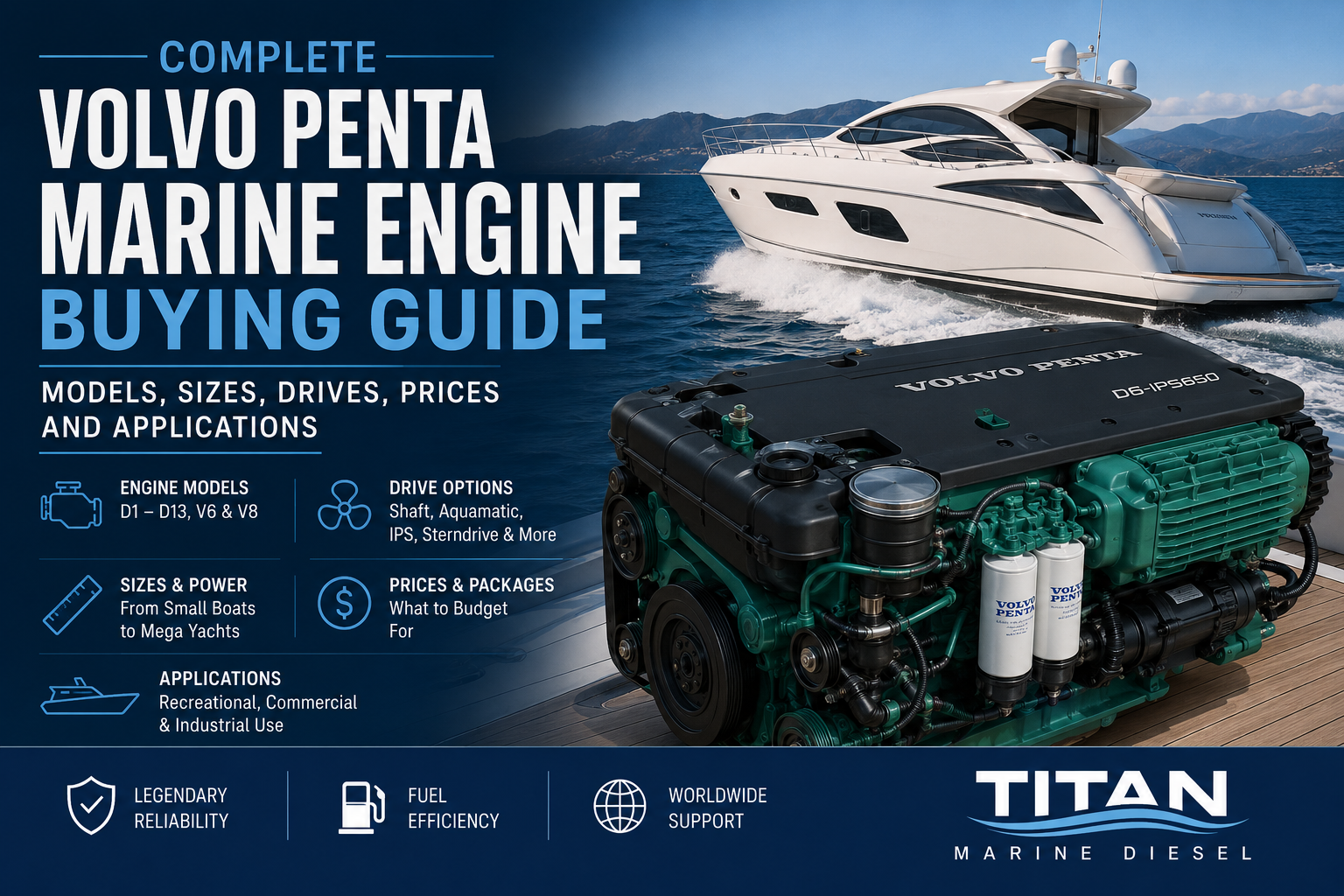
Complete Volvo Penta Marine Engine Buying Guide: Models, Sizes, Drives, Prices and Applications
Choosing a marine engine is not simply a matter of selecting a horsepower figure and finding the lowest online price.
The engine must work with the vessel’s hull, loaded weight, gearbox, reduction ratio, propeller, exhaust system, cooling arrangement, controls and intended duty cycle. When one of those elements is incorrectly matched, even a high-quality engine can deliver poor performance, excessive fuel consumption or premature wear.
From the enquiries we handle at Titan Marine Diesel, one of the most common mistakes is requesting a quotation for a particular model before confirming whether that engine is suitable for the vessel.
Sometimes the requested engine is correct. In other cases, the boat requires a different power rating, gearbox ratio, drive configuration or commercial duty rating.
This Volvo Penta marine engine buying guide explains how to compare Volvo Penta marine engines, diesel and gasoline options, available propulsion systems, package configurations, price factors and marine applications.
It is intended to help buyers ask the right questions before ordering. Final engine selection should still be confirmed by a qualified marine engineer, naval architect, installer or propulsion specialist familiar with the vessel.
Start With the Vessel, Not the Horsepower – Volvo Penta Marine Engine Buying Guide
Boat length alone does not determine the correct engine.
Two vessels of the same length can require very different propulsion systems. A lightweight planing cruiser and a heavy displacement trawler may both measure 40 feet, but their power, torque, gearing and propeller requirements will not be the same.
Before requesting a recommendation, collect the following information:
- Vessel make and model
- Length and beam
- Dry and fully loaded displacement
- Hull type
- Current engine model
- Current rated horsepower and RPM
- Gearbox or sterndrive model
- Gear reduction ratio
- Propeller dimensions
- Required cruising and maximum speeds
- Recreational or commercial use
- Expected annual operating hours
- Freshwater or saltwater operation
- Single- or twin-engine installation
A reliable dealer should ask how the vessel will be used—not simply how much horsepower the buyer wants.
Buyers who are uncertain about the required power range should also review our Volvo Penta engine sizes and horsepower guide before selecting a model.
Quick Volvo Penta Engine Selection Guide
The following table provides general guidance only. Exact suitability depends on the vessel and the current Volvo Penta product configuration available in the buyer’s region.
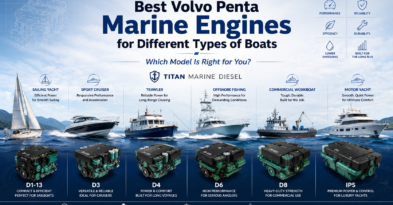
| Vessel or application | Common engine family | Typical propulsion option | Main consideration |
|---|---|---|---|
| Sailing yacht | D1 or D2 | Shaft drive or saildrive | Compact installation and displacement |
| Small motor cruiser | D3 or D4 | Shaft drive or sterndrive | Loaded weight and planing performance |
| Sport cruiser | D4 or D6 | Aquamatic or IPS | Acceleration, cruising speed and handling |
| Sport-fishing boat | D6, D8 or D11 | Shaft drive or IPS | Offshore load, range and service access |
| Workboat | D4 through D13 | Shaft drive or waterjet | Duty rating and operating hours |
| Passenger vessel | D6 through D13 | Shaft drive or IPS | Redundancy, comfort and compliance |
| Large motor yacht | D8, D11 or D13 | Shaft drive or IPS | Power, machinery space and range |
| Recreational sport boat | V6 or V8 gasoline | SX, DPS or Forward Drive | Acceleration and watersports use |
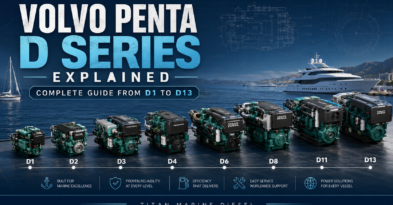
For a broader overview of how the diesel families compare, see our complete Volvo Penta D Series guide from D1 to D13.
Volvo Penta Diesel or Gasoline?
The right fuel type depends on operating profile, vessel size and ownership priorities.
Volvo Penta Diesel Engines
A Volvo Penta marine diesel engine is generally considered for:
- Long-distance cruising
- High annual operating hours
- Heavy vessels
- Commercial marine use
- Offshore fishing
- Trawlers
- Larger motor yachts
- Applications requiring strong low-speed torque
Diesel engines normally provide good fuel efficiency under sustained load and are available with several propulsion arrangements.
However, diesel engines usually cost more initially than comparable gasoline packages. Installation weight, maintenance requirements and the availability of local technical support should also be considered.
Buyers can view the available Volvo Penta diesel engines for sale through the main diesel-engine category.
Volvo Penta Gasoline Engines
A Volvo Penta gasoline marine engine may suit:
- Bowriders
- Sport boats
- Deck boats
- Day cruisers
- Watersports vessels
- Smaller performance cruisers
- Boats with lower annual operating hours
Gasoline engines can offer smooth operation, strong acceleration and favourable power-to-weight ratios. They may also have a lower initial purchase price.
Buyers should compare fuel consumption, local fuel availability, expected usage, maintenance costs and resale value before deciding.
For recreational applications, review our available Volvo Penta V6 and V8 gasoline engines.
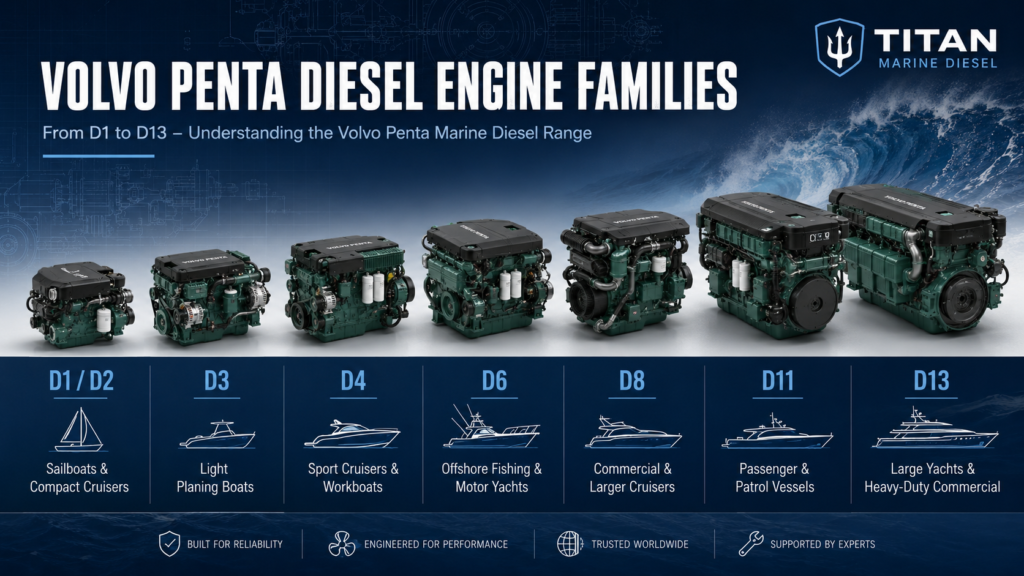
Volvo Penta Diesel Engine Families
Volvo Penta D1 and D2
The Volvo Penta D1 Series is commonly associated with smaller sailing yachts and compact displacement vessels.
The Volvo Penta D2 Series provides additional power for larger sailing yachts, motor sailers and compact motorboats.
These engines may be installed with a shaft drive or compatible saildrive, depending on the model and package.
During a repower, verify:
- Engine dimensions
- Mounting centres
- Exhaust outlet size
- Electrical voltage
- Saildrive compatibility
- Propeller selection
- Service clearance
Do not assume an existing saildrive will automatically match a replacement engine.
Buyers comparing compact yacht engines can explore our Volvo Penta D1 marine engines, Volvo Penta D2 marine engines and Volvo Penta saildrive packages.
Representative product pages may include the Volvo Penta D2-50, Volvo Penta D2-60 and Volvo Penta D2-75.
For more detailed selection advice, read Best Volvo Penta Engines for Sailboats.
Volvo Penta D3
The Volvo Penta D3 marine engine is typically used in lighter recreational boats where compact dimensions and low engine weight are important.
It may be suitable for:
- Smaller planing cruisers
- Lightweight sport boats
- Compact inboard installations
- Selected sterndrive applications
A D3 should not be chosen simply because it fits physically. Heavier vessels may require the greater displacement and torque of a D4 or D6.
View the available Volvo Penta D3 marine engines, including inboard and sterndrive configurations such as the Volvo Penta D3-150, D3-170, D3-200 and D3-220.
Volvo Penta D4
The Volvo Penta D4 marine engine is a versatile four-cylinder diesel platform commonly used in:
- Sport cruisers
- Fishing boats
- Patrol craft
- Workboats
- Inboard installations
- Aquamatic packages
The D4 often suits buyers who need more torque and sustained performance than a compact diesel can comfortably provide without moving to the larger D6 platform.
Explore the full range of Volvo Penta D4 marine engines, including D4 inboard engines and D4 Aquamatic packages.
Popular model pages may include the Volvo Penta D4-230, D4-270, D4-300 and D4-320.
Buyers deciding between the two most popular mid-range platforms should read our Volvo Penta D4 vs D6 comparison.
Volvo Penta D6
The Volvo Penta D6 marine engine is one of the most widely considered Volvo Penta platforms for medium-sized recreational and commercial vessels.
Applications may include:
- Express cruisers
- Offshore fishing boats
- Motor yachts
- Patrol craft
- Passenger vessels
- Workboats
- Shaft-drive packages
- Aquamatic installations
- IPS propulsion
The D6 offers six-cylinder smoothness, strong torque and several driveline options. It may be more appropriate than a D4 where vessel weight, load or required cruising performance is higher.
Browse our Volvo Penta D6 marine engines, D6 inboard engines and D6 Aquamatic packages.
Representative models include the Volvo Penta D6-300, D6-340, D6-380, D6-440 and D6-480.
Additional technical information is available in our complete Volvo Penta D6 Series guide and Volvo Penta D6 fuel-consumption guide.
Volvo Penta D8
The Volvo Penta D8 marine engine serves larger recreational and commercial vessels, including workboats, passenger craft, fishing boats and motor yachts.
At this level, buyers must pay close attention to:
- Engine-room ventilation
- Fuel supply
- Cooling capacity
- Exhaust design
- Gearbox selection
- Driveline load
- Service access
View our Volvo Penta D8 marine engines, including the Volvo Penta D8-550 and D8-600.
Volvo Penta D11 and D13
The Volvo Penta D11 and Volvo Penta D13 are intended for larger yachts and demanding commercial installations.
Common applications include:
- Large motor yachts
- Passenger vessels
- Fishing vessels
- Patrol craft
- Fast workboats
- Twin-engine shaft installations
- High-output IPS applications
These engines should be selected using proper vessel resistance, propeller and driveline calculations. Choosing one from horsepower alone would not be responsible.
Available products may include Volvo Penta D11 marine engines, the D11-625, D11-725, and larger Volvo Penta D13 marine engines such as the D13-800, D13-900 and D13-1000.
How to Select the Correct Engine Size
Do Not Buy More Power Than the Boat Can Use
More horsepower is not automatically better.
Excessive power may require changes to:
- Gearbox
- Shaft
- Propeller
- Coupling
- Engine beds
- Exhaust
- Fuel supply
- Cooling
- Ventilation
The vessel must also be capable of achieving the engine’s rated RPM under normal fully loaded conditions. Failure to reach rated RPM can indicate overloading.
Possible causes include:
- Incorrect propeller pitch
- Excessive propeller diameter
- Wrong reduction ratio
- Excess vessel weight
- Hull fouling
- Restricted exhaust
- Inadequate engine-room airflow
For more guidance on matching power to the vessel, review Volvo Penta engine sizes and horsepower explained.
Horsepower and Torque
Horsepower and torque are related, but they are not interchangeable.
Torque influences:
- Acceleration
- Planing performance
- Response under load
- Propeller-driving capability
- Performance in rough conditions
Two engines with similar horsepower can perform differently because of displacement, rated RPM, torque delivery, gearbox ratio and propeller design.
Single or Twin Engines?
A single-engine installation may offer:
- Lower purchase cost
- Simpler maintenance
- Reduced machinery weight
- More engine-room space
Twin engines may offer:
- Propulsion redundancy
- Improved maneuverability
- Better load distribution
- Greater power potential
Twin engines also increase purchase, servicing and installation costs. The decision should be based on vessel design, offshore use, safety requirements and required performance.
Marine Duty Ratings Matter
A recreational engine rating should not automatically be used for a commercial vessel.
A pleasure boat may operate for limited hours with changing loads. A charter boat, fishing vessel or passenger craft may operate daily and spend much more time under sustained load.
The correct duty rating depends on:
- Annual operating hours
- Average engine load
- Time spent at maximum power
- Vessel application
- Required cruising speed
- Expected service life
Always describe the vessel’s true use when requesting a quotation. Incorrectly classifying commercial operation as recreational use can affect reliability and warranty eligibility.
Commercial operators should review our Volvo Penta commercial marine engines and marine engine duty ratings guide.
Volvo Penta Propulsion Systems
Inboard Shaft Drive
A shaft-drive package connects the engine to a marine gearbox, propeller shaft and conventional propeller.
Advantages include:
- Proven design
- Mechanical simplicity
- Familiar service requirements
- Suitability for recreational and commercial boats
Correct gearbox ratio, shaft size, propeller specification and alignment are essential.
Browse our Volvo Penta inboard marine engines, marine gearboxes and Volvo Penta engine-and-gearbox packages.
Volvo Penta Aquamatic
Volvo Penta Aquamatic combines an inboard engine with a steerable sterndrive.
Potential advantages include:
- Responsive steering
- Trim adjustment
- Strong acceleration
- Efficient planing
- Compact installation
Sterndrives require regular inspection of anodes, bellows, oil, propellers and corrosion protection.
For a more detailed explanation, read the Complete Volvo Penta Aquamatic Guide or browse Volvo Penta Aquamatic engine packages.
SX and Duoprop Drives
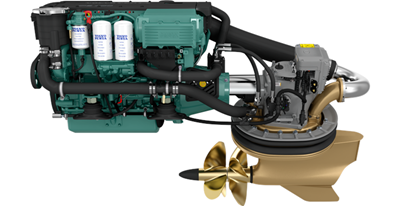
The Volvo Penta SX sterndrive uses a single propeller and is commonly associated with selected gasoline packages.
Volvo Penta Duoprop systems use counter-rotating propellers. Depending on the drive, they may improve:
- Acceleration
- Grip
- Planing performance
- Handling
- Cruising efficiency
DPS, DPH and DPI are not interchangeable. The drive must be matched to the engine and application.
Explore our Volvo Penta SX engines, Volvo Penta Duoprop engines, and our comparison of SX vs DPS vs DPH vs DPI.
Representative product pages include the Volvo Penta V8-300A-C SX, V8-350A-CE-PD-S, V8-380A-CE-PD-S and V8-430A-CE-PD-S.
Volvo Penta Forward Drive
Volvo Penta Forward Drive uses forward-facing propellers and is primarily designed for compatible watersports and recreational boats.
It should be selected only where the hull and intended use are suitable.
Learn more through our Volvo Penta Forward Drive engines and Forward Drive vs conventional sterndrive guide.
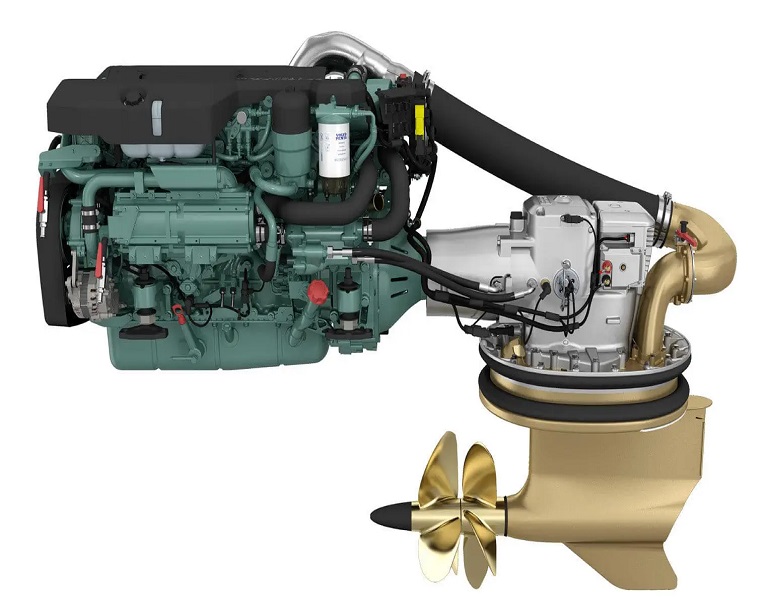
Volvo Penta IPS
Volvo Penta IPS propulsion integrates a diesel engine with steerable pods and forward-facing counter-rotating propellers.
Depending on the installation, IPS may offer:
- Joystick maneuvering
- Electronic steering
- Integrated controls
- Efficient machinery-space use
- Strong low-speed handling
IPS requires a compatible hull, proper structural installation and specialist servicing. It is not automatically superior to shaft drive for every vessel.
Browse our Volvo Penta IPS engine packages or read the Complete Volvo Penta IPS Guide.
Other useful resources include Volvo Penta IPS vs shaft drive, Volvo Penta IPS maintenance and Volvo Penta IPS fuel consumption.
Representative product pages may include the Volvo Penta IPS500, IPS600, IPS800, IPS950, IPS1200 and IPS1350.
Bobtail Engine or Complete Package?
Online prices are often misleading because package contents differ.
A Volvo Penta bobtail engine normally excludes the gearbox or sterndrive. It may also exclude controls, displays, wiring, mounts and installation components.
An engine-and-gearbox quotation should identify:
- Gearbox model
- Reduction ratio
- Output arrangement
- Shift type
- Cooler
- Coupling
- Mounts
A complete sterndrive or IPS package may include the engine, drive or pod, controls, steering, instrumentation, wiring and propellers. Every quotation should clearly list inclusions and exclusions.
Buyers can compare available Volvo Penta engine packages for sale or request a written package quotation from Titan Marine Diesel.
Volvo Penta Engine Prices
A reliable Volvo Penta engine price depends on:
- Engine model
- Power and duty rating
- Gearbox or drive
- Controls
- Displays
- Propellers
- Accessories
- Stock availability
- Freight destination
- Currency and factory pricing
Buyers should also budget for:
- Export packing
- Freight
- Cargo insurance
- Import duties and taxes
- Local transport
- Installation labour
- Exhaust or engine-bed modifications
- Propeller changes
- Commissioning
A written package quotation is more useful than an engine-only price found online.
For a more complete cost breakdown, read our Volvo Penta Marine Engine Price Guide and review our worldwide marine-engine shipping options.
New, Used or Rebuilt?
New Engine
A new Volvo Penta engine for sale generally provides:
- Known condition
- Current documentation
- Warranty eligibility
- Predictable service life
- Easier project planning
Used Engine
Before purchasing a used Volvo Penta engine, request:
- Serial number
- Operating hours
- Service records
- Diagnostic history
- Oil analysis where practical
- Cooling-system inspection
- Turbocharger condition
- Running video
- Load-test or sea-trial information
Fresh paint is not proof of good mechanical condition.
Read our comparison of new vs used Volvo Penta marine engines and our used marine diesel engine inspection guide.
Rebuilt or Remanufactured
Ask for:
- Rebuild scope
- Replacement-parts list
- Machining records
- Test results
- Builder information
- Warranty
- Serial-number documentation
Terms such as “rebuilt” and “remanufactured” should never be accepted without supporting records.
Repower Considerations
A Volvo Penta repower may be justified by:
- Repeated major repairs
- Low compression
- Severe corrosion
- Poor parts availability
- Persistent overheating
- Obsolete controls
- Repair costs approaching replacement value
Before ordering, confirm:
- Engine dimensions
- Mounting centres
- Gearbox output position
- Shaft angle
- Exhaust size
- Cooling-water supply
- Fuel-system capacity
- Electrical voltage
- Ventilation
- Installation access
An engine can fit inside the compartment and still be impossible to pass through the available hatch. Measurements should be checked before payment.
Review our Complete Volvo Penta Repower Guide, browse Volvo Penta replacement engines, or request a repower recommendation from Titan Marine Diesel.
Warranty and Installation
Warranty coverage may depend on:
- Engine model
- Duty rating
- Installation quality
- Commissioning
- Registration
- Service history
- Region of operation
Before purchasing, ask who will install, commission and register the engine.
Poor installation can cause overheating, exhaust restriction, fuel starvation, vibration, shaft misalignment and premature component failure.
A qualified installer should verify full-load RPM, temperatures, pressures, alignment and system operation during commissioning.
Buyers should review the Volvo Penta warranty guide, Titan Marine Diesel warranty policy, shipping and delivery policy, and returns and refunds policy before placing an order.
How to Verify an Online Supplier
Before sending payment, confirm:
- Legal company identity
- Physical contact information
- Formal written quotation
- Exact engine model
- Condition
- Package contents
- Warranty terms
- Availability or lead time
- Packing method
- Freight responsibilities
- Payment terms
- Commercial documentation
Warning signs include unrealistically low prices, vague specifications, unclear package contents, untraceable payment demands and refusal to provide written terms.
Buyers can learn more about Titan Marine Diesel, review our company policies or contact our marine-engine team before requesting a quotation.
Information Titan Marine Diesel Needs
To recommend the correct package, provide:
- Vessel make and model
- Length, beam and loaded weight
- Hull type
- Current engine and gearbox
- Horsepower and rated RPM
- Reduction ratio
- Single- or twin-engine configuration
- Recreational or commercial use
- Expected annual hours
- Required cruising speed
- Freshwater or saltwater operation
- Delivery destination
- Required lead time
Photographs of the engine identification plate, gearbox plate, mounts, controls and machinery space are also helpful.
Related Volvo Penta Guides
- Volvo Penta D Series Explained: D1 to D13
- Volvo Penta Engine Sizes and Horsepower Explained
- Volvo Penta D4 vs D6
- Complete Volvo Penta IPS Guide
- Complete Volvo Penta Aquamatic Guide
- Volvo Penta Marine Engine Price Guide
- New vs Used Volvo Penta Marine Engines
- Complete Volvo Penta Repower Guide
- Volvo Penta Fuel Consumption Guide
- How Long Do Volvo Penta Engines Last?
Final Advice
The most important lesson from this Volvo Penta engine buying guide is that you are not buying an engine in isolation.
You are buying a complete propulsion system.
The right package must match the vessel’s hull, loaded weight, duty cycle, gearbox, propeller, controls and operating environment.
Titan Marine Diesel supports recreational and commercial buyers with Volvo Penta engine selection, package quotations, repower guidance, availability checks and international shipping coordination.
Browse our range of Volvo Penta marine engines or request a Volvo Penta engine quotation by providing your vessel specifications, current propulsion details, delivery destination and required lead time.
Every final selection should be verified by the professionals responsible for the vessel’s installation and commissioning.

Comments (2)
[…] Best Volvo Penta Engines for Sailboats for a more detailed […]
[…] responsible Volvo Penta engine selection, use the boat’s realistic loaded displacement rather than only its brochure […]