
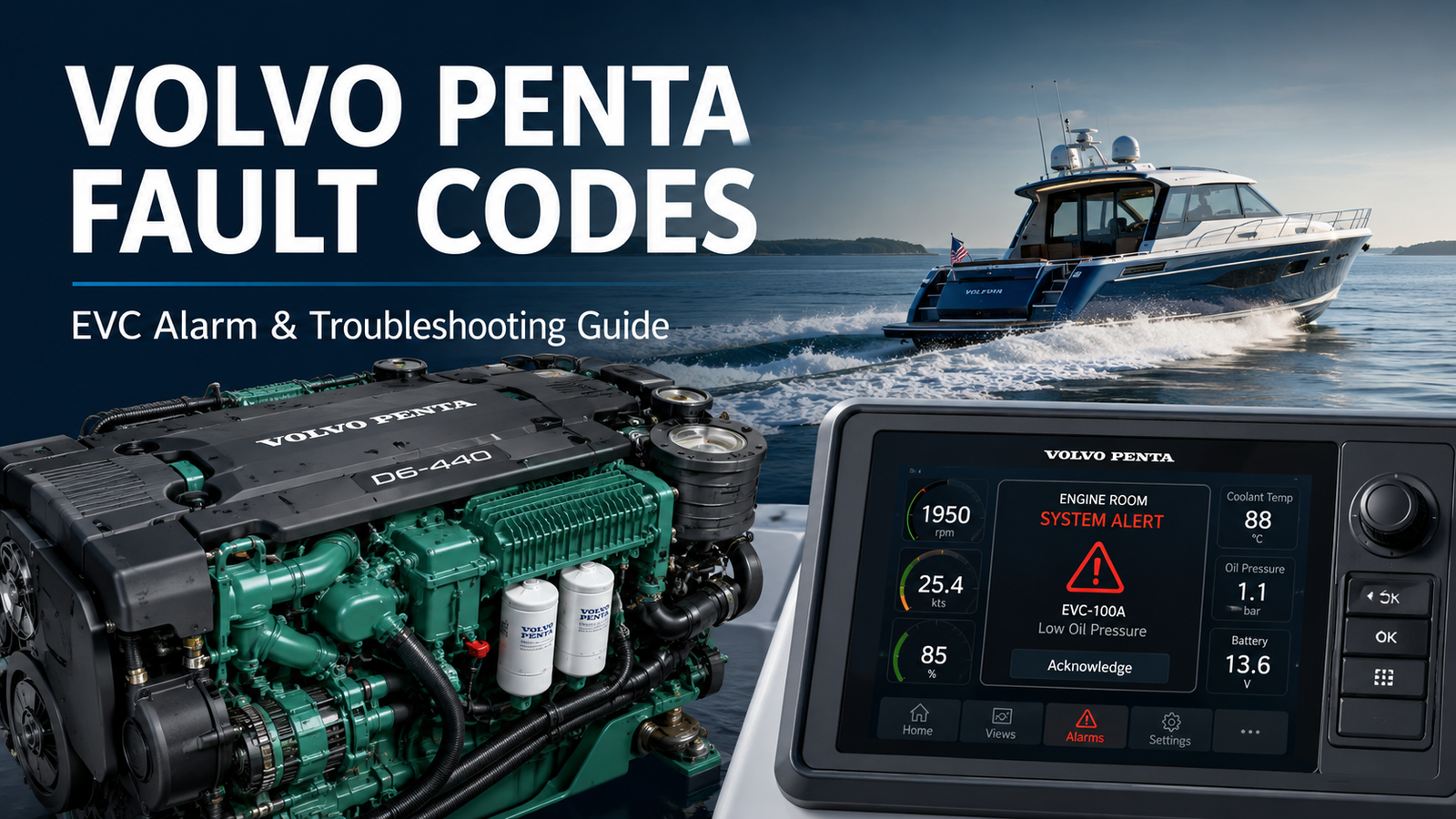
Volvo Penta Fault Codes Explained – Complete EVC Alarm & Troubleshooting Guide
If a Volvo Penta fault code appears while you are underway, your first instinct is probably not to admire how sophisticated the engine-management system is.
You want to know three things:
What does this alarm mean? Can I keep running the engine? And what should I check first?
Those are exactly the right questions.
A common pattern in Volvo Penta troubleshooting enquiries is that an owner arrives with a code written down or sometimes just a photograph of a flashing EVC display—and immediately asks which part needs replacing.
For example, imagine a D6-powered cruiser that has been running normally all morning. The skipper brings the boat onto plane, the alarm sounds, power drops, and a warning appears on the display. The natural reaction is to search the code online and order whatever component appears beside that number.
But here is where expensive mistakes start.
The code may point toward low fuel pressure, but the cause might be a partially blocked primary fuel filter. It may show a boost pressure fault, while the actual problem is a charge-air hose that has worked loose. An EVC communication fault can sometimes begin with something as basic as unstable battery voltage or a poor electrical connection.
That is why at Titan Marine Diesel we prefer to think about Volvo Penta fault codes as evidence—not a final diagnosis.
A modern Volvo Penta propulsion system is constantly monitoring engine and vessel information. Depending on the engine and installation, that can include engine RPM, coolant temperature, battery voltage, oil pressure, boost pressure, fuel information, transmission data and other sensor values. When something falls outside the expected operating range, the system can generate a warning or diagnostic trouble code (DTC). (volvopenta.com)
The important part is understanding why that value went wrong.
Was the engine genuinely overheating?
Did the temperature sensor or its wiring fail?
Was seawater flow restricted?
Was the engine overloaded because the propeller was fouled?
Those are four very different repairs that could begin with what appears to be the same Volvo Penta engine alarm.
This guide is therefore not going to give you a giant, questionable table claiming to contain every Volvo Penta code ever produced. That may look useful, but it ignores an important technical reality: Volvo Penta EVC fault codes vary according to engine model, production year, EVC generation, software, instrumentation and propulsion configuration.
Volvo Penta’s own Easy Connect documentation confirms that diagnostic trouble-code functionality differs between EVC generations. DTC sharing through Easy Connect, for example, is not available for D1/D2 engines using MDI or for earlier EVC A, B, C1 and C2 installations, while later compatible EVC systems offer broader diagnostic capability.
So a Volvo Penta D6 fault code on one generation should not automatically be interpreted using a random fault-code table written for another installation.
We are going to take the more useful approach.
This guide will show you how to identify the severity of an alarm, understand what the fault is actually telling you, troubleshoot the major engine systems logically, recognize Volvo Penta derate or limp mode, use EVC and Easy Connect information properly, and know when you have reached the point where professional Volvo Penta diagnostics are required.
Most importantly, we will separate the things an owner can safely check from the things that should be left to a qualified marine technician.
Because with a marine diesel engine, the goal is not simply to make the warning disappear.
The goal is to identify the root cause before a small fault becomes an expensive one.
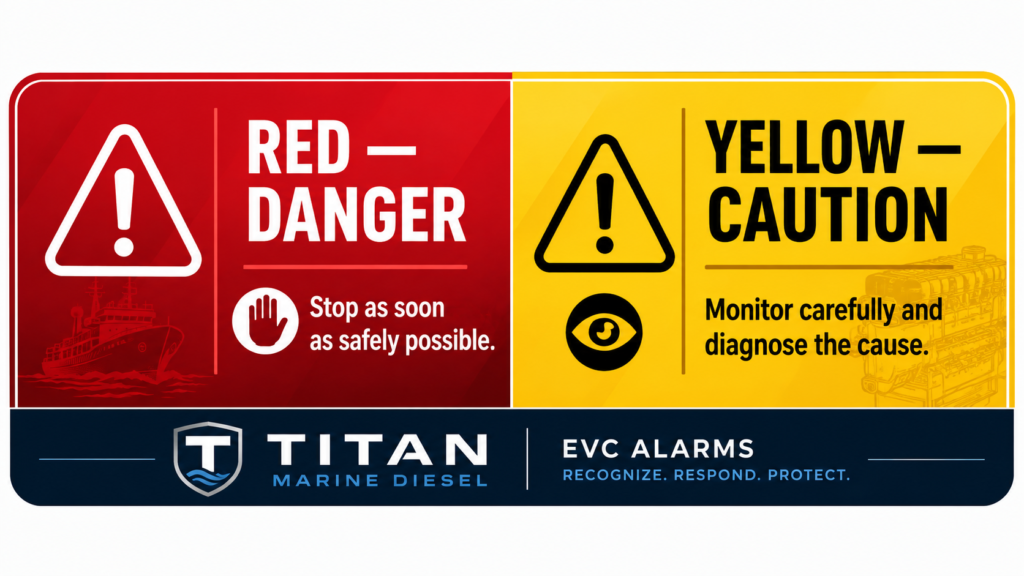
Volvo Penta itself makes this distinction clear. Its current troubleshooting guidance states that the color of an alarm indicates its general severity: yellow indicates caution and red indicates danger. For a red alarm, Volvo Penta recommends stopping as soon as it is safe to do so; some serious alarms can also cause the system to limit engine functionality automatically. A yellow warning normally allows cautious operation toward a safe harbour or dealer while the engine is closely monitored. (volvopenta.com)
That brings us to the first—and most important—thing to understand about Volvo Penta marine engine troubleshooting.
What a Volvo Penta Fault Code Actually Tells You
A Volvo Penta fault code tells you that the engine-management or vessel-control system detected something it considers abnormal.
It does not automatically tell you which component to replace.
That distinction sounds small, but it changes the entire troubleshooting process.
Volvo Penta’s EVC system is a drive-by-wire architecture that can integrate functions such as throttle, gearshift, steering, trim and propulsion monitoring. Because the system connects multiple parts of the vessel, an EVC alarm may originate from the engine itself, a sensor, an electrical circuit, a transmission or drive, a helm control, or communication between electronic modules. (volvopenta.com)
In practical terms, a fault generally tells you where the system noticed the problem. It does not always tell you where the problem started.
That is the key to diagnosing Volvo Penta alarms properly.
A Fault Code Identifies a Detected Abnormality
Depending on your engine and EVC generation, the system may detect conditions involving:
- Engine coolant temperature
- Engine oil pressure
- Battery voltage
- Fuel pressure
- Water in fuel
- Seawater pressure
- Turbo or boost pressure
- Exhaust temperature
- Transmission oil pressure or temperature
- Electronic throttle and shift
- Steering or IPS controls
- Sensor circuits
- EVC communication
Suppose, for example, the system detects fuel pressure below its expected value.
That is useful information. It tells us that the engine is not seeing the fuel pressure it expects under those operating conditions.
But several different faults could create that situation:
- A clogged fuel filter
- Air entering the fuel supply
- A restricted tank pickup
- Contaminated diesel
- Weak feed-pump performance
- Faulty pressure-sensor wiring
- A failed pressure sensor
- A high-pressure fuel-system problem
The DTC narrows the investigation.
It does not finish it.
The same principle applies to a Volvo Penta high coolant temperature alarm. The engine may genuinely be overheating, but the root cause could be a blocked seawater intake, clogged strainer, damaged raw-water impeller, restricted heat exchanger, low coolant, thermostat problem, hose restriction or excessive engine load.
That is why Volvo Penta advises owners and technicians to consider not only the alarm itself but also the sequence of events, operating conditions and other symptoms surrounding it. Volvo Penta notes that the combination of alarms, symptoms and what happened immediately beforehand provides clues to the actual root cause. (volvopenta.com)
That information is often as valuable as the code itself.
What a Fault Code Does NOT Automatically Tell You
This is where we need to challenge one of the most common habits in marine-engine troubleshooting:
Do not replace the part named in the fault description until you have proved that the part is actually faulty.
Consider these examples.
A Volvo Penta fuel pressure fault does not automatically mean you need a new high-pressure pump.
A Volvo Penta boost pressure fault does not automatically mean the turbocharger has failed.
A Volvo Penta coolant temperature fault does not automatically mean the temperature sensor is defective.
A Volvo Penta EVC communication fault does not automatically mean the engine control module needs replacing.
And a Volvo Penta battery voltage alarm does not automatically mean the alternator has failed.
In each case, the system is reporting what it can observe.
The underlying problem might be mechanical, electrical, hydraulic, environmental or even the result of another fault somewhere else in the system.
This becomes particularly important when several Volvo Penta alarm codes appear at once.
Imagine an unstable battery supply causes multiple electronic control units to lose communication for a moment. You might suddenly see several warnings involving the EVC system, controls and sensors.
That does not necessarily mean three or four components failed simultaneously.
They may all share one root cause: voltage.
The same thing can happen with cooling. A blocked seawater intake can begin with reduced raw-water flow, progress to elevated exhaust temperature and eventually produce a high coolant-temperature warning and engine derate.
Four symptoms.
One underlying problem.
This is why the best diagnostic question is not:
“What part does this code tell me to replace?”
The better question is:
“What condition caused the Volvo Penta system to generate this code?”
That shift—from replacing parts to identifying causes—is what separates fault-code reading from actual marine diesel engine diagnostics.
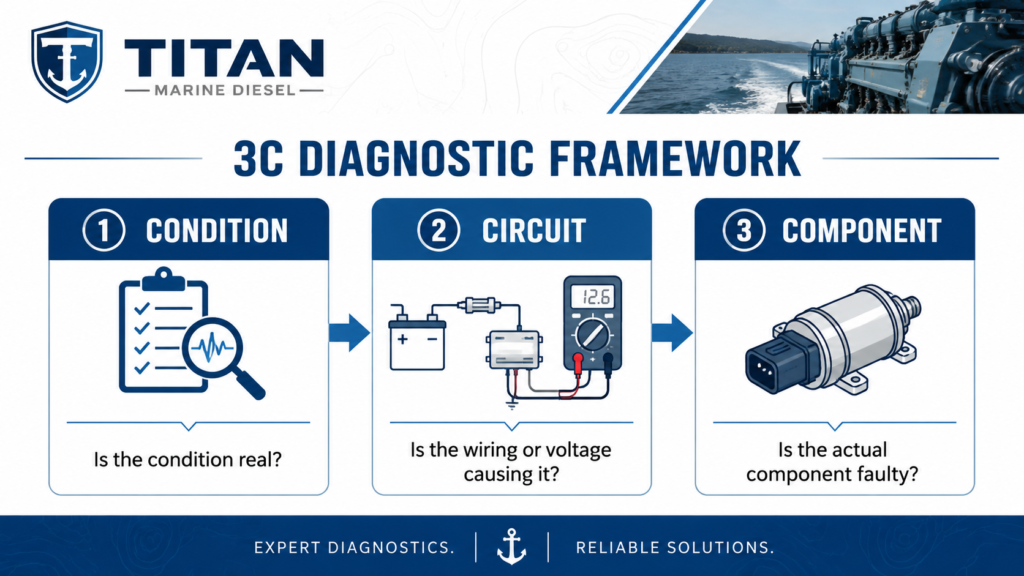
In the next section, we will turn that idea into Titan Marine Diesel’s 3C Diagnostic Framework: Condition → Circuit → Component, a practical method for troubleshooting Volvo Penta alarms before expensive parts start getting replaced.
The Titan Marine Diesel 3C Diagnostic Framework: Condition → Circuit → Component
When a Volvo Penta fault code appears, there is a simple question that can save you a lot of money:
Is the problem really the component named in the fault—or is that component simply reporting a problem happening somewhere else?
This is where our 3C Diagnostic Framework comes in.
At Titan Marine Diesel, we recommend thinking about most Volvo Penta EVC fault codes in this order:
Condition → Circuit → Component
Why this order?
Because replacing parts is easy.
Diagnosing the reason the fault appeared is harder.
And expensive marine-engine repairs often begin when those two things get confused.
Imagine your D6 reports a fuel-pressure fault. You search online, see “fuel rail pressure,” and immediately start thinking about injectors or a high-pressure pump.
Those are expensive components.
But suppose the actual cause is a primary fuel filter that has slowly become restricted.
The ECU sees low pressure. The ECU reports low pressure. The code is correct.
But replacing the pressure sensor or injection pump would not solve the problem.
The condition was real.
The component named in the diagnostic information was not necessarily defective.
That is why the 3C process starts with what is physically happening to the engine.
1. Condition: Is the Engine Actually Experiencing the Problem?
The first question should always be:
Is the operating condition described by the alarm actually happening?
If you receive a Volvo Penta high coolant temperature alarm, do not immediately ask:
“Is the coolant-temperature sensor bad?”
First ask:
“Is the engine actually overheating?”
Look for supporting evidence.
Has coolant temperature been rising gradually?
Did the alarm occur only after increasing RPM?
Has seawater discharge reduced?
Is the raw-water strainer filled with debris?
Did the problem begin after operating through weed?
Was the raw-water impeller recently changed?
This is diagnostic context.
And context matters because one fault code can have several possible causes.
Consider a Volvo Penta low oil pressure alarm.
Possible explanations include:
- Low engine-oil level
- Genuine loss of lubrication pressure
- Oil leakage
- Restricted oil filter
- Oil-pump problem
- Excessive internal engine wear
- Failed pressure sensor
- Damaged wiring
You cannot safely assume it is a sensor problem.
If actual oil pressure is low, continuing to operate the engine could damage bearings, the crankshaft or turbocharger.
The same logic applies across the engine.
A Volvo Penta boost pressure fault asks us:
Is the engine genuinely producing insufficient boost?
A Volvo Penta battery voltage warning asks:
Is system voltage actually low?
A Volvo Penta fuel pressure fault asks:
Is fuel pressure genuinely falling below specification?
A Volvo Penta seawater pressure alarm asks:
Is raw-water flow actually restricted?
The first job is therefore to compare the fault against what the engine is physically doing.
Look for symptoms that support the fault
Useful clues include:
- Rising coolant temperature
- Black smoke
- White smoke
- Blue smoke
- Loss of power
- Reduced maximum RPM
- Engine derate
- Abnormal vibration
- Difficult starting
- Rough running
- Unusual mechanical noise
- Display voltage changes
- Visible fluid leaks
- Reduced seawater flow
For example, imagine a turbocharged Volvo Penta that suddenly loses power and begins producing black smoke.
At the same time, an underboost-related warning appears.
Those symptoms support the possibility that the engine is genuinely receiving less air than expected.
Now your investigation can logically include:
- Charge-air hoses
- Hose clamps
- Charge-air cooler
- Turbocharger
- Air intake
- Exhaust restriction
Compare that with an engine running perfectly, producing normal power and normal smoke while the displayed boost-pressure reading suddenly becomes impossible.
That situation may push the investigation toward the electrical circuit or sensor.
That brings us to the second C.
2. Circuit: Could the Electrical System Be Creating the Fault?
Modern Volvo Penta engines depend heavily on electronics.
This is especially true for electronically controlled Volvo Penta D3, D4, D6, D8, D11 and D13 marine engines and vessels using EVC.
The engine-management system cannot physically look inside a fuel rail or cooling passage.
It relies on electrical signals from sensors.
Those signals travel through:
- Wiring
- Connectors
- Ground circuits
- Power supplies
- Network cables
- Electronic control modules
If that electrical path is compromised, the ECU can receive inaccurate information even when the mechanical system is healthy.
That is why the second step in the Titan Marine Diesel framework is:
Check the circuit.
Common electrical causes of Volvo Penta engine alarms include:
- Weak batteries
- Low charging voltage
- Loose terminals
- Corroded grounds
- Water intrusion into connectors
- Broken wiring
- Harness chafing
- Poor pin contact
- Blown fuses
- Network interruptions
- Reference-voltage faults
And marine environments are particularly hard on electrical systems.
Salt water, humidity, vibration and temperature cycles create conditions where a connector that looked perfectly fine six months ago can develop resistance or corrosion.
Low voltage can create surprisingly strange EVC symptoms
This deserves special attention.
If several Volvo Penta EVC alarms appear at roughly the same time, do not automatically assume multiple components have failed.
Check electrical power first.
EVC relies on stable voltage and communication between electronic control units.
Poor voltage or connection problems may contribute to symptoms such as:
- Displays rebooting
- Intermittent warnings
- Lost helm communication
- Controls temporarily unavailable
- Multiple sensor faults
- Joystick functions disappearing
- EVC modules dropping offline
Volvo Penta’s Easy Connect system itself can display battery voltage alongside engine information and diagnostic alerts on compatible installations, illustrating how closely electrical condition and electronic engine monitoring are connected.
Think about that for a moment.
If five electronic warnings appear within seconds of one another, what is more likely?
That five independent components happened to fail at exactly the same moment?
Or that something common to those systems—such as voltage, grounding or communication—was interrupted?
Sometimes it will be multiple problems.
But the common-cause explanation should always be investigated.
This is where fault-code diagnosis becomes different from parts replacement
A sensor may report “signal too low.”
That could mean the sensor failed.
But it could also mean:
- The sensor lost its voltage supply
- The signal wire is damaged
- A connector is corroded
- The circuit has excessive resistance
- The ground is poor
Replacing the sensor without testing the circuit can leave you with the same alarm and one unnecessary part on the invoice.
3. Component: Is the Actual Part Faulty?
Only after the physical condition and electrical circuit have been considered do we move to the third C:
Component.
Now we ask whether the sensor, actuator, pump or control unit itself has failed.
Depending on the fault, potential components may include:
- Pressure sensor
- Temperature sensor
- Fuel-feed pump
- Raw-water pump
- Thermostat
- Turbocharger
- Injector
- Alternator
- Electronic control module
- Shift actuator
- Steering component
- EVC control unit
The exact diagnostic procedure depends on the system.
Some components can be checked using:
- Resistance measurements
- Supply-voltage testing
- Mechanical pressure gauges
- Temperature verification
- Professional diagnostic equipment
- Substitution with a known-good component where approved
- Volvo Penta service procedures
This is the point where professional diagnostics become increasingly important.
Volvo Penta states that its dealer technicians have access to specialized diagnostic tools and recommends professional troubleshooting because identifying the true root cause can require both equipment and experience.
That does not mean owners cannot perform sensible first checks.
Checking oil level, the seawater strainer, battery terminals, fuel filters and visible wiring can reveal a great deal.
But opening a common-rail fuel system, bypassing engine protections or replacing an ECU because an online forum suggested it is a different matter entirely.
The Contrarian Rule: Do Not Replace the Part Named in the Code First
Here is the idea worth remembering from this entire section:
The component mentioned by the fault code is often the messenger—not necessarily the culprit.
A temperature sensor reporting excessive temperature may be doing its job perfectly.
A fuel-pressure sensor reporting inadequate pressure may be accurately exposing a blocked filter.
A boost sensor detecting low pressure may be warning you about a split charge-air hose.
An EVC module reporting communication loss may be exposing a weak battery connection.
This is why “code equals part” is a dangerous troubleshooting shortcut.
Instead use:
Condition → Circuit → Component
Ask:
Condition: Is the engine genuinely experiencing what the alarm describes?
Then:
Circuit: Can wiring, voltage, grounding or communication explain the reading?
Only then:
Component: Has the sensor, pump, actuator or module itself actually failed?
This approach does not magically diagnose every Volvo Penta marine engine fault.
Nothing does.
But it prevents one of the most common and expensive mistakes in troubleshooting: firing the parts cannon at the engine.
And if the fault remains unclear after those basic checks, do not guess.
Document the alarm and operating conditions and let proper diagnostic data take the investigation further.
That is especially important because Volvo Penta’s current Easy Connect support shows that diagnostic trouble-code availability differs by EVC generation. Later compatible systems such as C3, D, E and EVC 2.0 can provide DTC information through Easy Connect for many D-series installations, while older EVC generations have different diagnostic capabilities.
In the next section, we will explain exactly why Volvo Penta fault codes are not universal, how EVC generations affect what you see on the display, and why your engine serial number can be more useful than a generic fault-code chart found online.
Are Volvo Penta Fault Codes the Same on Every Engine?
No.
And this is one of the most important things to understand before you start troubleshooting.
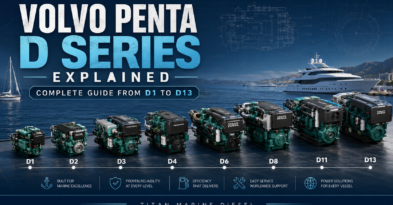
There is no single universal Volvo Penta fault code list that applies equally to every D1, D2, D3, D4, D6, D8, D11 or D13 engine ever produced.
That is not because Volvo Penta made the system unnecessarily complicated.
It is because the engines, control systems and EVC generations have evolved over time.
A Volvo Penta D6 built with an earlier EVC generation may not report or share diagnostic information in exactly the same way as a later D6 running EVC 2.0.
The same model family can therefore appear in different generations of boats with different displays, different control hardware and different diagnostic capability.
This is where generic internet fault-code charts can become dangerous.
They may look authoritative.
They may contain hundreds of numbers.
But unless the information matches your exact engine and control system, you could end up diagnosing the wrong problem.
Why There Is No Universal Volvo Penta Fault Code List
A Volvo Penta diagnostic trouble code depends on more than the model name printed on the engine cover.
You may need to consider:
- Engine model
- Engine serial number
- Production year
- EVC generation
- Engine-control module
- Software version
- Helm display
- Number of engines
- Transmission or drive configuration
- Installed sensors
- Vessel-control options
That means two owners can both say:
“I have a Volvo Penta D6.”
Yet one may have an earlier EVC installation using conventional displays, while the other has a much newer EVC architecture with Easy Connect and integrated vessel-control functions.
The engines may belong to the same basic family.
The diagnostic environment is not necessarily the same.
Volvo Penta’s current Easy Connect compatibility information demonstrates this clearly. Diagnostic Trouble Code sharing is supported for many later installations using EVC C3, D, E and EVC 2.0, while earlier EVC A, B, C1 and C2 systems do not provide DTC sharing through Easy Connect.
So when searching for Volvo Penta alarm codes, your first question should not be:
“What does code XXXX mean?”
Your first question should be:
“Which engine and EVC generation produced this code?”
That one piece of information can completely change the troubleshooting path.
Volvo Penta D1 and D2 Fault Diagnostics Are Different
The D1 and D2 deserve special attention because they do not fit neatly into the same diagnostic structure as larger electronically controlled D-series engines.
Many D1 and D2 installations use Volvo Penta’s MDI—Mechanical Diesel Interface—rather than the full EVC architecture used on engines such as the D4 or D6.
Volvo Penta’s current Easy Connect compatibility list states that D1 and D2 installations can use Easy Connect with the appropriate interface arrangement, but Diagnostic Trouble Codes are not available through Easy Connect for MDI engines.
That distinction matters.
If somebody searches:
“Volvo Penta D2 fault codes”
they should not expect the same type of electronic DTC access they might find on a later D6 EVC installation.
D1 and D2 owners may instead encounter:
- Warning lights
- Audible alarms
- MDI-related electrical symptoms
- Temperature warnings
- Oil-pressure warnings
- Charging problems
- Start/stop problems
Troubleshooting those systems still requires good diagnostic thinking, but the method of accessing information is different.
That is why the engine model alone is never enough.
You need to know the control system attached to it.
Volvo Penta D3 Fault Codes Depend on EVC Generation
The Volvo Penta D3 is another good example of why generation matters.
Volvo Penta currently lists D3 installations with older MC-C, C1 and C2 EVC systems as not providing DTC sharing through Easy Connect.
Later D3 installations using C3, D or E generations do support Diagnostic Trouble Code functionality through Easy Connect.
So two D3 owners could have very different experiences.
One may be able to view and share detailed fault information through the Easy Connect app.
The other may need to rely on helm instrumentation and professional diagnostic equipment.
Same basic engine family.
Different diagnostic capability.
This is why we strongly recommend recording the exact model designation and serial number before searching for a Volvo Penta D3 fault code online.
Earlier EVC A, B, C1 and C2 Systems
Older Volvo Penta electronic installations may use:
- EVC A
- EVC B
- EVC C1
- EVC C2
These systems can still provide engine alarms and diagnostic information through their respective instrumentation and service procedures.
But according to Volvo Penta’s current Easy Connect documentation, DTC sharing through Easy Connect is not available for EVC A, B, C1 or C2.
That does not mean the engine has no diagnostics.
It means you should not assume a modern app-based diagnostic workflow applies.
This distinction is especially important for owners purchasing older used boats.
You may find a beautifully maintained D4 or D6 installation that is mechanically excellent but belongs to an earlier EVC generation.
That engine may require a different troubleshooting process than the newest version of the same model family.
Later EVC C3, D, E and EVC 2.0 Systems
Later EVC generations brought broader integration and more accessible diagnostic information.
For Volvo Penta diesel engines, the current Easy Connect compatibility table lists D4, D6, D8, D9, D11, D13 and D16 installations using C3, D, E or EVC 2.0 as supporting Diagnostic Trouble Codes through compatible Easy Connect installations.
Depending on the vessel, these systems may also integrate functions such as:
- Electronic throttle
- Gear shift
- Engine monitoring
- Steering
- Joystick control
- IPS functions
- Other vessel-control features
This increased integration gives technicians more information.
But it also creates a very important diagnostic lesson:
Not every EVC alarm is an internal engine failure.
A fault may originate from:
- A helm control
- A network connection
- Steering system
- Transmission
- IPS system
- Sensor
- Electrical supply
- Another control module
This is why electronically controlled marine engines require a system-level troubleshooting approach rather than simply opening the engine room and looking for a broken mechanical part.
Why Your Volvo Penta Serial Number Matters More Than You Think
If there is one piece of information you should have before asking for technical help, it is the Volvo Penta engine serial number.
Volvo Penta describes the serial number as the unique identifier for the product and specifically says it is key to efficient servicing and ordering the correct parts.
The serial number helps identify the exact version of the engine.
That can matter because the same model family may change over its production life.
Your serial number can help determine:
- Production configuration
- Correct operator manual
- Applicable service information
- Correct replacement components
- Technical updates
- Relevant recalls or service campaigns
- Which diagnostic information applies
Volvo Penta’s support system allows owners to search product information using the serial number, product number or product designation.
That is far more reliable than simply typing:
“Volvo Penta D6 code list”
into Google and trusting the first PDF you find.
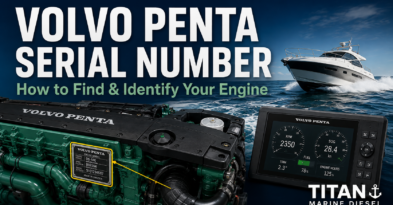
Where Do You Find the Volvo Penta Serial Number?
Depending on the engine model and production year, the number can be located on:
- An engine identification plate
- Product plate
- Identification decal
- Other marked location specified in the operator manual
Volvo Penta notes that the appearance and location of the identification information can vary by model and manufacturing year.
The plate may contain information such as:
- Product designation
- Product number
- Serial number
- Engine output
On drive and transmission identification plates, you may also find:
- Drive model
- Gear ratio
- Serial number
- Product number
This becomes particularly useful when diagnosing a propulsion problem that may involve both the engine and transmission.
For example, if a customer tells us:
“My Volvo Penta D6 has a gearbox alarm.”
We would ideally want both:
Engine identification information
and
Transmission identification information.
Because the fault may not belong to the engine at all.
Do Not Diagnose From the Engine Cover Alone
There is another surprisingly common problem.
The model marking that you can see easily may not tell the complete story.
Engines are sometimes:
- Repowered
- Repainted
- Reconfigured
- Installed with replacement controls
- Paired with different gearboxes
- Updated during previous repairs
That is why identification plates and serial numbers matter more than appearance.
If you are buying a used Volvo Penta engine, this becomes even more important.
Do not rely solely on the seller saying:
“It’s a D6.”
Request photographs of:
- Engine identification plate
- Serial number
- Gearbox plate
- Drive identification
- EVC controls
- Display
- Engine hours if available
The difference between knowing you have “a D6” and knowing the exact D6 configuration can be the difference between ordering the correct component and ordering something that does not belong on the engine.
Why This Matters for Google Fault-Code Searches
Suppose you search:
and find three pages giving three different explanations.
That does not automatically mean two of them are wrong.
They could be discussing:
- Different D4 generations
- Different EVC versions
- Different display formats
- Different software
- Different diagnostic systems
This is also why forums can be useful for gathering clues but should not replace model-specific service information.
Someone saying:
“My D6 had that code and changing the sensor fixed it”
does not prove your sensor is faulty.
Their:
- Serial number may be different.
- EVC generation may be different.
- Symptoms may be different.
- Root cause may be different.
Use other owners’ experiences as clues.
Do not use them as your final diagnosis.
The Titan Marine Diesel Identification Rule
Before interpreting any Volvo Penta EVC fault code, identify these four things:
1. Engine model
Example:
D4, D6, D8, D11 or D13.
2. Engine serial number
This identifies the specific product.
3. EVC generation
If known.
4. Exact alarm information
Record the message exactly as shown.
Do not paraphrase:
“It said something about fuel.”
Photograph the display.
Those four pieces of information provide a much stronger starting point than the code alone.
And this leads us naturally to the next question.
Before you even begin diagnosing what caused the fault, you need to know how serious the warning is.
Because a yellow warning and a red alarm should not be treated the same way.
In the next section, we’ll explain Volvo Penta red and yellow alarms, what each warning level means, and how to decide whether you should continue operating or shut the engine down.
Below is the continuation from “Are Volvo Penta Fault Codes the Same on Every Engine?” through the conclusion and CTA.
Volvo Penta Alarm Colors Explained: Red vs Yellow
Before trying to decode a number, determine how serious the alarm is.
This sounds obvious, but it is where troubleshooting should begin.
Volvo Penta’s current troubleshooting guidance separates alarms into two broad severity levels: yellow means caution and red means danger. A red alarm means Volvo Penta recommends stopping as soon as possible, although vessel safety comes first—you should not shut down in a location where doing so creates a greater danger. Volvo Penta also notes that some red alarms can automatically limit engine functionality. (Volvo Penta)
Red Volvo Penta Alarm: Treat It as Serious
A red Volvo Penta alarm is not something we recommend acknowledging and forgetting because the engine still sounds normal.
The system has detected a condition serious enough to classify as danger.
Depending on your installation, the cause could involve lubrication, overheating, engine management, propulsion control or another critical system.
If a red warning appears, maintain control of the vessel, reduce load where appropriate and move to a safe location before stopping the engine.
If the alarm is accompanied by rapidly rising coolant temperature, abnormal mechanical noise, smoke, loss of oil pressure or severe vibration, continued operation can turn a manageable fault into a very expensive repair.
Yellow Volvo Penta Alarm: Caution Does Not Mean Ignore
A yellow Volvo Penta warning indicates that something requires attention but is not categorized by Volvo Penta as an immediate danger to the engine.
Volvo Penta says cautious operation toward the next harbour or dealer may be possible while closely observing engine behaviour. (Volvo Penta)
That does not mean, “Finish the season and look at it later.”
Watch the engine.
Is temperature increasing?
Has maximum RPM dropped?
Is voltage falling?
Did the engine begin smoking?
Did the alarm change from yellow to red?
A yellow alarm is your opportunity to investigate before the problem becomes more serious.
What to Record Before You Reset a Volvo Penta Alarm
One of the easiest ways to make troubleshooting harder is to erase the evidence before recording it.
We understand why people do it.
The buzzer is annoying. The display is flashing. Restarting the engine feels like the marine equivalent of restarting a computer.
Sometimes the alarm disappears.
But the fact that the screen becomes quiet does not prove the problem disappeared.
Before clearing or power-cycling the system, record the exact alarm text or code, alarm color, engine RPM, coolant temperature, oil pressure if displayed, battery voltage, vessel speed and which engine produced the warning on a multi-engine installation.
Also write down what happened immediately beforehand.
That last detail is extremely valuable.
Did the alarm begin while accelerating onto plane?
After running at full throttle?
Immediately after refueling?
After changing the fuel filters?
After servicing the batteries?
After launching following winter storage?
After travelling through heavy weed?
Volvo Penta specifically recommends providing the sequence of events leading up to an alarm because the combination of alarms, symptoms and preceding events helps identify the root cause. (Volvo Penta)
A photograph of the helm display can be worth more than saying:
“The boat showed some kind of fuel warning.”
Exact information beats memory.
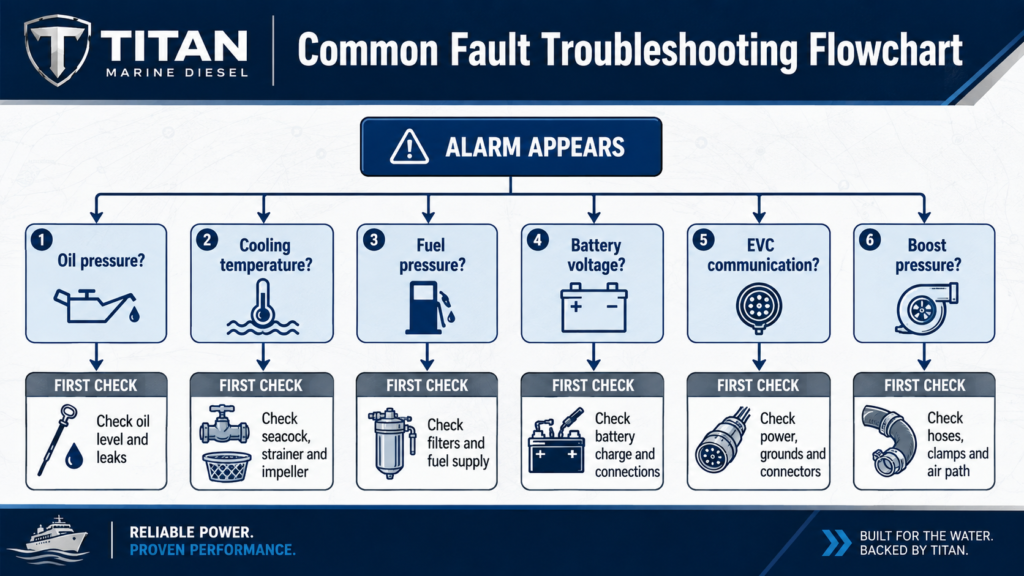
Common Volvo Penta Faults and How to Approach Them
Now we get into the part most owners are looking for.
Below are some of the most important Volvo Penta engine alarm categories and the logical direction we would investigate.
This is not a substitute for the service information for your exact serial number.
It is a troubleshooting roadmap.
Volvo Penta Low Oil Pressure Alarm
A Volvo Penta low oil pressure alarm should always be taken seriously until actual lubrication pressure has been verified.
Engine oil protects components such as crankshaft bearings, connecting-rod bearings, camshaft components, valve gear and turbocharger bearings.
Possible causes range from something simple like a low oil level to a genuine mechanical lubrication problem.
The issue may be low oil quantity, incorrect oil specification, an external leak, a restricted oil filter, an oil-pump problem, excessive internal wear, a faulty pressure sensor or damaged sensor wiring.
If the alarm is serious, stop as soon as vessel safety permits.
Check the oil level after allowing the engine to settle, inspect for obvious leaks and do not assume the sender is faulty simply because the engine still sounds smooth.
A mechanically quiet engine can still have inadequate oil pressure.
The responsible way to separate a sensor fault from a real lubrication problem is to verify the actual pressure using the appropriate diagnostic procedure.
Remember the 3C framework:
Condition: Is oil pressure genuinely low?
Circuit: Is the electrical signal reliable?
Component: Is the sender or another component faulty?
Do not reverse that order.
Volvo Penta High Coolant Temperature and Overheating Alarm
A Volvo Penta overheating alarm is one of the most common marine-engine warnings because marine diesels depend on both an internal freshwater cooling circuit and an external raw-water circuit.
A failure in either side can raise temperature.
If an engine begins overheating, think through the cooling path logically.
Raw water must enter through the through-hull intake, pass the seacock, move through the seawater strainer and raw-water pump, continue through the relevant coolers and heat exchanger, and eventually contribute to cooling the exhaust stream.
A restriction anywhere in that path can become a problem.
Common causes include a blocked intake, clogged seawater strainer, closed seacock, damaged impeller, missing impeller blades lodged downstream, restricted heat exchanger, collapsed hose, low coolant, coolant leak, thermostat fault, circulation-pump problem or excessive engine load.
Here is a useful diagnostic clue.
If the engine remains cool at idle but temperature climbs rapidly as RPM increases, suspect a problem that becomes more significant as cooling demand rises.
That could include reduced raw-water flow, heat-exchanger restriction or excessive engine loading.
Never remove a pressurized coolant cap from a hot engine.
Allow the cooling system to cool before opening it.
Volvo Penta Seawater Pressure Alarm
Where the installation monitors seawater pressure, a Volvo Penta seawater pressure alarm can give you an earlier clue that raw-water flow is deteriorating.
Think about the basics first.
Is the seacock open?
Is the strainer clean?
Did the boat recently pass through floating weed or debris?
Was the impeller changed recently?
Could a suction hose be leaking air?
Could the intake be partially blocked?
Could the pressure sensor or its circuit be faulty?
One of the simplest but most useful troubleshooting questions is:
What changed immediately before the fault appeared?
If the engine was serviced yesterday and the seawater alarm began today, recheck anything disturbed during that service.
A forgotten valve position can produce a very expensive afternoon.
Volvo Penta Low Coolant Level Alarm
A low coolant warning should lead to another question:
Where did the coolant go?
Coolant is not something you should routinely need to keep adding to a healthy sealed system.
Possible causes include an external hose leak, expansion-tank issue, loose clamp, leaking heat exchanger, cap problem, internal coolant loss or faulty level sensor.
If you top up the coolant today and the level is low again tomorrow, the refill is not the repair.
The loss must be located.
Also inspect the engine oil if internal contamination is suspected. Milky or emulsified oil can indicate coolant or water contamination and warrants further investigation.
Volvo Penta Water-in-Fuel Alarm
A Volvo Penta water in fuel alarm should not be ignored, particularly on modern common-rail diesel engines.
High-pressure fuel systems depend on clean, properly lubricating diesel fuel.
Water can contribute to corrosion, poor combustion and expensive fuel-system damage.
The immediate problem may simply be water collected in the fuel/water separator.
But ask why it is there.
Possible sources include contaminated fuel, condensation, damaged fuel-fill seals, water entering through the tank vent or a contaminated storage tank.
If you drain the separator and water keeps returning, repeatedly draining it is not a long-term solution.
Investigate the tank and fuel source.
Volvo Penta Fuel Pressure Fault
A Volvo Penta fuel pressure fault is a perfect example of why we use Condition → Circuit → Component.
Modern D4, D6 and larger electronically controlled diesels use sophisticated fuel systems. A pressure-related diagnostic code may eventually lead to a high-pressure component—but that is not where we recommend starting.
Begin from the tank and work toward the engine.
Fuel has to leave the tank, pass through pickup plumbing, primary filtration, supply lines, secondary filtration and the low-pressure supply side before the high-pressure system can do its job.
A restricted primary filter can starve everything downstream.
Possible causes include clogged filters, air entering the fuel system, restricted tank pickup, contaminated fuel, poor feed-pump performance, pressure-sensor problems, wiring faults, injector leakage or high-pressure pump issues.
Here is the rule:
Diagnose tank-to-engine fuel supply before condemning expensive common-rail components.
If the engine started losing power shortly after receiving questionable fuel, that history matters.
If the problem appeared immediately after a fuel-filter change, that matters too.
You may be chasing air introduced during service rather than a failed injection pump.
Volvo Penta Battery Voltage and Charging Alarm
Low voltage deserves far more respect on a modern Volvo Penta vessel.
The EVC system connects multiple electronic functions and control modules. Volvo Penta describes EVC as its drive-by-wire system for controlling and monitoring functions such as throttle, gearshift, steering and trim. (Volvo Penta)
If electrical supply becomes unstable, the symptoms can look dramatic.
You may see displays restart, helm controls disappear, communication warnings appear, sensors drop offline or several seemingly unrelated alarms arrive at once.
Possible causes include a weak battery, failing alternator, loose terminal, corroded ground, battery-isolator problem, charging-cable fault or damaged connector.
This is why we often say:
Multiple electronic alarms? Check common power and ground before assuming multiple electronic modules failed.
Measure voltage under the conditions that produce the problem.
A battery that looks acceptable while sitting unused can behave very differently when cranking or carrying significant electrical load.
Volvo Penta EVC Communication Fault
An EVC communication fault means part of the network is not communicating as expected.
That does not automatically mean the ECU is dead.
The EVC system links helm stations, engines and drives, and depending on the installation it may handle throttle, shifting, steering, trim and other integrated functions. (Volvo Penta)
A communication problem may therefore involve power supply, grounding, connectors, network cabling, corrosion, configuration, software or an actual module failure.
Symptoms can include an unavailable throttle, loss of helm information, steering warnings, joystick faults or multiple devices disappearing together.
Again, look for common causes.
A network that loses stable power can create communication errors throughout the vessel.
Volvo Penta Turbo and Boost Pressure Fault
A Volvo Penta boost pressure fault often appears together with a performance complaint.
Typical symptoms can include reduced power, black smoke, slow acceleration or inability to reach normal maximum RPM.
Possible causes include a split or loose charge-air hose, leaking intercooler or charge-air cooler, restricted air intake, turbocharger problem, boost-pressure sensor fault, exhaust restriction or excessive engine loading.
Do not condemn the turbocharger simply because “boost” appears in the message.
Check the air path.
A loose clamp can lose a surprising amount of performance while costing a fraction of the price of a turbo.
Volvo Penta Exhaust Temperature Alarm
Exhaust temperature on a marine diesel is closely connected to engine load and cooling-water flow.
A Volvo Penta exhaust temperature alarm may therefore point toward reduced raw-water flow, an exhaust elbow restriction, mixing problem, heavy engine load, sensor issue or another cooling-system fault.
If exhaust temperature rises alongside seawater-pressure or coolant-temperature warnings, do not treat those alarms as unrelated until you have ruled out a common cooling problem.
This is another example of one root cause producing several warnings.
Volvo Penta Transmission or Gearbox Alarm
A propulsion alarm is not always an engine alarm.
Where the system monitors the transmission or drive, faults may relate to oil temperature, pressure, shift control, sensors or electronic communication.
If the gearbox begins slipping, refuses to engage or develops abnormal mechanical noise, stop using it as soon as safely possible.
A slipping clutch pack generates heat quickly.
Continuing operation can turn an adjustment, pressure or oil problem into major transmission damage.
For technical support, provide both the engine identification and the gearbox or drive identification.
The engine model alone may not be enough.
Volvo Penta IPS, Steering and Joystick Alarms
On IPS and other highly integrated installations, a warning may involve the propulsion-control system rather than internal engine mechanics.
Possible areas include steering, helm controls, IPS communication, electrical supply, control modules and the EVC network.
Volvo Penta’s current EVC architecture integrates maneuvering functions across the propulsion package, so Volvo Penta IPS fault codes, steering warnings and joystick problems have to be diagnosed at a system level. (Volvo Penta)
If steering behaviour changes unexpectedly, treat the situation as a vessel-safety issue first.
Get the boat under safe control before thinking about fault codes.
Volvo Penta Sensor Fault
A Volvo Penta sensor fault can mean the sensor failed.
It can also mean the sensor is correctly reporting a real mechanical problem—or that the electrical circuit has failed.
A useful clue is plausibility.
Suppose the coolant-temperature display changes instantly from normal temperature to a physically impossible reading.
That behaviour may suggest a sensor or circuit problem.
But “may suggest” is the important phrase.
It does not prove the engine is safe.
Always verify the actual physical condition before dismissing a serious alarm as an electrical problem.
Volvo Penta Derate or Limp Mode Explained
Owners often describe this as:
“The engine suddenly won’t rev.”
Or:
“My D6 will only make a certain RPM.”
This may be Volvo Penta engine derate.
Derate means the control system is intentionally limiting engine output or functionality because it detected a condition that requires protection.
Possible symptoms include limited maximum RPM, reduced throttle response, loss of available power or restricted propulsion functions.
For some serious alarms, Volvo Penta confirms that the engine can automatically limit functionality. (Volvo Penta)
Derate Is Not the Problem
This is important enough to say plainly:
Derate is the engine protecting itself. The fault is what caused the engine to need protection.
Do not focus on “getting it out of limp mode” before determining why it entered protection.
If the cause is overheating, low fuel pressure or another genuine operating fault, defeating the protection would expose the engine to the very condition the system is trying to protect it from.
Fix the cause.
Then verify that normal operation returns.
The Titan Marine Diesel SAFE Alarm Response
You already have our 3C Diagnostic Framework for investigating the cause.
For the moment an alarm actually appears, use another simple framework:
S — Severity
Is it red or yellow?
A red alarm deserves urgent attention.
A yellow alarm means caution and investigation.
A — Assess
Look at the engine and vessel.
Is temperature increasing?
Is oil pressure abnormal?
Has power dropped?
Is there smoke?
Is the engine vibrating?
Does it sound mechanically different?
F — Freeze the Evidence
Before resetting anything, photograph or write down the exact code, message, RPM, voltage, temperature and operating condition.
E — Examine or Escalate
Perform only the safe basic checks appropriate to your experience.
If the alarm remains serious, unclear or persistent, escalate to qualified diagnostics.
So remember:
SAFE tells you what to do when the alarm appears.
3C tells you how to think about what caused it.
Safe Checks an Owner Can Make Before Calling a Technician
There is a useful middle ground between doing nothing and dismantling the engine.
An owner who understands the installation can usually inspect the oil level, visible leaks, seawater strainer, seacock position, fuel/water separator, battery connections, obvious loose wiring, coolant level after the engine has cooled, intake hoses and other basic external conditions.
But there are limits.
Do not open a hot pressurized cooling system.
Do not place hands near moving belts or pulleys.
Do not open common-rail high-pressure fuel lines.
Do not bypass protection circuits because someone on a forum said it worked.
And do not start replacing expensive electronic modules without appropriate testing.
There is a difference between inspection and diagnosis.
Knowing where that line sits is part of good seamanship.
Volvo Penta Easy Connect and Diagnostic Trouble Codes
Volvo Penta Easy Connect can make engine information considerably easier to access on compatible installations.
Depending on the engine and system, the app can display operating data and diagnostic information.
For compatible engines, Volvo Penta says Diagnostic Trouble Codes can be found in the Easy Connect Alerts view and can be sent to a selected dealer. When a DTC is shared, installation information such as the serial number and engine hours is also shared. (Volvo Penta)
That is useful because a technician is receiving more than just:
“Code 123 came up.”
They receive context tied to the installation.
Easy Connect Does Not Provide DTCs on Every Volvo Penta Engine
This is where we need to repeat an important limitation.
Volvo Penta’s current compatibility table states that DTC availability through Easy Connect differs according to EVC generation.
D3 installations using MC-C, C1 and C2 are listed without DTC capability through Easy Connect, while D3 C3, D and E are listed with it.
D4, D6, D8, D9, D11, D13 and D16 with C3, D, E or EVC 2.0 are listed with DTC capability, while older A, B, C1 and C2 generations do not provide it through Easy Connect.
D1 and D2 engines using MDI are also listed without DTC capability through Easy Connect. (Volvo Penta)
So if your app does not show the diagnostic information described in a newer online tutorial, your installation may simply belong to a different generation.
Why Easy Connect and the Helm Display May Not Look Identical
Do not assume there is a contradiction simply because information in an app is presented differently from the helm display.
Different interfaces can provide different levels of detail or present the same underlying condition differently.
The important things are the exact DTC, the engine to which it relates, the time it occurred and the symptoms surrounding the event.
When speaking with a technician, provide both the displayed warning and any Easy Connect information available.
More context usually makes diagnosis easier.
Volvo Penta Fault Codes by Engine Family
One of the SEO temptations with this topic would be to publish huge pages of alleged Volvo Penta D4 fault codes, Volvo Penta D6 fault codes and code numbers copied from unidentified manuals.
We are deliberately not doing that.
The safer and more technically responsible approach is to match the diagnostic information to the exact engine serial number and EVC generation.
Volvo Penta D3 Fault Codes
D3 troubleshooting depends significantly on generation.
As Volvo Penta’s current compatibility information shows, earlier MC-C, C1 and C2 installations differ from C3, D and E in Easy Connect DTC availability. (Volvo Penta)
So identify the exact installation before interpreting codes.
Volvo Penta D4 Fault Codes
D4 diagnostics may involve common-rail fuel pressure, turbocharging, cooling, EVC communication, sensors and—depending on the package—Aquamatic or related drive functions.
Do not assume a D4 engine alarm is necessarily internal engine damage.
Volvo Penta D6 Fault Codes
The D6 combines electronically controlled diesel systems with a range of propulsion packages.
Common diagnostic areas include fuel supply, rail pressure, boost, cooling, EVC communications, battery supply and transmission or drive functions.
The D6 is also a good example of why generic lists can mislead: the family has existed across multiple EVC generations.
Volvo Penta D8 Fault Codes
D8 installations may be found in both leisure and commercial applications and can include shaft or IPS configurations.
Troubleshooting therefore has to distinguish engine-system warnings from propulsion and control-system warnings.
Volvo Penta D11 and D13 Fault Codes
D11 and D13 engines are often installed in larger yachts and demanding commercial vessels.
On multi-engine or integrated propulsion systems, one alarm can sit inside a much larger network of controls, transmissions, IPS components and vessel electronics.
At this level, professional diagnostic data becomes particularly valuable.
Why Several Volvo Penta Fault Codes Can Appear at Once
This is one of the best opportunities to save yourself from unnecessary parts replacement.
Suppose you receive four alarms simultaneously.
The instinct is to think:
“Four things have broken.”
Maybe.
But not necessarily.
One root cause can create multiple downstream faults.
Low battery voltage can interrupt communication between several control units.
Fuel starvation can create low feed pressure, rail-pressure deviation, reduced power and derate.
Restricted seawater flow can produce low seawater pressure, increased exhaust temperature, increased coolant temperature and eventually engine protection.
That leads to another Titan Marine Diesel rule:
When several fault codes appear together, search for the shared cause before assuming several independent failures.
This is basic systems thinking.
And modern marine engines reward it.
Active, Stored and Intermittent Volvo Penta Faults
Not every fault behaves the same way.
An active fault is occurring now.
A stored or inactive fault may record something that happened previously but is no longer present.
An intermittent fault may only appear under a particular combination of vibration, temperature, RPM, voltage or sea conditions.
Those intermittent faults can be frustrating.
The engine may run perfectly at the dock.
Then the alarm appears every time you push above 2,800 RPM.
Or only after the engine room becomes hot.
Or only after the boat hits rough water.
Do not dismiss that pattern.
The circumstances are part of the diagnostic evidence.
For example, a fault that repeatedly appears during rough seas may encourage inspection of connectors, wiring and fuel pickup conditions.
A fault appearing only at sustained high load may send you toward cooling, fuel delivery, boost or engine loading.
The pattern matters.
Clearing a Volvo Penta Fault Code Is Not Fixing the Engine
This sentence deserves to stand on its own:
A cleared code tells you the dashboard is quiet. It does not tell you the engine is healthy.
If the underlying cause disappears temporarily, the warning may go inactive.
If you power-cycle the system, the display may change.
Neither event proves the mechanical or electrical problem has been corrected.
Before clearing a warning, preserve the evidence.
Then diagnose the cause.
Otherwise you may spend the next service visit saying:
“I don’t remember the exact alarm, but I think it said something about pressure.”
That makes everybody’s job harder.
When You Need Professional Volvo Penta Diagnostics
There is a point where sensible owner troubleshooting should stop.
Professional assistance is strongly advisable when a red alarm repeats, the engine remains in derate, a fault returns immediately after restart, the engine will not start, oil pressure may genuinely be low, severe overheating has occurred, rail-pressure problems persist, steering or IPS control is affected, or multiple communication faults cannot be explained by obvious power or connection problems.
Volvo Penta’s own support guidance recommends contacting a dealer when troubleshooting is required, and compatible Easy Connect systems can send DTC information directly to a dealer. (Volvo Penta)
A trained technician can combine fault history with live data and physical testing.
That combination matters.
A fault code without physical testing is incomplete.
Physical testing without diagnostic information can also miss the electronic side of the problem.
Good diagnosis uses both.
Information to Send Your Volvo Penta Technician
The best technical inquiry is not:
“My Volvo Penta has an alarm. What is wrong?”
Give the person helping you enough information to work with.
A useful diagnostic package contains the engine model and serial number, engine hours, EVC generation if known, exact alarm text, DTC, alarm color, RPM when it happened, coolant temperature, oil pressure if available, battery voltage, vessel speed, fuel level, recent maintenance and a description of what happened immediately before the fault.
Include photos of the engine identification plate and helm display.
For gearbox, IPS or drive-related problems, include the propulsion-unit identification information as well.
Volvo Penta Easy Connect can also share DTCs together with serial number and engine-hour information on compatible systems. (Volvo Penta)
The better the input, the better the diagnosis.
When Fault Codes Turn Into a Repair-vs-Repower Decision
Most Volvo Penta fault codes do not mean you need a new engine.
A failed sensor, blocked filter, poor electrical connection or worn impeller is a repair problem.
But repeated alarms can sometimes reveal a much bigger story.
Persistent low oil pressure, repeated severe overheating, poor compression, heavy blow-by, significant metal in the lubricating oil, coolant contamination, serious internal corrosion or repeated high-cost fuel and turbocharger repairs may justify a deeper economic evaluation.
At that stage, the question changes.
It is no longer:
“What does the fault code mean?”
It becomes:
“Does repairing this engine still make financial and operational sense?”
Repair
Appropriate when the engine’s basic condition remains sound and the fault is localized.
Rebuild
May be appropriate when the existing engine is suitable for the vessel but requires major internal restoration.
Remanufacture
A remanufactured engine generally undergoes a more systematic restoration process than a simple repair or cosmetic refurbishment, with worn components inspected and replaced according to the remanufacturing standard being used.
Replace or Repower
May make sense when reliability, parts availability, control-system age, repeated repair cost or vessel operating requirements justify moving to a newer propulsion package.
This decision should consider more than the engine.
A repower can involve the gearbox, reduction ratio, propeller, engine beds, exhaust, cooling, fuel system, electrical system and controls.
Never assume that a newer engine with the same horsepower is automatically a direct replacement.
How to Prevent Future Volvo Penta Alarms
Fault prevention is less exciting than fault diagnosis.
It is also usually cheaper.
Cooling-system maintenance is especially important on marine diesels. Inspect raw-water impellers, strainers, hoses, coolant condition and heat exchangers at the appropriate intervals for your engine and operating environment.
Maintain the fuel system. Replace filters according to the correct service schedule and investigate recurring water contamination rather than simply draining the separator indefinitely.
Keep batteries, grounds and electrical connections healthy. EVC depends on stable power and communication.
And pay attention to small performance changes.
A boat that suddenly loses 150 RPM at wide-open throttle is telling you something.
So is an engine that begins running slightly warmer than normal.
So is increasing black smoke.
So is harder starting.
You do not need to panic over every small variation.
But you should establish what “normal” looks like for your boat.
That makes abnormal behaviour much easier to recognize.
Frequently Asked Questions About Volvo Penta Fault Codes
How do I read Volvo Penta fault codes?
The procedure depends on the engine, EVC generation and instrumentation. Later compatible EVC installations can provide Diagnostic Trouble Codes through Easy Connect, while older EVC generations and D1/D2 MDI installations have different diagnostic capabilities. (Volvo Penta)
Where can I find a Volvo Penta fault code list?
Use service or operator information that matches your exact engine model, serial number and EVC generation. Avoid treating a generic internet list as universal because Volvo Penta diagnostic capability and code presentation vary by generation.
What does a red Volvo Penta alarm mean?
Red indicates danger. Volvo Penta recommends stopping as soon as possible, unless doing so immediately would place the vessel in a more dangerous situation. Some red alarms may also cause automatic functional limitation. (Volvo Penta)
What does a yellow Volvo Penta warning mean?
Yellow indicates caution. Volvo Penta says cautious operation toward the next harbour or dealer may be possible, but the engine should be monitored and the problem investigated. (Volvo Penta)
Can I keep driving with a Volvo Penta alarm?
It depends on severity and symptoms. A red alarm should be treated as serious. A yellow warning may permit careful continued operation according to the applicable manual and circumstances. Vessel safety always comes first.
Why did my Volvo Penta engine go into limp mode?
The engine may have entered derate mode because the control system detected a condition requiring protection. Find the fault that triggered derate rather than trying to defeat the power limitation.
How do I clear a Volvo Penta fault code?
The appropriate procedure depends on the system. More importantly, clearing a code should come after documenting and correcting the cause. Resetting an alarm is not a repair.
Will disconnecting the battery clear Volvo Penta fault codes?
Power cycling may alter what is shown on some systems, but it does not correct the underlying cause and may remove useful immediate evidence. Record the alarm before resetting anything.
Can low battery voltage cause EVC alarms?
Yes. EVC is an electronic control and communication system, so unstable power, poor grounds and bad connections can contribute to multiple communication or control symptoms.
Can a bad sensor cause a Volvo Penta alarm?
Yes, but do not assume the sensor is bad simply because the warning references its measured parameter. Use Condition → Circuit → Component.
Can a clogged fuel filter cause a fault code?
Yes. A restricted fuel supply can contribute to pressure deviation, reduced power and derate on electronically controlled diesel engines.
Can a bad impeller trigger an overheating alarm?
Yes. A worn or damaged raw-water impeller can reduce seawater flow, potentially contributing to overheating and related cooling alarms.
Are Volvo Penta D4 and D6 fault codes the same?
Not necessarily. Both families have existed across different EVC generations, and diagnostic capability depends on the specific installation and software.
Does Easy Connect show Volvo Penta fault codes?
It can on compatible installations. Volvo Penta currently lists DTC capability for many engines using EVC C3, D, E and EVC 2.0, while older EVC A/B/C1/C2 and D1/D2 MDI installations do not provide DTCs through Easy Connect. (Volvo Penta)
What diagnostic tool does a Volvo Penta technician use?
Qualified Volvo Penta technicians have model-specific diagnostic and service resources that provide more information than the helm display alone. The exact diagnostic method depends on the engine and EVC generation.
Can Titan Marine Diesel identify my fault from a code?
Titan Marine Diesel can help review the engine model, fault information and operating symptoms and can advise on replacement or repower options where appropriate. Definitive diagnosis of serious mechanical or EVC faults may require on-vessel testing by a qualified technician.
Conclusion: Treat the Fault Code as Evidence, Not the Diagnosis
If you remember nothing else from this Volvo Penta fault codes guide, remember these two frameworks.
When the alarm first appears, use SAFE:
Severity → Assess → Freeze the Evidence → Examine or Escalate.
When you begin investigating why it happened, use 3C:
Condition → Circuit → Component.
That approach immediately improves the quality of troubleshooting.
A Volvo Penta low oil pressure alarm does not automatically mean the sender failed.
A Volvo Penta fuel pressure fault does not automatically mean the high-pressure pump is bad.
A Volvo Penta boost pressure fault does not automatically mean you need a turbocharger.
And several Volvo Penta EVC fault codes appearing together do not automatically mean several components failed.
Look for the root cause.
Protect the engine first.
Preserve the diagnostic evidence.
Then move from the simplest verifiable causes toward the more complex ones.
That is how you avoid turning a clogged filter, weak battery, loose hose or corroded connector into a four-figure guessing exercise.
And remember that Volvo Penta fault codes are not universal across every engine and EVC generation. Volvo Penta’s own current compatibility information shows significant differences between D1/D2 MDI, earlier EVC systems and later C3/D/E/EVC 2.0 installations. (Volvo Penta)
Your exact engine model, serial number and EVC generation matter.
Need Help With a Volvo Penta Fault or Replacement Engine?
If you contact Titan Marine Diesel regarding a Volvo Penta engine problem, send the engine model, serial number, engine hours, exact fault code or alarm message, EVC generation if known, photograph of the display and a short description of what happened immediately before the alarm appeared.
If troubleshooting reveals that an older engine is no longer economical to repair, Titan Marine Diesel can also assist with Volvo Penta replacement engines, marine diesel repower packages, engine-and-gearbox configurations and international engine supply.
The goal is not simply to silence the alarm.
The goal is to understand what the engine is telling you—and make the right decision before the problem becomes bigger.
Call to Action: Request Volvo Penta Engine Assistance
Secondary Call to Action: Browse Volvo Penta Marine Engines
This completes the article from the earlier sections through the FAQs, conclusion, and call to action.

Leave a Reply