
Volvo Penta Engine Sizes and Horsepower Explained – How Much Power Does Your Boat Really Need?
One of the most common questions we receive at Titan Marine Diesel is:
“My boat is 35 feet long. Which Volvo Penta engine should I buy?”
It sounds like a straightforward question. But boat length alone does not tell us how much power the vessel needs.
A lightweight 35-foot planing cruiser may require several hundred horsepower to reach its intended cruising speed. A heavy 35-foot displacement trawler may operate efficiently with far less power. A sailing yacht of the same length will have an entirely different propulsion requirement again.
Same length. Three completely different boats.
That is why selecting the correct Volvo Penta engine sizes and horsepower requires more than choosing a model from a catalogue. The engine must be matched to the vessel’s:
- Fully loaded displacement
- Hull design
- Required cruising speed
- Duty cycle
- Gearbox or drive
- Reduction ratio
- Propeller
- Engine-room dimensions
- Intended operating conditions
When reviewing repower and new-engine enquiries, we regularly find that the requested horsepower is based on boat length, the output of a friend’s boat or a desire to increase speed. Sometimes the requested engine is suitable. In other cases, a different engine family, gearbox ratio or propulsion system would be more appropriate.
The right engine is not the largest model that will fit.
It is the engine that can move the fully loaded vessel at the required speed without being overloaded, underused or mismatched to the driveline.
This guide explains Volvo Penta engine horsepower, marine diesel displacement, torque, hull types, duty ratings and the practical factors that determine how much horsepower a boat really needs.
Quick Volvo Penta Engine Size and Horsepower Guide
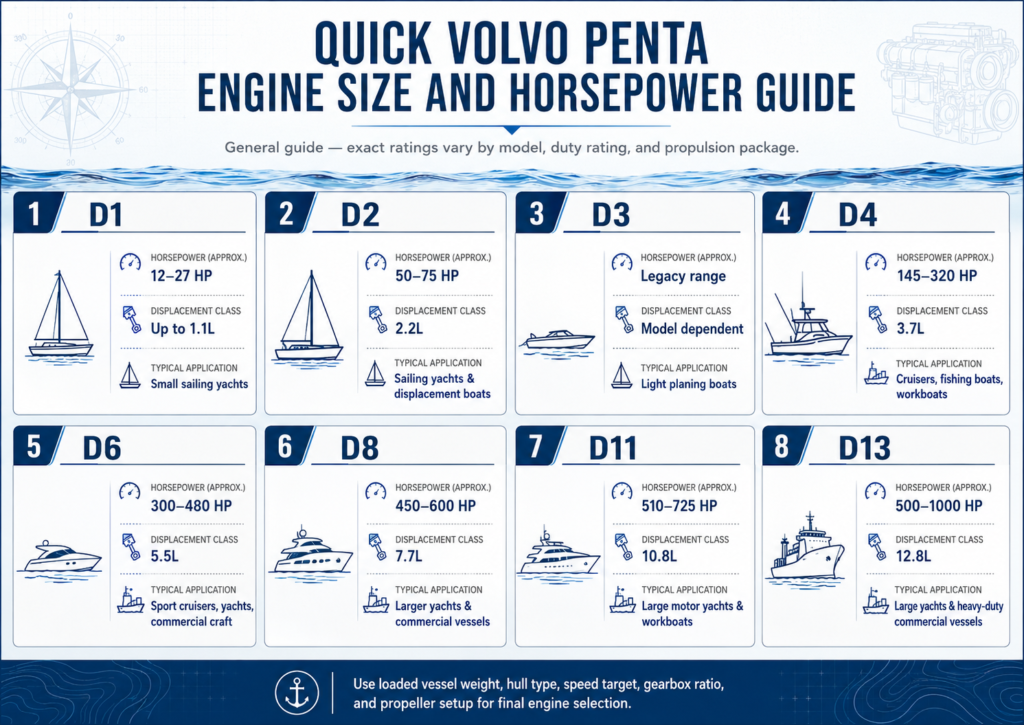
The table below shows where the main Volvo Penta diesel families generally sit. Exact ratings vary by model, propulsion configuration, duty cycle, production generation and market.
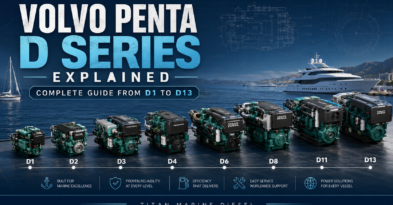
| Engine family | General power class | Displacement class | Typical applications |
|---|---|---|---|
| D1 | Compact, low-horsepower range | Up to approximately 1.1 litres | Smaller sailing yachts |
| D2 | Approximately 50–75 HP | 2.2 litres | Sailing yachts and displacement boats |
| D3 | Legacy compact performance range | Model-dependent | Lightweight planing boats |
| D4 | Approximately 145–320 HP | 3.7 litres | Cruisers, fishing boats and workboats |
| D6 | Approximately 300–480 HP | 5.5 litres | Sport cruisers, yachts and commercial craft |
| D8 | Approximately 450–600 HP in current IPS packages | 7.7 litres | Larger yachts and commercial vessels |
| D11 | Model- and duty-dependent | 10.8 litres | Large motor yachts and workboats |
| D13 | Up to approximately 1,000 HP in selected leisure configurations | 12.8 litres | Large yachts and demanding commercial vessels |
Volvo Penta’s current D6-DPI range includes 300, 340, 380, 400, 440 and 480 HP packages based on the same 5.5-litre inline-six engine platform. Its current D8-IPS range uses a 7.7-litre inline-six platform with published crankshaft outputs from 450 to 600 HP, depending on package and rating.
These figures are useful for comparison, but they should never be used as the sole basis for ordering a marine inboard diesel engine.
What Does Marine Engine Size Actually Mean? – Volvo Penta engine sizes and horsepower.
When buyers talk about engine size, they often mean horsepower. From a marine-engine specialist’s perspective, engine size involves several measurements:
- Physical dimensions
- Dry weight
- Number of cylinders
- Engine displacement
- Horsepower
- Torque
- Rated RPM
- Duty rating
- Cooling and airflow requirements
Two engines can produce similar maximum horsepower while delivering very different performance in the same vessel.
One may be a smaller-displacement engine producing power at higher RPM. The other may be a larger engine producing stronger torque lower in the operating range.
The smaller engine may suit a lightweight planing boat. The larger platform may be better suited to a heavy cruiser, passenger vessel or commercial workboat.
Horsepower matters, but it must be viewed as part of a complete marine propulsion system.
Marine Engine Displacement Explained
Engine displacement is the total internal volume swept by the pistons during operation.
In practical terms, larger displacement can support:
- Stronger torque
- Better response under heavy load
- Greater propeller-driving capability
- More suitable performance for heavy vessels
- Greater operating reserve
It can also mean:
- More engine weight
- Larger installation dimensions
- Higher fuel-flow requirements
- Greater cooling and ventilation demand
- A more substantial gearbox and driveline
A larger-displacement engine is not automatically better. It is useful only when the vessel and operating profile require it.
Why Cylinder Count Matters
The D4 is a four-cylinder engine, while the D6, D8, D11 and D13 are inline-six platforms.
Cylinder configuration can influence:
- Engine smoothness
- Physical length
- Weight
- Torque delivery
- Noise and vibration
- Maintenance access
A six-cylinder engine often provides smoother power delivery, but a compact four-cylinder D4 may be the better package when engine-room space and installed weight are limited.
Volvo Penta identifies the D4 as a 3.7-litre inline-four common-rail diesel, while the D6 uses a 5.5-litre inline-six common-rail platform. (volvopenta.com)
Understanding Marine Horsepower
Horsepower measures how quickly an engine can perform work.
In a boat, horsepower contributes to:
- Acceleration
- Maximum-speed potential
- Ability to reach plane
- Ability to maintain speed under load
- Propeller power
- Performance against wind, waves and current
More horsepower does not always mean proportionally more speed.
A displacement hull eventually reaches a point where increasing horsepower creates more wake and fuel consumption without producing a meaningful increase in speed.
A planing hull behaves differently. It needs sufficient power to overcome resistance, lift more of its hull out of the water and remain on plane.
This is why simple rules such as “a boat needs a certain number of horsepower per foot” are unreliable.
Crankshaft Horsepower vs Propeller-Shaft Power
Marine-engine specifications usually state power at the crankshaft.
Some power is lost through the:
- Gearbox
- Sterndrive
- IPS pod
- Coupling
- Shaft bearings
- Propeller shaft
These are normal mechanical losses, but they matter when comparing one propulsion system with another.
An IPS model designation should also not automatically be treated as the engine’s crankshaft horsepower. Always check the technical data for the exact engine-and-pod package.
Why Rated RPM Matters
A correctly matched marine engine should normally be able to reach its specified rated RPM when the boat is fully loaded and operating under appropriate test conditions.
Failure to reach rated RPM can indicate:
- Excessive propeller pitch
- Oversized propeller diameter
- Incorrect marine gearbox ratio
- Excess vessel weight
- Hull fouling
- A damaged propeller
- Restricted exhaust
- Inadequate engine-room airflow
- A mechanical or fuel-system problem
An engine that is consistently overloaded may experience excessive temperature, smoke, carbon accumulation and shortened service life.
For this reason, a proper commissioning sea trial should include a full-load RPM test.
Horsepower vs Torque
Horsepower receives most of the attention, but marine engine torque plays a major role in how the boat feels and performs.
Torque is the rotational force produced by the engine.
It affects:
- Propeller-driving ability
- Low-speed acceleration
- Time to plane
- Performance with passengers or cargo
- Towing and pushing capacity
- Response in rough conditions
Two engines rated at 300 HP may not perform identically.
Their performance can differ because of:
- Engine displacement
- Torque curve
- Rated RPM
- Gear reduction
- Propeller diameter
- Propeller pitch
- Vessel weight
This is why the correct propeller and gearbox matching is just as important as the advertised horsepower.
Why Boat Length Alone Cannot Determine Horsepower
Consider two 40-foot boats.
Boat A: Lightweight Planing Cruiser
- Designed for higher speed
- Moderate fuel and water capacity
- Lower displacement
- Sterndrive or IPS propulsion
- Cruising target above 20 knots
Boat B: Heavy Displacement Trawler
- Large fuel and water capacity
- Greater operating weight
- Conventional shaft drive
- Long-range cruising profile
- Cruising target near hull speed
Boat A may require substantial horsepower to reach plane.
Boat B may need much less horsepower because its hull is not designed to travel at planing speeds. It may benefit more from low-speed torque, an efficient propeller and the correct reduction ratio.
The useful question is not:
“How much horsepower does a 40-foot boat need?”
It is:
“How much horsepower does this hull need at its actual loaded displacement and required cruising speed?”
Use Fully Loaded Displacement
Published dry weight often excludes many of the items carried during real operation.
A vessel’s loaded weight may include:
- Fuel
- Fresh water
- Passengers
- Crew
- Batteries
- Generator
- Tender
- Safety gear
- Fishing gear
- Ice
- Personal belongings
- Optional accessories
- Commercial cargo
An offshore fishing boat may become considerably heavier once its tanks, bait wells, tower, generator, crew and fishing gear are added.
For accurate marine diesel engine sizing, work from the vessel’s realistic operating weight—not an empty-hull brochure figure.
Hull Type Changes the Power Requirement
Displacement Hulls
Displacement hulls move through the water rather than climbing onto its surface.
Examples include:
- Sailing yachts
- Trawlers
- Traditional workboats
- Heavy cruising boats
These boats are strongly influenced by waterline length and hull speed.
Adding excessive horsepower may increase fuel consumption without creating a useful increase in speed.
The priorities are often:
- Reliable low-speed torque
- Efficient propeller matching
- Suitable cruising power
- Ability to handle adverse conditions
- Correct duty rating
Semi-Displacement Hulls
Semi-displacement vessels operate between displacement and planing behaviour.
Examples can include:
- Fast trawlers
- Pilot boats
- Patrol craft
- Passenger vessels
Their resistance can increase rapidly as speed rises, making professional propulsion calculations particularly important.
Planing Hulls
Planing boats need enough power to accelerate and lift more of the hull above the water.
Examples include:
- Sport cruisers
- Offshore fishing boats
- Day boats
- Performance yachts
- Fast patrol boats
The calculation must consider:
- Loaded displacement
- Deadrise
- Passenger and cargo load
- Time to plane
- Cruising-speed target
- Propeller selection
- Trim
- Single- or twin-engine arrangement
A lightly loaded demonstration run can make an underpowered boat seem acceptable. The more meaningful test is performance at its normal operating load.
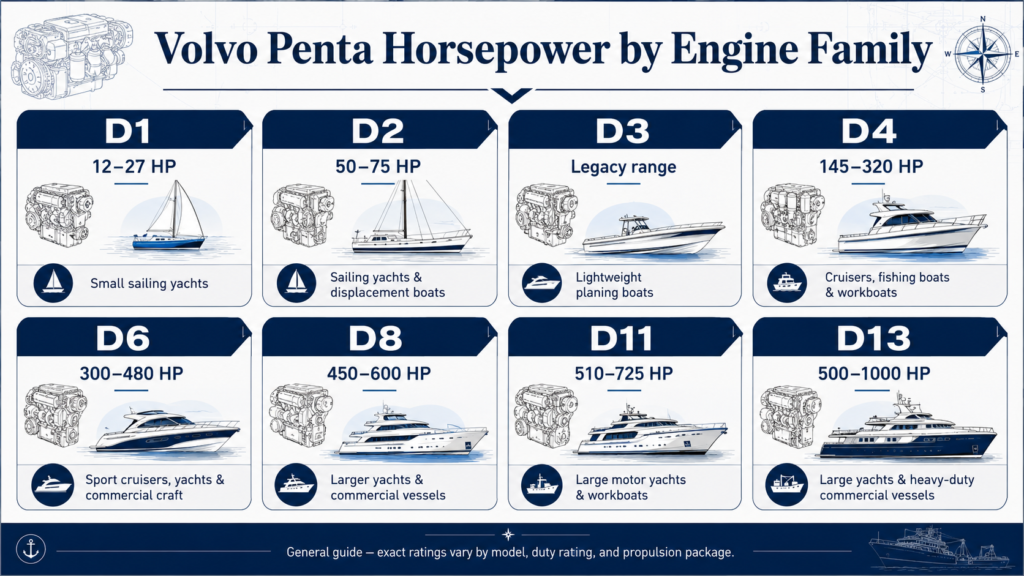
Volvo Penta Horsepower by Engine Family
Volvo Penta D1 Marine Inboard Engine
The Volvo Penta D1 engine range is designed primarily for smaller sailing yachts and compact displacement boats.
It may be appropriate when:
- Installation space is limited
- Auxiliary propulsion is required
- The vessel operates at displacement speed
- Shaft drive or saildrive is preferred
- Installed weight must remain low
A D1 may be insufficient when the boat is heavily loaded, regularly motors against difficult conditions or carries high electrical loads.
Volvo Penta D2 Marine Diesel Engine
The Volvo Penta D2 engine range uses a 2.2-litre inline-four platform and is commonly associated with sailing yachts, motor sailers and compact displacement vessels. Volvo Penta’s official D2 description identifies it as a naturally aspirated, freshwater-cooled marine diesel. (volvopenta.com)
Representative models include:
The final choice should account for loaded displacement, propeller arrangement, saildrive or shaft configuration and expected operating conditions.
Volvo Penta D3 Marine Diesel Engine
The D3 remains important because many existing recreational boats use D3 inboard or sterndrive packages.
Volvo Penta’s earlier D3 generation combined a compact diesel platform with common-rail injection and Electronic Vessel Control. Buyers evaluating a used D3 should confirm the production year, engine hours, diagnostic history, drive condition and parts support. (volvopenta.com)
For some repower projects, a current D4 package may be a more appropriate alternative.
Volvo Penta D4 Marine Diesel Engine
The Volvo Penta D4 horsepower range extends from approximately 145 to 320 HP, depending on model and propulsion package.
It is commonly used in:
- Sport cruisers
- Fishing boats
- Workboats
- Patrol craft
- Passenger launches
The D4 offers a useful balance of compact dimensions, four-cylinder torque and inboard or Aquamatic options.
A buyer should consider moving to the D6 when:
- Vessel displacement is higher
- Greater sustained output is required
- Six-cylinder refinement is preferred
- Load changes significantly
- The required propulsion option favours the D6
Volvo Penta D6 Marine Diesel Engine
The Volvo Penta D6 horsepower range reaches 480 HP in current DPI packages.
It is commonly considered for:
- Express cruisers
- Offshore fishing boats
- Motor yachts
- Passenger vessels
- Workboats
- Aquamatic installations
- IPS propulsion
The same 5.5-litre engine platform is offered at multiple horsepower levels, but that does not make all versions interchangeable. Rating, turbocharging arrangement, drive compatibility and duty classification still matter. (volvopenta.com)
Volvo Penta D8 Marine Diesel Engine
The Volvo Penta D8 uses a 7.7-litre inline-six platform. Current D8-IPS packages list crankshaft power from 450 to 600 HP, depending on model and rating. (volvopenta.com)
Applications include:
- Larger motor yachts
- Passenger boats
- Patrol craft
- Offshore fishing vessels
- Commercial workboats
At this level, the engine room must be evaluated for airflow, cooling, fuel flow, exhaust sizing and maintenance access.
Volvo Penta D11 and D13 Marine Diesel Engine
The Volvo Penta D11 and Volvo Penta D13 serve larger yachts and demanding commercial vessels.
The D13 is a 12.8-litre inline-six platform and has been offered at up to 1,000 HP in selected leisure configurations. (volvopenta.com)
These installations should be engineered around:
- Vessel resistance
- Required continuous power
- Gearbox capacity
- Shaft diameter
- Propeller design
- Cooling requirements
- Exhaust backpressure
- Engine-room airflow
- Structural mounting
- Control-system integration
At this power level, choosing by headline horsepower alone is not responsible.
Single Engine vs Twin Engines
A single-engine installation can offer:
- Lower purchase cost
- Lower maintenance expense
- Reduced machinery weight
- Simpler installation
- More machinery-space access
Twin engines can offer:
- Propulsion redundancy
- Improved maneuverability
- Greater combined power
- Better offshore confidence
- More flexible load distribution
Two 300 HP engines provide 600 HP of combined rated output, but that does not mean the boat will travel twice as fast as it would with one 300 HP engine.
Twin installations also add drag, weight, fuel-system complexity and servicing costs.
Recreational vs Commercial Duty
The same engine family may be offered at different power ratings for different operating profiles.
A recreational vessel may operate limited annual hours with constantly changing loads.
A passenger vessel, charter boat, fishing vessel or workboat may run daily and spend much more time under sustained load.
For commercial applications, a lower-output rating may provide a more appropriate balance of durability and operating hours than the highest available horsepower.
Volvo Penta’s current commercial warranty conditions distinguish between engine families, ratings and operating-hour limits. The company’s expanded global marine warranty applies to products delivered from 2025 onward, but actual coverage still depends on the product, operating application, delivery date, region and accumulated hours. (volvopenta.com)
Commercial buyers should provide:
- Annual operating hours
- Average engine load
- Time at full power
- Passenger or cargo load
- Required cruising speed
- Classification requirements
Horsepower Selection for a Repower
A Volvo Penta repower should begin with the vessel’s current performance. Marine engines & boat motors for power
Record:
- Existing engine model
- Current horsepower
- Rated RPM
- Gearbox ratio
- Propeller dimensions
- Actual cruising speed
- Maximum speed
- Fuel consumption
- Known performance problems
Increasing horsepower may require changes to:
- Gearbox
- Shaft
- Propeller
- Engine beds
- Exhaust
- Cooling
- Fuel supply
- Ventilation
- Controls
Volvo Penta’s repower guidance emphasizes evaluating the complete installation rather than simply replacing one engine with another.
More horsepower will not solve:
- A fouled hull
- Incorrect propeller pitch
- Damaged propeller blades
- Poor weight distribution
- Restricted exhaust
- A failing fuel system
- An overloaded boat
Fuel Consumption and Engine Size
A larger engine does not automatically consume more fuel while performing the same task.
A correctly sized larger engine operating at a moderate load may sometimes compare favourably with a smaller engine working continuously near maximum output.
That is not a universal rule.
Volvo Penta fuel consumption depends on:
- Vessel weight
- Hull type
- Speed
- Engine load
- Gear ratio
- Propeller efficiency
- Sea conditions
- Hull cleanliness
- Trim
- Maintenance condition
For meaningful comparisons, evaluate:
- Fuel per hour
- Boat speed
- Fuel per nautical mile
- Engine-load percentage
- Cruising range
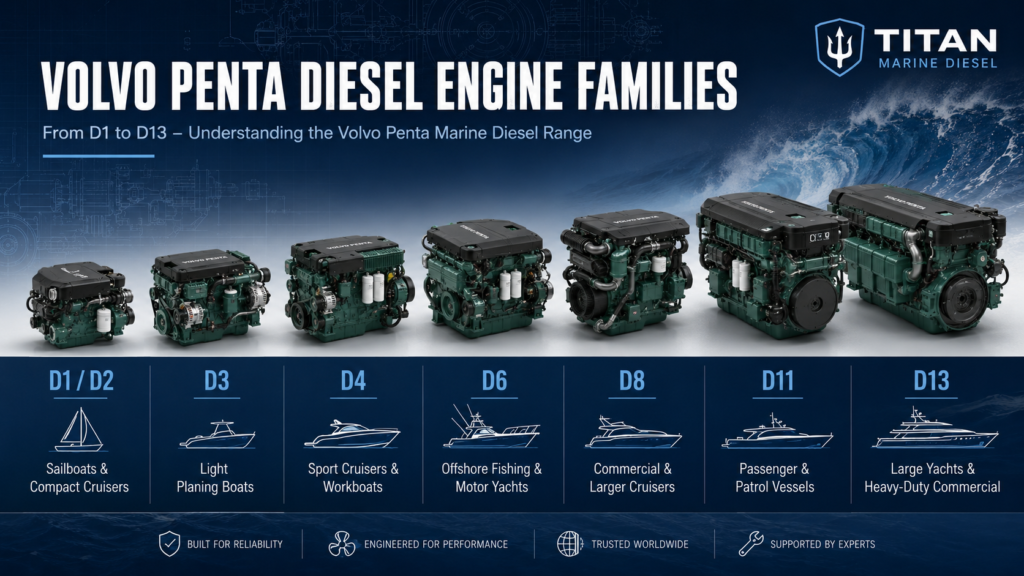
Common Marine Engine Sizing Mistakes
The mistakes we see most frequently include:
- Choosing by boat length alone
- Using dry weight instead of fully loaded displacement
- Automatically selecting the highest horsepower
- Ignoring torque
- Reusing an unsuitable gearbox
- Failing to confirm the reduction ratio
- Assuming more horsepower always produces more speed
- Ignoring rated RPM during the sea trial
- Comparing an engine-only price with a complete propulsion package
- Ordering before measuring installation access
The most expensive mistake is purchasing the engine first and trying to solve compatibility problems afterwards.
Frequently Asked Questions
How much horsepower does my boat need?
There is no responsible answer based on length alone. The calculation must consider loaded displacement, hull type, desired speed, duty cycle, gearbox, propeller and propulsion configuration.
How much horsepower does a 30-foot boat need?
A 30-foot sailboat, trawler and planing sport boat can require completely different power. The vessel type and loaded weight must be known before making a recommendation.
What is the smallest Volvo Penta marine diesel engine?
The D1 family represents the compact end of Volvo Penta’s current inboard diesel range and is mainly used for smaller sailing yachts and displacement craft.
What is the difference between a Volvo Penta D4 and D6?
The D4 is a 3.7-litre four-cylinder platform. The D6 is a larger 5.5-litre inline-six. The D6 generally offers more power, stronger torque and smoother operation, while the D4 provides a more compact installation.
Can I replace a Volvo Penta D4 with a D6?
Possibly, but the change may require different engine mounts, gearbox, shaft, propeller, exhaust, cooling, fuel supply and controls. A complete installation review is required.
Is twin 300 HP equal to one 600 HP engine?
The total rated horsepower is equal, but the installations are not. Twin engines add redundancy and maneuverability but also add drag, weight, maintenance and fuel-system complexity.
Does more horsepower improve fuel economy?
Not automatically. Fuel economy depends on engine load, hull resistance, propeller selection, gearing and cruising speed.
How do I know whether my marine engine is overloaded?
Possible signs include failure to reach rated RPM, excessive smoke, elevated temperatures, poor acceleration and high fuel consumption. These symptoms can have several causes and should be diagnosed by a qualified marine technician.
What gearbox ratio should I use?
The correct marine transmission ratio depends on engine RPM, propeller diameter, available propeller clearance, vessel speed, and hull resistance. It should be calculated as part of the propulsion system.
Does Volvo Penta EVC affect engine selection?
It can. Volvo Penta Electronic Vessel Control integrates compatible engines, controls, transmissions, instruments and optional functions. Existing mechanical or earlier-generation electronic controls may not be reusable with a new package. (volvopenta.com)
Does Titan Marine Diesel provide engine-sizing recommendations?
Titan Marine Diesel can review vessel information and prepare a suitable engine-and-package recommendation. Final installation, propeller and structural decisions should be verified by the responsible installer, naval architect or qualified marine professional.
Information Titan Marine Diesel Needs
To prepare a responsible recommendation, provide:
- Vessel make and model
- Length and beam
- Fully loaded displacement
- Hull type
- Existing engine model
- Current horsepower and rated RPM
- Gearbox or drive model
- Reduction ratio
- Propeller dimensions
- Desired cruising speed
- Expected maximum speed
- Recreational or commercial use
- Annual operating hours
- Single- or twin-engine installation
- Delivery destination
- Required lead time
Photographs of the engine identification plate, gearbox plate, machinery space, mounts, controls and exhaust arrangement are also useful.
Final Thoughts: Choose the Power the Boat Needs
The correct engine is not the largest Volvo Penta model that fits inside the machinery space.
It is the engine that can move the fully loaded vessel at the required speed while operating within its proper load and duty range.
Remember:
- Boat length alone does not determine horsepower.
- Loaded displacement matters.
- Hull type changes the power requirement.
- Torque matters alongside horsepower.
- The duty cycle must match the engine rating.
- Gearbox and propeller selection are critical.
- Installation access must be measured.
- Rated RPM should be verified during commissioning.
Titan Marine Diesel supports recreational and commercial buyers with Volvo Penta engine sizing, horsepower comparisons, marine inboard diesel engine packages, repower guidance and international shipping coordination.
To request a Volvo Penta engine size and horsepower recommendation, provide your vessel specifications, current propulsion details, intended operating profile, delivery destination and required lead time.

Leave a Reply