
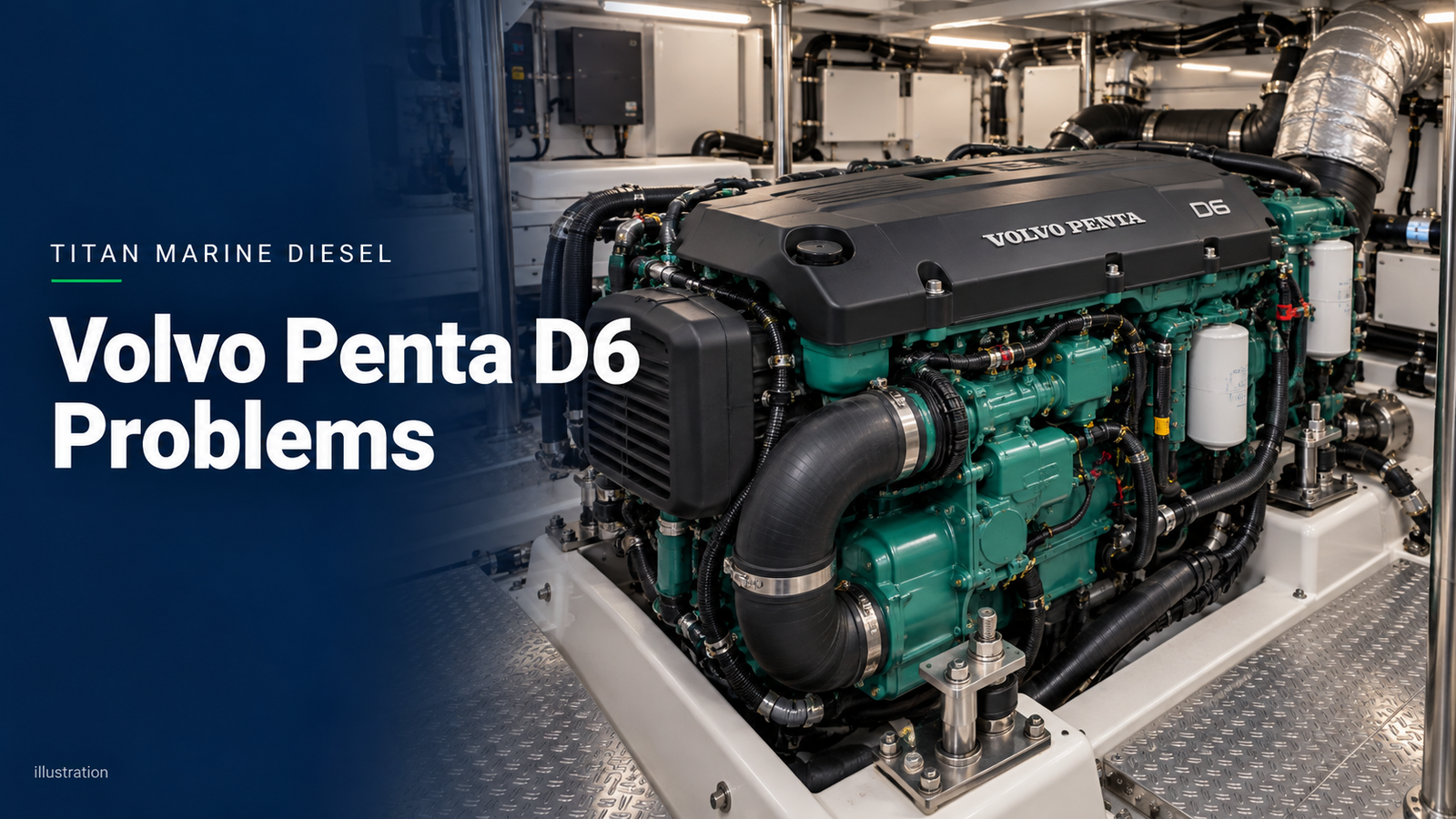
Volvo Penta D6 Problems – Common Faults, Symptoms & Solutions Before They Get Expensive
A small installation problem can create an expensive-looking engine symptom.
French Marine Motors describes an investigation into a Volvo Penta D6-330 that overheated as RPM increased. The reported cause was a split plastic elbow between a hose and the drive, damaged by an incorrectly installed clip. It is one company’s account of one repair, but it illustrates why looking beyond the engine itself matters.
If your D6 suddenly overheats, loses power, or displays an alarm, it is understandable to worry about turbochargers, injectors, and major repair bills. Before choosing a replacement part, however, you need to establish what is actually happening.
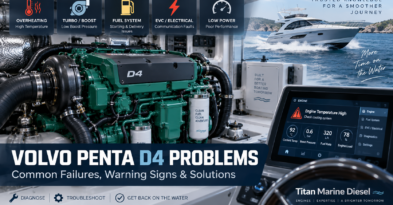
Volvo Penta D6 problems can involve cooling, fuel delivery, electronics, or the connected propulsion equipment. Symptoms can overlap, and different D6 generations do not necessarily use identical components or diagnostic procedures.
This Titan Marine Diesel guide will help you recognize serious warnings, collect useful evidence, and understand the next steps toward a sound repair decision.
We will discuss troubleshooting categories rather than claim that every D6 suffers from the same failures. The correct operator manual and a qualified technician’s assessment remain essential when the situation requires specific testing.
Volvo Penta D6 Problems at a Glance
Start by identifying the symptom, the conditions under which it appears, and any recent change to the vessel. Those details are more useful than guessing a failed component from an alarm alone.
Volvo Penta’s support guidance explains that one alarm or symptom can have several causes. Information about when it occurred, what happened beforehand, and accompanying symptoms helps establish the root cause. Volvo Penta’s engine identification and manual resources
Quick Symptom, Possible Cause, and Next-Step Table
This table provides starting points for Volvo Penta D6 troubleshooting. It does not replace the fault-tracing instructions for your particular installation.
| Symptom | Investigation areas | Evidence to record | Appropriate next step |
|---|---|---|---|
| Overheating alarm | Coolant level, seawater supply, filter, impeller, leaks | Alarm wording, RPM, temperature trend | Follow the manual’s response instructions |
| Reduced power or maximum RPM | Fuel supply, air supply, protective controls, vessel load | RPM, alarms, recent changes | Establish when performance deteriorates |
| Difficult starting | Electrical supply, starting circuit, fuel system | No crank, slow crank, or normal cranking | Separate the starting symptoms |
| Unusual exhaust smoke | Combustion, air supply, oil or cooling concerns | Color, duration, operating conditions | Assess associated symptoms |
| Fuel-pressure warning | Fuel level, filtration, leakage, pressure-control system | Exact message and fuel-service history | Follow applicable checks; escalate if unresolved |
| Intermittent EVC faults | Power supply, connections, communication | Display messages and affected functions | Preserve evidence for diagnosis |
| Fluid leaks | Engine and associated equipment | Fluid type, source, rate of loss | Assess urgency before operating |
| Abnormal noise or vibration | Engine, mounts, driveline, propeller | Relationship to RPM and gear engagement | Stop further testing if severe |
Volvo Penta’s D4/D6 operator manual, publication 47702599 dated December 2011, includes checks for coolant level, seawater-filter blockage, impeller condition, fuel filtration, and leaks. These support the general investigation areas above, but that edition must not be treated as the correct manual for every D6.
Warning Signs That Need Immediate Attention
Some symptoms require prompt action:
- A serious engine oil-pressure warning.
- Severe overheating or rapid coolant loss.
- A fuel leak.
- Heavy abnormal mechanical noise.
- Severe vibration.
- Loss of steering or propulsion control.
Volvo Penta classifies red alarms as danger and recommends stopping as soon as safely possible, while recognizing that the vessel may first need to reach a position where stopping is safe. Follow the instructions for the specific alarm and installation.
Do not make another high-load run simply to reproduce a serious warning. Where people or vessel safety are threatened, obtaining appropriate assistance takes priority over troubleshooting.
Identify Your D6 Before Diagnosing It
Why “Volvo Penta D6” Is Not Complete Identification
The engine cover gives you a starting point. The identification plate gives you information needed to move forward.
Before requesting help with Volvo Penta D6 engine problems, collect:
- Full product designation, including the suffix.
- Serial number and product number where shown.
- Engine hours.
- Available service and repair records.
- A clear photograph of the complete identification plate.
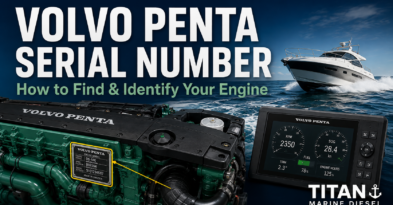
Volvo Penta describes the serial number as essential to efficient servicing and correct parts ordering. Its location and appearance can vary by model and manufacturing year.
Generation matters, too. Volvo Penta’s 2019 D4/D6 update introduced changes involving engine management, fuel injection, turbocharging, and supercharging across the range. Older and newer installations therefore require careful distinction when discussing components and specifications.
A search for “D6-370 problems” or “D6-435 problems” can help you find relevant reading. It does not establish that the advice applies to your exact engine.
Our Volvo Penta serial-number guide explains which identification details to collect.
Identify the Gearbox, Sterndrive, or IPS Installation
Record the equipment connecting the engine to the propeller.
That might be an inboard gearbox and shaft, an Aquamatic sterndrive, or an IPS propulsion system. Photograph the relevant component identification plates separately.
This helps distinguish an engine-running problem from a propulsion or control problem.
For example, an engine that runs smoothly while gear engagement behaves abnormally requires a different investigation from one that runs roughly in neutral. Describing both situations as “my D6 is failing” hides information that could narrow the diagnosis.
Match the EVC System and Manual to the Installation
For Volvo Penta D6 EVC faults, record the complete message rather than paraphrasing it as “an engine warning.”
Photograph the display and include the EVC generation if known. Avoid guessing based on the boat’s age.
Use documentation matched to the engine and associated equipment. Volvo Penta’s identification resources provide access to manuals, while Volvo Penta Connect offers product-related documentation and registered service information.
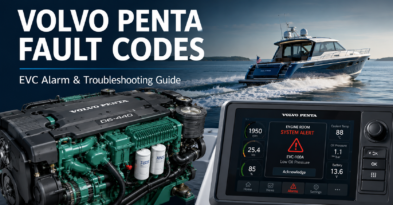
Titan’s Volvo Penta fault-code guide provides additional background on interpreting alarms without assuming that the component named in a message has failed.
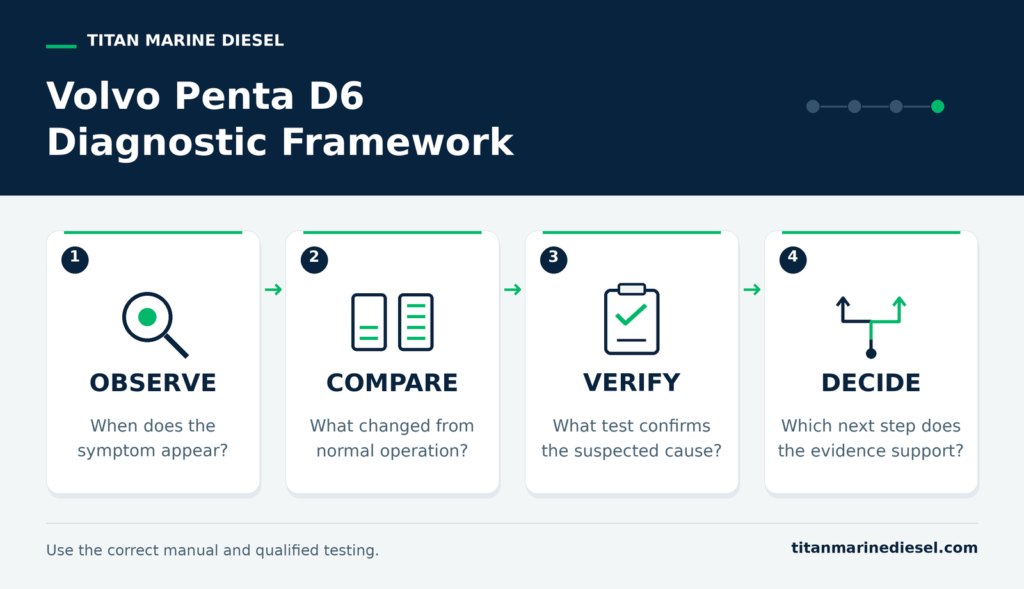
The Titan D6 Diagnostic Sequence: Observe → Compare → Verify → Decide
This is an original framework for organizing a troubleshooting enquiry. It complements manufacturer instructions and professional diagnosis.
Observe—Record Exactly When the Symptom Appears
“Sometimes it loses power” is a difficult complaint to investigate.
A more useful description is:
“The engine starts normally, but after warming up it loses power during acceleration. The problem began after the fuel filters were changed.”
That does not prove the cause. It establishes a sequence worth checking.
Record whether the problem occurs during cold starting, warm restarting, idling, acceleration, or sustained cruising. Note alarms, visible leaks, smoke, and recent work.
For Volvo Penta D6 loss of power, the difference between a sudden change after servicing and a gradual decline over several months can materially change the investigation.
Make observations from a safe position. Keep clear of belts, hot surfaces, and other moving equipment.
Compare—Use a Meaningful Baseline
Compare current behavior with previous operation under similar conditions.
Useful records may include RPM, boat speed, displayed temperatures, fuel use, and alarms. Account for changes in loading, sea conditions, and the vessel itself.
On twin-engine boats, the other engine can provide a reference, but it does not automatically prove which component is faulty. Differences need interpretation.
This is also useful when considering Volvo Penta D6 reliability: maintenance records and operating history tell you more about a particular engine than a collection of unrelated online complaints.
Verify—Test the Suspected Cause Before Ordering Parts
Ask what evidence supports the proposed repair.
Has the suspected condition been measured? Does the measurement match the correct specification? Were relevant supply conditions, connections, and associated equipment checked?
The D4/D6 manual illustrates why this matters: its low fuel-pressure guidance includes checking fuel level, filters, and leakage. A fuel-pressure warning does not automatically establish injector failure.
Owner observations help narrow the investigation. High-pressure fuel testing and other specialist procedures require qualified personnel and suitable equipment.
Decide—Repair, Investigate Further, or Assess Replacement
A confirmed isolated fault may justify a targeted repair. Conflicting evidence calls for further investigation. Several deteriorating systems may justify a wider condition assessment before major expenditure.
A problem that appears to come from the engine can originate elsewhere in the installation. That is the lesson from the attributed overheating example at the beginning of this guide.
Before discussing a Volvo Penta D6 replacement engine, establish the existing engine’s condition, the repair scope, and the requirements of the complete propulsion package.
With that information organized, we can examine the individual symptoms more closely—starting with overheating, reduced RPM, boost problems, starting difficulties, smoke, and electrical faults.
Volvo Penta D6 Overheating and Cooling-System Problems
Volvo Penta D6 overheating requires an investigation of both cooling circuits and the conditions under which temperature rises. A temperature alarm alone cannot identify the failed component.
The useful question is: what changed between normal operation and the first sign of overheating?
Separate the Seawater Circuit From the Coolant Circuit
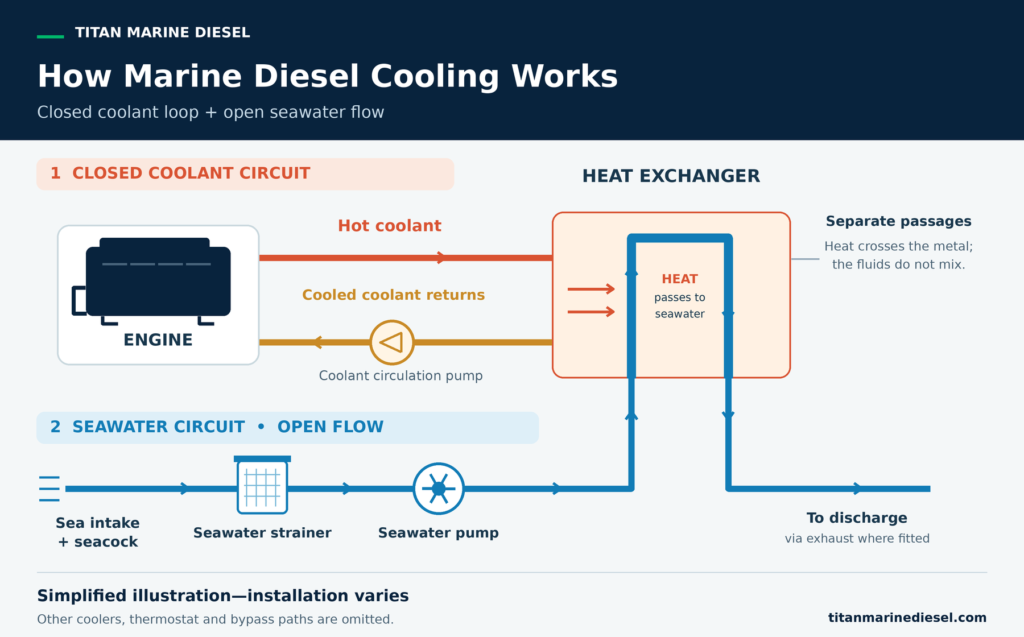
The engine’s closed coolant circuit carries heat away from internal components. The seawater circuit removes heat through the installation’s heat-exchange equipment.
These circuits interact, but they perform different jobs. A full coolant expansion tank does not prove that seawater is circulating correctly. Likewise, visible water at the exhaust does not establish that every cooler is transferring heat effectively.
Identify the actual cooling arrangement before inspecting it. Hose routing and associated coolers depend on the propulsion package.
D6 Overheating at High RPM Versus at Idle
If temperature remains stable at idle but rises during acceleration or sustained cruising, record that distinction.
A useful working hypothesis is that cooling capacity becomes insufficient as demand increases. It still needs testing: the symptom does not identify a particular restriction, pump, or thermostat.
Overheating at idle also needs prompt attention. Do not assume that low engine speed makes continued operation harmless.
Avoid repeated loaded runs to “see whether it happens again” after a serious alarm.
Impeller, Strainer, Heat Exchanger, and Coolant Checks
For covered installations, Volvo Penta’s December 2011 D4/D6 manual directs attention to coolant level, the seawater filter, impeller condition, and leaks when coolant temperature is excessive. Use the edition applicable to your engine.
Organize the investigation around what has actually been inspected. “The cooling system was serviced” is less useful than knowing which components were opened, cleaned, tested, or replaced.
Ask the technician whether the heat exchanger and charge-air cooler need further assessment based on the symptoms and service history.
What Owners Can Observe Safely
Record the alarm, temperature trend, RPM, and any accessible visible leaks.
Opening strainers or seawater plumbing can admit water into the vessel. Follow the correct isolation procedure before servicing them, and never remove a hot pressurized coolant cap.
If the inspection exceeds your experience or access is unsafe, preserve the evidence and arrange assistance.
Volvo Penta D6 Loss of Power or Failure to Reach Full RPM
Establish Whether Output Is Restricted or the Engine Is Under Excessive Load
Volvo Penta D6 loss of power describes an outcome, not a diagnosis.
First establish whether an alarm coincides with the reduced output. Then consider whether the engine is struggling to deliver power or whether the vessel’s propulsion demand has changed.
Volvo Penta’s fault-tracing table includes fuel and air concerns, abnormal loading, underwater fouling, and propeller problems among possible contributors to insufficient maximum RPM.
This is why an engine-only investigation can miss the cause.
Check Recent Changes Before Suspecting Major Engine Damage
Build a short timeline:
- Did performance change after servicing or refuelling?
- Was the propeller repaired or replaced?
- Has the vessel gained weight?
- Has it spent an extended period afloat?
- Did an alarm appear before the power reduction?
A sudden change after one intervention gives the technician a different starting point from gradual deterioration over a season.
Comparing Twin D6 Engines
Compare available RPM, temperatures, boost readings, fuel use, and alarms under reasonably comparable conditions.
Record which engine changes first and whether both exhibit the same symptom.
The comparison helps frame questions; it does not authorize swapping injectors, sensors, or control modules between engines. Such work may introduce new faults or require procedures beyond a simple physical exchange. Volvo Penta’s alarm and troubleshooting guidance.
Volvo Penta D6 Turbo, Boost, and Acceleration Problems
Low Boost Does Not Confirm a Failed Turbocharger
Volvo Penta D6 turbo problems are easy to suspect when acceleration deteriorates. However, a low-boost reading needs context.
A technician may investigate intake restriction, charge-air leakage, exhaust conditions, fuel delivery, and the reliability of the pressure reading before condemning the turbocharger.
Garrett’s general turbocharger guidance emphasizes checking associated engine systems before replacement because low power, smoke, and oil consumption can originate elsewhere. This supports the diagnostic principle; it is not a D6-specific repair procedure.
Replacing a turbo without establishing why performance changed risks leaving the original problem unresolved.
Supercharger-Related Symptoms on Applicable Configurations
Establish whether your exact D6 configuration includes a supercharger before interpreting a hesitation as a supercharger fault.
Volvo Penta documents changes to turbocharging and supercharging in its updated D4/D6 range. That makes generation-specific documentation important.
Do not borrow a supposed universal engagement or disengagement RPM from another owner’s boat. Record when the hesitation occurs and let the applicable specifications guide testing.
When Professional Boost and Air-System Testing Is Needed
Arrange assessment when poor acceleration, unusual noises, smoke, or boost-related warnings persist.
Ask for an explanation connecting the measurements to the proposed repair. Useful findings should distinguish a verified air-system fault from a suspected one.
Garrett also advises stopping diagnostic trials when significant malfunction symptoms appear and performing physical turbo inspections with the engine stopped and cold.
Volvo Penta D6 Starting and Fuel-System Problems
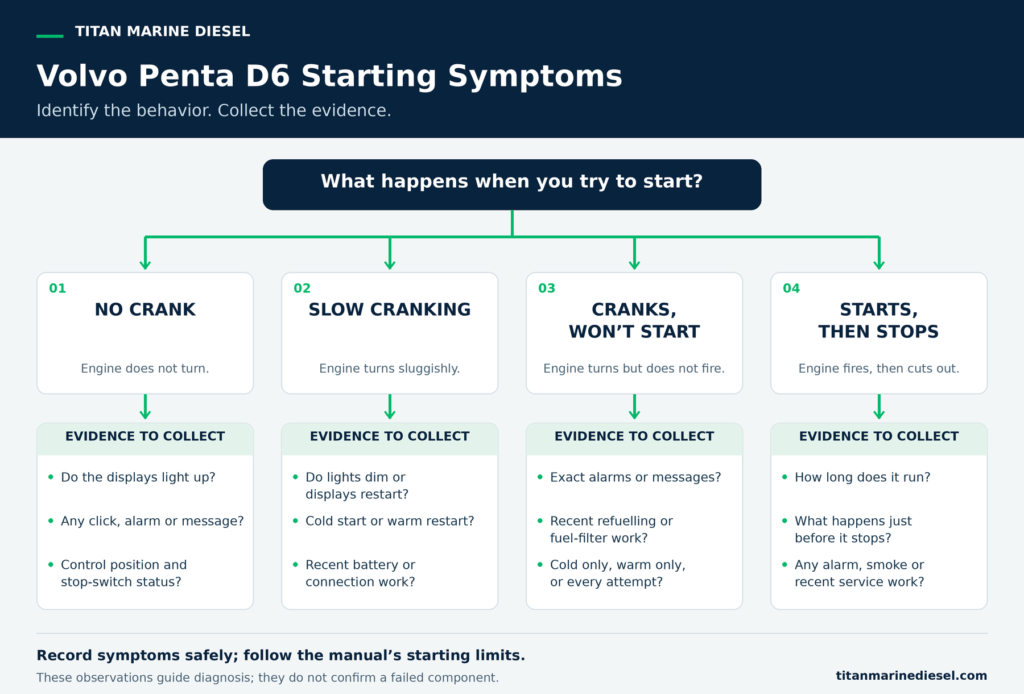
Separate No Crank, Slow Cranking, and Cranking Without Starting
When a Volvo Penta D6 won’t start, describe what happens after the start command.
| Starting behavior | Information to provide |
|---|---|
| Nothing turns | Display behavior, clicks, warnings, control position |
| Engine turns slowly | Whether this changes when warm and what happens to the instruments |
| Engine turns normally but does not fire | Fuel-service history, warnings, cold versus warm conditions |
| Engine starts and stops | How long it runs and what changes immediately before stopping |
These observations help the technician choose the correct investigation rather than treating every starting complaint as a fuel problem.
Hard Starting After a Fuel-Filter Change
If D6 hard starting begins immediately after filter replacement, report that sequence clearly.
Ask whether the correct filter was fitted, seals and connections were checked, and the specified priming or bleeding procedure was completed.
Do not loosen high-pressure injector pipes to bleed a common-rail system. Follow the applicable manual and have qualified personnel investigate persistent starting difficulty.
Fuel-Pressure Alarms and Suspected Injector Problems
A fuel-pressure alarm should lead to a diagnosis of the pressure condition and its cause.
For installations covered by the reviewed D4/D6 manual, initial guidance includes checking fuel level, filter restriction, and leakage. That does not establish injector or high-pressure-pump failure.
Record recent refuelling and any water-in-fuel warning. Tell the technician what has already been checked so expensive component testing follows a clear sequence.
What Black, White, and Blue Smoke Can Tell You
Smoke color helps organize an investigation, but it cannot confirm a diagnosis by itself. Duration, engine temperature, load, fluid consumption, and running quality all matter.
General diesel troubleshooting guidance from Perkins connects smoke symptoms with several possible fuel, lubrication, and cooling conditions. These are general diesel principles—not proof of a particular D6 defect.
Black Smoke During Acceleration or Under Load
For Volvo Penta D6 black smoke, record whether it appears briefly during acceleration or continues after engine speed stabilizes.
Pair that observation with RPM and performance: does the boat accelerate normally, struggle to get onto plane, or produce smoke while losing speed?
Air supply, fuel delivery, and loading deserve consideration. Avoid deciding that smoke automatically means failed injectors.
White Smoke, Vapor, and Coolant Loss
Persistent Volvo Penta D6 white smoke deserves closer investigation, particularly when accompanied by rough running or unexplained fluid loss.
Cold-combustion conditions can produce white smoke, while water vapor can look similar. Perkins notes that overcooling can contribute to poor combustion and white smoke; that general explanation does not establish what is happening on your boat.
A short video taken safely, together with temperature and coolant-level observations, is more useful than color alone.
Blue Smoke and Oil-Consumption Changes
Blue smoke can indicate oil entering combustion. Possible sources differ, so neither piston wear nor turbocharger failure should be assumed without testing. Perkins identifies several potential causes in its guidance on blue smoke.
Track oil additions and use the correct checking procedure. Report whether the change began after servicing.
| Observation | Useful accompanying evidence |
|---|---|
| Black smoke | Load, acceleration, RPM, available boost reading |
| White smoke or vapor | Cold/warm condition, coolant trend, running quality |
| Blue smoke | Oil consumption, recent servicing, operating conditions |
Volvo Penta D6 EVC Alarms, Electrical Faults, and Derate
What to Record Before Clearing an Alarm
For Volvo Penta D6 EVC faults, photograph the complete message and record when it appeared.
Include the engine identity, affected helm station, operating conditions, and any other warnings. Follow the correct acknowledgement procedure, while retaining evidence for diagnosis.
Volvo Penta’s support guidance emphasizes that the combination and timing of symptoms can help explain their cause.
Why Several Alarms May Need a Shared-Cause Investigation
Several messages appearing together should prompt the question: are these separate faults, or related effects of one disturbance?
Have the technician assess relevant electrical supply, connections, and communications alongside the reported components.
Avoid dismissing alarms as “just electrical.” An electrical problem affecting propulsion controls can still require urgent attention.
Why Clearing a Code Does Not Establish That the Fault Is Fixed
Volvo Penta D6 limp mode, often used informally to describe restricted output, needs investigation of the triggering condition.
Volvo Penta confirms that some serious alarms can limit engine functionality. Removing a message does not demonstrate that the underlying condition has been corrected.
Do not bypass protective functions. Repair verification should establish normal operation under conditions appropriate to the original fault.
For more context, see Titan’s Volvo Penta fault-code guide.
Leaks, Corrosion, Vibration, and Drive-Related Symptoms
Identify the Fluid and Trace the Source
Photograph a leak before cleaning removes useful evidence, provided it is safe.
Record the apparent fluid type, location, and whether it appears while stopped or running. Fluid can travel before dripping, so the puddle’s position may not identify its source.
Never use your hand to search for a high-pressure fuel leak.
Investigate Corrosion Without Assuming Every D6 Shares the Same Defect
Describe the affected component, nearby leaks, and maintenance history. Ask whether the corrosion is superficial or affects sealing, strength, or operation.
The installation-damage example in Part 1 illustrates the value of examining surrounding components. It does not establish a common manufacturing defect.
Separate Engine Vibration From Propulsion Problems
Record whether vibration occurs in neutral, only in gear, during acceleration, or within a particular RPM range.
The reviewed Volvo Penta manual includes propeller and engine-mounting concerns in its vibration fault tracing.
Avoid continued loaded operation with severe new vibration. Give the technician the symptom history and any recent grounding, propeller work, or installation changes.
Repair, Rebuild, or Repower Your Volvo Penta D6?
The right decision depends on the confirmed fault, the condition of the complete propulsion system, and your plans for the vessel. Engine age or one repair quotation cannot answer the question alone.
Before comparing options, ask the technician to distinguish confirmed findings from suspected problems. That separation makes the financial decision much clearer.
When a Targeted Repair May Be Appropriate
A targeted repair deserves consideration when the fault is isolated, the diagnosis is supported by testing, and the surrounding equipment remains serviceable.
Ask three questions:
- What evidence confirms the failed component or condition?
- What work is included in the repair?
- How will successful operation be verified afterward?
For Volvo Penta D6 problems, a clear explanation of the repair matters more than a confident guess. A quotation should identify the proposed work and any remaining uncertainty.
When a Wider Condition Assessment Is Justified
A broader assessment becomes useful when faults recur, service history is incomplete, corrosion is substantial, or several systems need attention.
Before authorizing major internal work, ask what condition the engine and associated equipment will be in after that work is complete.
A rebuild proposal should specify inspection findings, machining where required, replacement components, testing, exclusions, and warranty terms. The word “rebuilt” alone does not define the work.
Volvo Penta publishes a remanufactured-parts catalogue covering selected D6 variants. That provides a reason to investigate applicable remanufactured options, but availability and compatibility must be checked for the exact engine.
Compare the Full Project Cost
A Volvo Penta D6 replacement engine price is only one part of a potential repower.
Request a written scope addressing removal, installation, associated equipment, controls, commissioning, freight, and any necessary vessel modifications. Confirm which existing components can be retained.
Use this decision worksheet to compare proposals:
| Decision factor | Repair or rebuild proposal | Replacement or repower proposal |
|---|---|---|
| Confirmed scope | Which faults and wear conditions are addressed? | What engine and equipment are supplied? |
| Remaining uncertainty | What has not been inspected? | What compatibility checks remain? |
| Associated equipment | What existing items still need work? | What must be retained, adapted, or replaced? |
| Project cost | What could trigger additional charges? | What installation costs are excluded? |
| Downtime | What affects completion? | What affects delivery and commissioning? |
| Verification | What tests demonstrate success? | What acceptance checks are included? |
| Warranty | What work and components are covered? | What terms apply to the specific package? |
There is no responsible universal rule that replacement becomes sensible at a particular percentage of engine value. Compare documented proposals against your expected use and ownership period.
What to Check Before Buying a Used D6-Powered Boat or Engine
Confirm Identity and Service Evidence
For a used Volvo Penta D6 inspection, begin with identification plates and records.
Match the engine, gearbox or drive, and advertised specification. Review dated service invoices, previous repairs, and available diagnostic reports.
For an engine sold separately, confirm what is included. Controls, wiring, instrumentation, mounts, gearbox, and other equipment should be itemized rather than assumed.
Volvo Penta identifies the serial number as central to correct servicing and parts ordering. That makes it an essential starting point for a used-equipment enquiry.
Arrange Appropriate Inspection and Testing
Ask an independent, suitably qualified marine technician to define an inspection appropriate to the purchase.
Discuss cold-start observation, diagnostic review, cooling-system assessment, and a sea trial or suitable load-test evidence where safe and practical. Additional testing should respond to identified risks.
A brief running video cannot establish how an engine performs under sustained load. Equally, one satisfactory observation cannot rule out every concealed or intermittent problem.
Questions to Ask the Seller
Before committing, ask:
- What alarms or recurring symptoms have occurred?
- What major work has been completed, and by whom?
- Are invoices and test reports available?
- How was the equipment stored?
- What supports the stated operating hours?
- What exactly is included in the sale?
Evaluate the answers alongside inspection findings. Missing records create uncertainty; they do not automatically prove poor condition.
Preventing Repeat D6 Problems
Follow the Correct Maintenance Schedule
Use the Volvo Penta D6 maintenance schedule applicable to the engine and its connected propulsion equipment.
Do not transfer an interval from a different generation or assume engine servicing covers the gearbox, sterndrive, or IPS system.
Volvo Penta’s support resources direct owners to product-specific manuals and service information.
Titan’s Volvo Penta maintenance guide explains how to organize that planning.
Record a Healthy Performance Baseline
Keep a simple operating log when the vessel is performing normally.
Record comparable cruising conditions, RPM, speed, displayed temperatures, available fuel readings, and significant changes in loading or equipment.
The purpose is practical: give future troubleshooting a reference point. A record that performance changed after a particular event is more useful than trying to remember how the boat behaved last season.
Investigate Changes Before They Become Persistent
Report new leaks, unusual smoke, altered starting behavior, vibration, or an unexplained performance decline.
Acknowledge an alarm according to the manual, then address its cause. Repeatedly clearing a warning is not maintenance.
Keep the repair findings and verification results with the service history. They can help resolve a future recurrence and support a later sale.
Frequently Asked Questions About Volvo Penta D6 Problems
Are Volvo Penta D6 Engines Reliable?
Reliability cannot be judged responsibly from forum complaints alone. For an individual D6, evaluate the exact version, application, maintenance history, installation, and inspection findings. This guide does not establish a fleet-wide failure rate or guarantee a particular service life.
Why Does My Volvo Penta D6 Overheat at High RPM?
The pattern suggests investigating cooling performance as operating demand increases. It does not identify one failed component. Record the conditions and have the applicable cooling checks performed. Do not repeatedly reproduce serious overheating to collect more evidence.
Why Won’t My Volvo Penta D6 Reach Full RPM?
Possible investigation areas include fuel delivery, air supply, protective power limitation, vessel loading, fouling, and propeller suitability. Volvo Penta’s D4/D6 fault-tracing guidance includes both engine and vessel-related causes. Use the correct rated-speed information for your installation.
Does Black Smoke Mean the D6 Turbocharger Has Failed?
No. Smoke and poor performance require a wider investigation before turbocharger replacement. Garrett’s general diagnostic guidance identifies several associated engine systems that can produce similar complaints. This principle does not replace D6-specific testing.
Why Does My Volvo Penta D6 Crank but Not Start?
Normal cranking narrows the starting complaint but does not establish the cause. Record alarms, fuel-service history, and whether the problem occurs cold or warm. Follow the applicable manual and arrange diagnosis if basic permitted checks do not resolve it.
What Causes a Volvo Penta D6 to Enter Limp Mode?
“Limp mode” commonly describes restricted output. Volvo Penta explains that some serious alarms can limit engine functionality. The underlying warning must be investigated; bypassing protection or clearing a message does not establish that normal operation is safe.
Are D6 Engine Problems and IPS Drive Problems the Same?
No. The engine, drive, and controls are connected but contain distinct components and service requirements. Identify the affected equipment and record the actual symptoms. An IPS-related warning does not, by itself, establish internal engine damage.
What Information Should I Send for Parts or Replacement Advice?
Provide the full engine designation, serial-number photograph, gearbox or drive identification, vessel details, symptoms, and relevant records. For a quotation, include the required equipment, delivery destination, and purchase timeline. This helps clarify compatibility and scope before ordering.
Conclusion: Use Evidence to Choose the Right Next Step
When investigating Volvo Penta D6 problems, begin with a clear description of the symptom and the exact installation.
Use the diagnostic sequence introduced in Part 1: Observe → Compare → Verify → Decide.
Record what happened, compare it with normal operation, verify the suspected cause, and evaluate the appropriate repair. If replacement becomes a serious option, compare the complete project rather than the engine price alone.
Discuss Your Volvo Penta D6 Requirements With Titan Marine Diesel
If you are identifying replacement parts or evaluating Volvo Penta D6 repower options, contact Titan Marine Diesel.
Send photographs of the engine and gearbox or drive identification plates, your vessel details, relevant diagnostic findings, and a description of the equipment required. Include your delivery location and how soon you intend to purchase.
That information provides a practical starting point for a properly specified parts enquiry or engine-package quotation.

Leave a Reply