
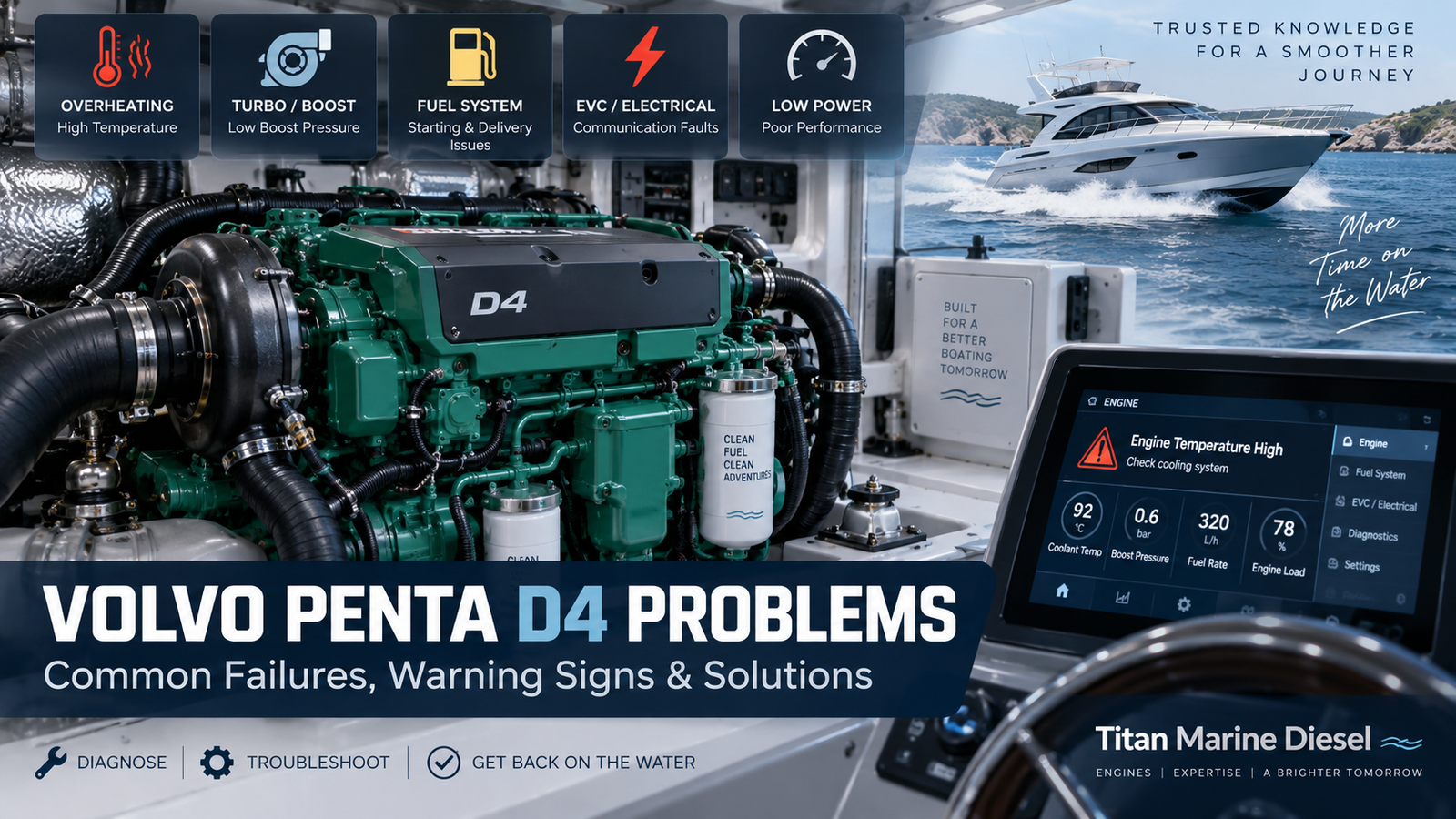
Volvo Penta D4 Problems – Common Failures, Warning Signs & Solutions Owners Should Know
A Volvo Penta D4 can run beautifully for years, and then one small change gets your attention.
Maybe the boat is suddenly slower getting onto plane.
Maybe the engine that normally reaches its expected RPM stops several hundred revolutions short.
Maybe you see black smoke behind the boat.
Or perhaps the EVC display gives you an alarm, and now every expensive component in the engine room starts running through your mind.
Turbo? Injectors? Common-rail pump? Major engine failure?
Not necessarily.
A useful example is a composite of the kind of D4 enquiries marine suppliers and technicians regularly receive: an owner reports that his boat has suddenly lost power, produces black smoke, and no longer reaches normal maximum RPM. He is convinced the Volvo Penta D4 turbo has failed.
That is certainly possible.
But those same symptoms could also be caused by a loose charge-air hose, restricted air flow, fouled propellers, a fuel-delivery issue, excessive hull growth, an EVC derate condition, or another problem that prevents the engine from receiving enough air or shedding the load being placed on it.
The symptom tells you where to start looking.
It does not automatically tell you which part to buy.
That principle is going to run through this entire guide.
At Titan Marine Diesel, we believe the most useful way to approach Volvo Penta D4 problems is not to create a scary list of expensive failures. It is to help owners separate symptoms from causes.
Because there is a major difference between:
“My D4 has low boost.”
and:
“My D4 needs a new turbocharger.”
The first is an observation.
The second is a diagnosis.
You need evidence before moving from one to the other.
The Volvo Penta D4 is a four-cylinder marine diesel platform that has appeared across multiple generations, power ratings, electronic-control configurations and propulsion packages. Volvo Penta’s own current and remanufacturing documentation lists D4 variants ranging across multiple ratings, including D4-145, D4-175, D4-230, D4-270, D4-300, and D4-320 G-generation versions, while earlier D4-260 and D4-300 variants are also documented.
That matters because a Volvo Penta D4-260 problem should not automatically be diagnosed using information written for a later D4-320 installation.
Engine generation matters.
Serial number matters.
The gearbox or drive matters.
And sometimes what looks like an engine fault is actually a problem with the boat surrounding the engine.
This guide will cover common Volvo Penta D4 problems, including:
- Overheating
- Raw-water and impeller problems
- Heat-exchanger restrictions
- Volvo Penta D4 turbo problems
- Supercharger problems
- Black, white and blue smoke
- Fuel-pressure and common-rail faults
- Injector problems
- Hard starting
- EVC and electrical problems
- Sensor faults
- Low power
- Failure to reach full RPM
- Limp mode or derate
- Exhaust restrictions
- Oil and coolant leaks
- DPH/DPI drive problems
- Used-engine inspection
- Repair versus repower decisions
But first, we need to answer the question most owners searching this topic actually have.
What Are the Most Common Volvo Penta D4 Problems?
Quick answer: The most common areas to investigate when a common Volvo Penta engine problems are the cooling and raw-water system, fuel supply and common-rail system, turbo/supercharger and charge-air system, EVC/electrical system, sensors, and excessive engine load caused by propeller, hull or drive problems.
Typical symptoms include:
- Volvo Penta D4 overheating
- Reduced seawater flow
- Low boost
- Black smoke
- Failure to reach full RPM
- Hard starting
- Fuel-pressure alarms
- EVC warnings
- Engine derate
- High fuel consumption
- Coolant loss
- Oil leaks
- Poor acceleration
That does not mean every D4 will suffer these failures.
It means these are important diagnostic areas when one of those symptoms appears.
That distinction matters for trustworthiness.
People naturally post online when something goes wrong. They rarely start a forum thread saying:
“My Volvo Penta D4 ran perfectly again today.”
So the visibility of a failure online should never automatically be treated as proof that the failure is statistically common across the entire engine population.
This article focuses on symptoms, likely causes and logical troubleshooting, not exaggerated claims that every D4 suffers the same defects.
First, Understand Which Volvo Penta D4 You Own
Before diagnosing a D4, identify it properly.
This is one of the easiest ways to avoid bad technical advice.
D4 Models Have Changed Over Time
The D4 family has been produced in multiple versions.
Volvo Penta’s remanufacturing documentation, for example, lists earlier variants such as:
alongside later G-generation variants including:
- D4-150A-G
- D4-175I-G
- D4-230A-G
- D4-230I-G
- D4-270A-G
- D4-270I-G
- D4-300A-G
- D4-300I-G
- D4-320A-G
- D4-320I-G
Current Volvo Penta North American emissions documentation also lists G-generation D4 ratings including 145, 175, 230, 270, 300 and 320 hp configurations.
Why does this matter?
Because parts, controls, service procedures and even maintenance kits can differ according to generation.
Volvo Penta’s own maintenance catalog separates D4/D6 A-F through model year 2019 from D4/D6 G from model year 2020 onward.
That is strong evidence that you should never treat “D4” as one completely identical product across every production year.
Inboard D4 vs Aquamatic D4
You also need to know how the engine is installed.
A conventional inboard D4 coupled to a marine gearbox is not the same propulsion system as a D4 paired with an Aquamatic sterndrive.
This becomes important when the owner reports symptoms such as:
- Failure to reach RPM
- Vibration
- Poor acceleration
- Shift problems
- Steering faults
- Propeller issues
- EVC warnings
Sometimes the engine is blamed when the real issue is farther downstream.
The drive, props, gearbox, steering system or vessel load can all affect how the engine behaves.
Find the Serial Number Before Serious Diagnosis
Before ordering expensive parts or relying on a technical manual, collect:
- Exact D4 designation
- Product number
- Serial number
- Engine hours
- EVC generation if known
- Gearbox or drive model
- Gear ratio if applicable
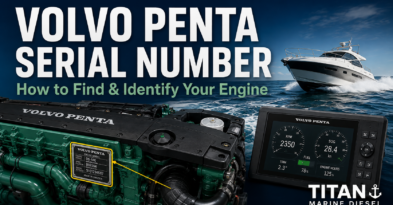
If you have already published the Titan Marine Diesel serial-number guide, this is a natural place to link to How to Find Your Volvo Penta Serial Number and Identify Your Engine Correctly.
The serial number is not administrative trivia.
It is part of the diagnosis.
The Titan Marine Diesel D4 Five-System Diagnostic Framework
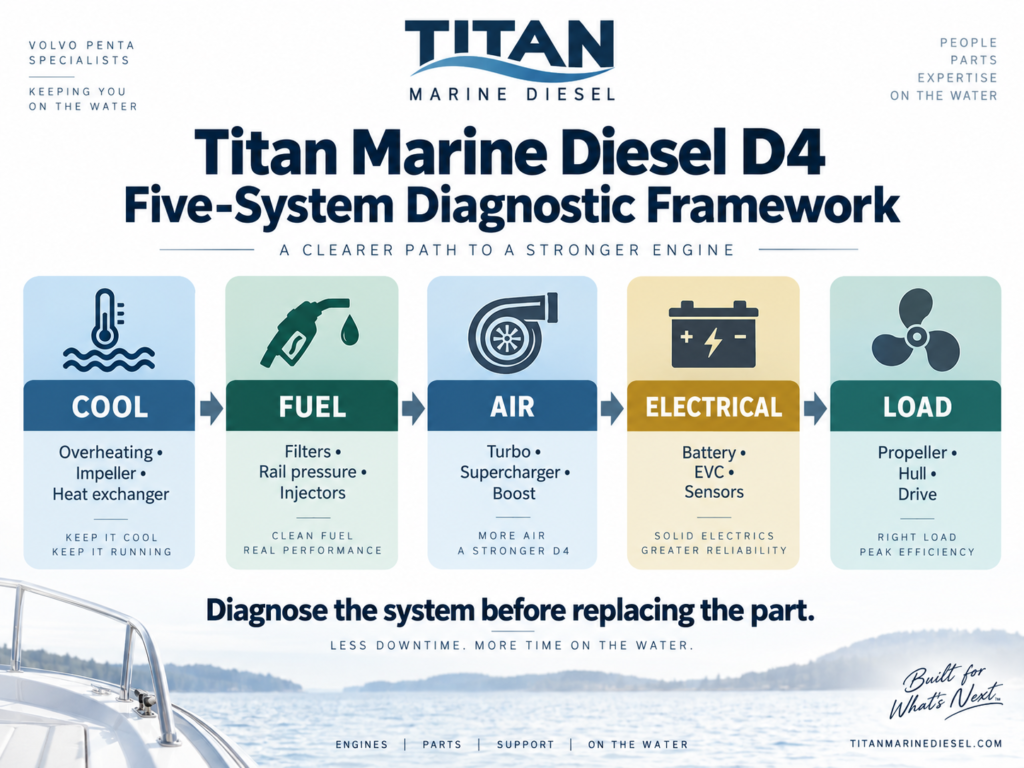
When a D4 starts behaving differently, we recommend thinking through five systems before firing the parts cannon.
COOL → FUEL → AIR → ELECTRICAL → LOAD
Most Volvo Penta D4 troubleshooting complaints can be placed somewhere in this framework.
1. COOL — Cooling and Seawater System
Think COOL when you see:
- High coolant temperature
- Overheat alarm
- Exhaust-temperature warning
- Steam
- Reduced seawater flow
- Temperature rising under load
Possible areas include:
- Seacock
- Raw-water intake
- Strainer
- Impeller
- Seawater pump
- Heat exchanger
- Coolant circuit
- Thermostat
- Exhaust cooling
2. FUEL — Fuel Supply and Common Rail
Think FUEL when you see:
- Hard starting
- Hesitation
- Rail-pressure fault
- Derate
- Engine shutdown
- Poor acceleration
Follow the fuel logically:
Tank → Pickup → Primary Filter → Lines → Secondary Filter → Feed System → Common Rail
Do not jump straight to the most expensive component.
3. AIR — Intake, Supercharger, Turbo and Exhaust
Think AIR when you see:
- Volvo Penta D4 black smoke
- Low boost
- Slow acceleration
- Poor planing performance
- Low maximum RPM
Check the complete breathing system.
On applicable D4/D6 propulsion packages, Volvo Penta describes the supercharger as providing low-end torque before the turbocharger takes over at higher RPM.
That means acceleration and high-RPM performance can tell you different things.
4. ELECTRICAL — Battery, EVC, Sensors and Wiring
Think ELECTRICAL when you see:
- Multiple alarms
- Intermittent faults
- No-start condition
- Displays restarting
- Lost helm control
- Implausible sensor readings
Modern electronic engines need stable voltage and clean communication.
A loose ground can look far more dramatic on the display than it does when you physically inspect it.
5. LOAD — Hull, Propeller and Drive
This is the system owners forget.
Think LOAD when you see:
- Low maximum RPM
- Black smoke
- Higher fuel consumption
- Poor acceleration
- Engine struggling under load
Possible causes include:
- Fouled propeller
- Rope around the prop
- Damaged blades
- Marine growth on the hull
- Excessive vessel weight
- Incorrect propeller
- Drive problem
And this brings us to one of the most important contrarian insights in the article:
Not every Volvo Penta D4 problem is inside the Volvo Penta D4.
The engine may be doing exactly what physics forces it to do when the boat asks for more torque than the propulsion system can efficiently deliver.
Before condemning an injector, turbo or common-rail pump, make sure the engine itself is actually the source of the complaint.
Volvo Penta D4 Overheating Problems
Volvo Penta D4 overheating deserves its own section because cooling problems on marine diesels can escalate quickly.
Unlike an automotive engine, a marine diesel relies heavily on seawater to remove heat from the propulsion system.
That means the engine has two cooling worlds working together:
- The internal freshwater/coolant circuit
- The external raw-water circuit
A problem in either can push the engine temperature upward.
Common Causes of Volvo Penta D4 Overheating
Start with the obvious and work inward.
Possible causes include:
- Blocked seawater intake
- Closed or partially closed seacock
- Clogged raw-water strainer
- Damaged seawater-pump impeller
- Broken impeller blades lodged downstream
- Heat-exchanger restriction
- Low coolant
- Coolant leak
- Thermostat problem
- Circulation-pump problem
- Hose restriction
- Exhaust-side restriction
- Excessive engine load
The order matters.
If the engine was running perfectly yesterday and overheats today after passing through heavy weed, checking the raw-water intake and strainer makes more sense than immediately replacing a thermostat.
D4 Overheats Only at High RPM
This symptom is especially useful.
Suppose the engine remains at normal temperature around the harbor.
Then you bring the boat onto plane and the temperature begins climbing.
That often suggests that the cooling system can cope with low heat load, but cannot remove enough heat once engine output increases.
Possible reasons include:
- Restricted seawater flow
- Partially damaged impeller
- Fouled heat exchanger
- Restricted exhaust water flow
- Excessive propulsion load
The fact that the engine behaves normally at idle does not prove the cooling system is healthy.
It may simply mean the problem is not severe enough to reveal itself until demand increases.
D4 Overheats at Idle
Overheating at idle can point the investigation in a somewhat different direction.
Potential causes include:
- Severe raw-water restriction
- No seawater flow
- Coolant circulation issue
- Closed seacock
- Significant airlock
- Failed pump
- Sensor or wiring problem
Again, use evidence.
Is the displayed temperature believable?
Is seawater flowing?
Is coolant actually hot?
Never dismiss an overheating alarm as a sensor fault until the physical engine temperature has been verified safely.
Safe First Checks for D4 Overheating
If conditions permit and you can inspect safely:
- Reduce engine load.
- Check the seawater strainer.
- Verify the seacock is open.
- Look for obvious coolant or seawater leaks.
- Observe whether seawater discharge appears abnormal where your installation makes this safely visible.
- Allow the engine to cool before checking coolant level.
- Inspect the impeller if the symptoms point toward raw-water loss.
Do not remove a hot pressurized coolant cap.
And do not keep running an overheating engine simply because the boat is still moving.
When Should You Shut the D4 Down?
Stop as soon as vessel safety allows if you have:
- A serious overheat alarm
- Rapidly rising temperature
- Steam
- Major coolant loss
- Abnormal mechanical noise
- Clear loss of cooling-water flow
The cost of towing is usually easier to accept than the cost of a cylinder head, piston or turbocharger damaged by severe overheating.
Volvo Penta D4 Raw-Water Pump and Impeller Problems
The Volvo Penta D4 impeller is a small component with a very large job.
The flexible impeller inside the seawater pump moves cooling water through the raw-water side of the engine.
If it loses blades, hardens with age or cannot create enough flow, cooling performance suffers.
Volvo Penta’s own maintenance documentation includes dedicated D4 impeller kits and identifies the impeller as one of the routine maintenance components in D4 maintenance kits. The catalog also distinguishes D4 impeller/maintenance components across earlier A-F engines and later G-generation engines, which reinforces why exact engine identification matters.
Warning Signs of a D4 Impeller Problem
Possible signs include:
- Temperature increasing under load
- Reduced raw-water flow
- Overheat alarm
- Sudden cooling problem after storage
- Damaged or missing vanes during inspection
An impeller does not have to disintegrate completely to create a problem.
A partially damaged impeller may still move enough water at idle but fail to meet cooling demand at higher RPM.
That can create the classic:
“It runs cool in the marina but overheats on plane.”
Where Do Broken Impeller Blades Go?
This is the part people sometimes miss.
If pieces are missing from the old impeller, they did not disappear.
They may have moved downstream into:
- Hoses
- Cooler passages
- Heat-exchanger entry points
- Other restrictions in the raw-water path
Installing a new impeller without locating significant missing pieces can leave you with a new impeller and the same cooling problem.
How Often Should a D4 Impeller Be Replaced?
Use the service schedule for your exact engine and installation rather than a universal internet interval.
Volvo Penta itself tells owners to refer to the operator manual for the recommended maintenance and service intervals for the specific engine and drive.
Calendar time matters too.
A boat with low annual hours can still have an ageing rubber impeller.
That is one reason “low hours” does not automatically mean “no maintenance required.”
Volvo Penta D4 Heat Exchanger and Cooling-System Problems
If raw-water flow is good but the engine still struggles to control temperature under load, the Volvo Penta D4 heat exchanger becomes another area to investigate.
The heat exchanger transfers engine heat from the freshwater coolant circuit into the raw-water circuit.
If heat cannot transfer efficiently, temperature climbs.
Marine Growth and Internal Restriction
On the seawater side, restrictions can develop from:
- Marine growth
- Debris
- Salt deposits
- Scale
- Pieces of damaged impeller
- General fouling
Even partial restriction can matter when the engine is operating at high load.
Coolant-Side Problems
The freshwater side can also suffer from:
- Incorrect coolant
- Degraded coolant
- Deposits
- Air
- Internal contamination
- Circulation problems
The result may be a system that appears perfectly adequate during light operation but cannot reject heat under sustained power.
Symptoms of Poor Heat Transfer
Watch for a pattern such as:
- Normal temperature at idle
- Normal low-speed operation
- Gradual temperature rise at cruise
- Faster rise at high load
- Temperature returning toward normal when throttle is reduced
That pattern does not prove the heat exchanger is restricted.
But it strongly suggests the cooling system should be evaluated under load rather than only at the dock.
Cleaning or Replacing the Heat Exchanger
Do not automatically replace the heat exchanger because the engine is hot.
First establish:
- Raw-water flow
- Coolant condition
- Thermostat operation
- Circulation
- Actual temperature
- Engine loading
Once restriction or deterioration has been confirmed, cleaning, servicing or replacement can be considered according to the condition of the unit and applicable Volvo Penta service procedures.
That is the theme throughout this guide:
Diagnose first. Replace second.
Volvo Penta D4 Turbo Problems
If your D4 suddenly loses power, struggles to reach normal RPM, or starts blowing black smoke, the turbocharger is going to be high on the suspect list.
Sometimes that is correct.
Sometimes it is not.
The Volvo Penta D4 turbo is part of a larger air-management system. Low boost can be caused by the turbo itself, but it can also come from leaks, restrictions, sensors, exhaust problems, or excessive engine load.
That is why “low boost” should be treated as a symptom.
Not a final diagnosis.
Symptoms of Volvo Penta D4 Turbo Problems
Common warning signs can include:
- Reduced maximum RPM
- Poor acceleration
- Difficulty getting onto plane
- Volvo Penta D4 black smoke
- Low boost-pressure readings
- Unusual turbo noise
- Oil around turbo plumbing
- Loss of power under load
A seized or damaged turbocharger can absolutely create these symptoms.
But so can a loose hose clamp.
That is why the first inspection should not begin with ordering a turbo.
Why Marine Turbochargers Can Develop Problems
Marine engines live in a difficult environment.
Salt-laden air, moisture, long periods of inactivity, hot exhaust gases, and corrosion can all contribute to deterioration over time.
A boat that sits for months between operating periods can also develop problems very differently from a commercial vessel running every day.
This matters because owners often assume:
“Low engine hours mean the turbo must be almost new.”
Not necessarily.
Calendar age and operating environment matter too.
A 15-year-old turbocharger with 300 hours has still spent 15 years in a marine environment.
Low Boost Does Not Automatically Mean a Failed Turbo
Before condemning the turbocharger, investigate:
- Charge-air hoses
- Hose clamps
- Intake restriction
- Charge-air cooler
- Boost-pressure sensor
- Exhaust restriction
- Engine load
- Propeller condition
Imagine the turbo is producing the air correctly, but a charge-air hose has split.
The air escapes before it reaches the engine.
The result?
- Lower boost
- Black smoke
- Reduced power
- Poor acceleration
The turbo may be perfectly healthy.
This is another example of why the AIR portion of our five-system framework should be diagnosed as a system.
Can You Keep Running a D4 With Low Boost?
It depends on the cause and severity, but sustained operation with significant low boost and black smoke is not something to ignore.
Black smoke means the engine is generally receiving more fuel than the available air can burn cleanly.
That can contribute to:
- Higher exhaust temperature
- Carbon buildup
- Poor efficiency
- Increased engine load
- Potential turbo or exhaust stress
If the engine suddenly loses substantial power or produces persistent heavy smoke, reduce load and diagnose the cause.
Volvo Penta D4 Supercharger Problems
Some D4 configurations use a supercharger to improve low-RPM torque and acceleration before the turbocharger becomes dominant at higher engine speed.
This is important because a supercharger issue can create a very different performance pattern from a turbocharger issue.
What the Supercharger Does
On applicable D4/D6 configurations, the supercharger supports low-end torque and acceleration, while the turbocharger takes over as RPM increases.
That means the supercharger can be especially important when:
- Accelerating from displacement speed
- Getting a planing boat onto plane
- Carrying a heavy load
- Moving through the transition RPM range
Symptoms of D4 Supercharger Problems
Possible symptoms can include:
- Sluggish acceleration
- Difficulty getting onto plane
- Flat performance at lower or mid RPM
- Abnormal engagement behavior
- Power improving once the turbo becomes fully effective
The exact behavior depends on the engine generation and system configuration.
Not every D4 uses the same air-management arrangement, which is another reason the engine serial number matters.
Supercharger vs Turbo Problems
One useful clue is when the problem appears.
If acceleration is weak at low RPM but the engine performs better once RPM rises, the supercharger system deserves attention.
If performance is good initially but boost falls at higher load, the investigation may shift toward:
- Turbocharger
- Charge-air leaks
- Exhaust restriction
- Fuel delivery
- Excessive vessel load
Use the symptom pattern.
Do not diagnose from the component name alone.
Volvo Penta D4 Black Smoke
Black smoke is one of the most useful clues a diesel engine can give you.
It usually means the engine has too much fuel for the amount of air available—or the engine is being loaded so heavily that combustion cannot remain clean.
That does not automatically mean “bad injectors.”
Possible causes include:
- Low boost
- Turbocharger problem
- Charge-air leak
- Intake restriction
- Supercharger problem
- Injector/fueling issue
- Propeller overload
- Fouled hull
- Excessive vessel weight
- Exhaust restriction
Black Smoke Only During Acceleration
A brief puff during rapid acceleration can be very different from continuous heavy smoke.
When throttle is applied quickly, fueling rises faster than airflow can sometimes respond.
But persistent black smoke through the acceleration range deserves investigation.
Ask:
- Does the engine eventually clear up?
- Does boost increase normally?
- Does the engine reach rated RPM?
- Is the vessel slower than usual?
Those details help separate normal transient behavior from a real problem.
Black Smoke + Low RPM
This combination deserves attention.
If the engine:
- Cannot reach normal RPM
- Produces heavy black smoke
- Feels overloaded
then think first about AIR and LOAD.
Possible causes include:
- Low boost
- Fouled propeller
- Excessive pitch
- Hull fouling
- Drive problem
- Charge-air leak
This is a good example of why the engine should not be blamed too quickly.
A badly fouled propeller can make a perfectly healthy D4 behave like a sick engine.
Black Smoke on One Engine in a Twin Installation
Twin-engine boats give you something very useful:
A built-in comparison engine.
If one D4:
- Reaches normal RPM
- Has normal boost
- Runs cleanly
while the other:
- Smokes
- Runs lower RPM
- Has reduced boost
then compare the two systematically.
Look at:
- Boost pressure
- Coolant temperature
- RPM
- Fuel consumption
- Smoke
- Acceleration
Do not randomly swap components between engines unless the service procedure supports doing so.
The healthy engine is a reference point—not a donor bin.
Volvo Penta D4 White Smoke
White smoke can have several meanings.
That is why you need to look at when it appears and what it smells like.
Possible causes include:
- Cold combustion
- Unburned diesel
- Injector issue
- Low compression
- Coolant entering combustion
- Startup conditions
White Smoke on Cold Start
Some white vapor during a cold start can be related to incomplete combustion while the engine warms.
But if the smoke:
- Continues after warm-up
- Smells strongly of diesel
- Is accompanied by rough running
then look more closely at combustion quality, injectors, compression, and fuel delivery.
White Smoke vs Steam
Steam can look like white smoke.
If the engine is overheating or the exhaust cooling system is malfunctioning, water vapor can create a very different situation from unburned diesel.
Context matters.
Ask:
- Is coolant temperature high?
- Is coolant disappearing?
- Does the exhaust smell like fuel?
- Does the engine run smoothly?
These clues help separate combustion smoke from water vapor.
Volvo Penta D4 Blue Smoke
Blue smoke usually suggests engine oil is entering the combustion process.
Possible causes include:
- Turbocharger oil leakage
- Excess oil level
- Crankcase ventilation issue
- Cylinder/ring wear
- Valve-related oil consumption
Occasional Puff vs Continuous Blue Smoke
A small transient puff and continuous blue smoke are not the same.
Persistent blue smoke under load deserves investigation, especially if accompanied by:
- Falling oil level
- Oily exhaust residue
- Increased blow-by
- Reduced compression
- Turbo oil leakage
Do not assume the turbo has failed simply because there is oil around the intake side.
Oil can migrate through crankcase ventilation or other pathways.
Again:
Condition → system → component.
Volvo Penta D4 Fuel-System and Common-Rail Problems
The D4’s fuel system is one of the places where troubleshooting can become expensive very quickly.
That is exactly why the diagnostic order matters.
The rule is:
Start with the low-cost supply side before condemning the high-pressure side.
Think through fuel flow from beginning to end:
Tank → Pickup → Primary Filter → Fuel Line → Secondary Filter → Feed System → Common Rail → Injectors
If the fuel cannot reach the high-pressure pump properly, the common rail cannot maintain pressure.
That does not automatically make the high-pressure pump defective.
Clogged Fuel Filters
A restricted filter can create:
- Low power
- Hard starting
- Hesitation
- Fuel-pressure alarms
- Engine derate
- Failure to reach full RPM
The filter may allow enough fuel for idle but not enough for high-load operation.
This creates a very similar pattern to a partially restricted cooling system:
Everything looks fine at low demand.
Then the problem appears when the engine asks for more.
Air Entering the Fuel System
Air can enter through:
- Loose filter
- Damaged O-ring
- Poor hose connection
- Leaking fitting
- Improper filter installation
Symptoms can include:
- Long cranking
- Uneven running
- Poor acceleration
- Engine stopping
- Difficult restart
If the problem begins immediately after fuel-filter service, check the work that was just performed before assuming an internal engine failure.
Water or Contaminated Diesel
Modern common-rail fuel systems require clean fuel.
Contamination can lead to:
- Filter blockage
- Corrosion
- Injector problems
- High-pressure component damage
- Rough running
- Poor starting
If water repeatedly appears in the separator, draining it is not enough.
Find the source.
Possible causes include:
- Contaminated fuel delivery
- Tank condensation
- Damaged fill seal
- Water intrusion
High-Pressure Fuel Pump Problems
A genuine high-pressure pump fault can create:
- Rail-pressure errors
- No-start
- Derate
- Poor performance
- Engine shutdown
But this is where professional diagnostics become important.
Before replacing an expensive pump, verify:
- Low-pressure fuel supply
- Filter condition
- Air leaks
- Pressure sensor circuit
- Actual rail-pressure data
The code may report pressure.
It does not tell you which part of the pressure system caused the problem.
Volvo Penta D4 Injector Problems
Possible signs of injector trouble include:
- Rough idle
- Hard starting
- Excessive smoke
- Poor fuel economy
- Cylinder imbalance
- Uneven exhaust note
But smoke alone is not enough to condemn injectors.
Black smoke can be caused by low boost.
White smoke can be caused by poor combustion.
A rough cylinder can be caused by compression or electrical issues.
Injectors should be tested using appropriate diagnostic procedures rather than replaced because an internet post says “D4s need injectors.”
Volvo Penta D4 Hard Starting or No-Start Problems
A D4 that will not start needs to be divided into categories.
The first question is simple:
What exactly happens when you try to start it?
Cranks Normally but Will Not Start
If the starter spins the engine at normal speed but it does not fire, investigate:
- Fuel supply
- Air in the fuel system
- Rail pressure
- Fuel contamination
- EVC authorization
- Engine-speed sensors
- Other engine-management inputs
Do not overlook recent service work.
A fuel system opened yesterday and a no-start today are probably related until proven otherwise.
Cranks Slowly
If the engine turns over slowly, start with ELECTRICAL.
Check:
- Battery condition
- Battery voltage under load
- Terminals
- Grounds
- Starter cables
- Starter motor
A modern common-rail diesel may crank but still fail to start if cranking speed or voltage is too low for the control and injection systems to operate correctly.
Completely Dead at the Helm
If nothing happens at all, possible areas include:
- Battery isolation
- Main fuse
- EVC supply
- Control-panel power
- Harness connection
- Ground
- Helm control/network issue
This is where owners often jump to:
“The ECU is dead.”
Maybe.
But power supply must be verified first.
A dead control module and a healthy control module with no power can look identical from the helm.
Volvo Penta D4 EVC and Electrical Problems
Modern D4 installations depend heavily on electronic control.
That provides excellent monitoring and control—but it means battery and wiring condition matter more than many owners expect.
Low Battery Voltage
Low voltage can produce symptoms such as:
- Multiple EVC alarms
- Display resets
- Intermittent controls
- Difficult starting
- Shift problems
- Communication errors
A battery can show an acceptable resting voltage and still collapse under load.
Test the system under realistic operating conditions.
Alternator and Charging Problems
A charging problem may show up as:
- Falling voltage while underway
- Battery alarm
- Intermittent EVC faults
- Batteries repeatedly discharged
Check:
- Alternator output
- Belt condition
- Charging cables
- Connections
- Grounds
Corroded Grounds and Connectors
Marine environments punish electrical connections.
Salt, humidity, vibration, and temperature cycles can create:
- Corrosion
- Increased resistance
- Intermittent contact
- Water intrusion
This is why an electrical problem may disappear at the dock and return when the boat hits rough water.
Vibration changes the connection.
EVC Communication Faults
A Volvo Penta D4 EVC problem may involve:
- Battery supply
- Ground
- Network connection
- Helm control
- Sensor communication
- Control module
- Harness
If several faults appear together, look for a shared cause.
One voltage or ground problem can create multiple downstream alarms.
Internal link opportunity:
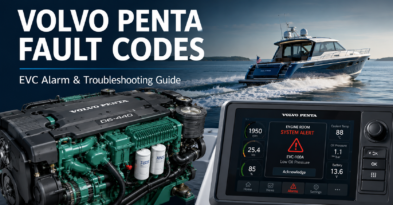
Volvo Penta Fault Codes Explained: Complete EVC Alarm & Troubleshooting Guide
Volvo Penta D4 Sensor Problems
Modern engine management depends on sensors to tell the ECU what is happening.
Possible monitored values include:
- Temperature
- Pressure
- Boost
- Oil pressure
- Fuel pressure
- Engine speed
A sensor fault can be caused by:
- Failed sensor
- Open circuit
- Short circuit
- Damaged wiring
- Poor connector
- Reference-voltage problem
Implausible Readings
One useful clue is plausibility.
If coolant temperature goes from normal to an impossible value instantly, that may suggest:
- Sensor
- Wiring
- Connector
rather than a physical engine that heated instantly.
But “may” matters.
Verify the real engine condition before dismissing a serious warning.
Test Wiring Before Replacing the Sensor
This follows the earlier Titan Marine Diesel 3C logic:
Condition → Circuit → Component
If a sensor has no proper power or signal path, replacing the sensor does not repair the circuit.
Intermittent Sensor Faults
Intermittent faults can be caused by:
- Heat
- Vibration
- Moisture
- Connector corrosion
- Harness movement
Record when the fault happens.
That pattern is diagnostic information.
Volvo Penta D4 Low Power or Won’t Reach Full RPM
This is one of the most important sections of the entire article.
If a D4 cannot reach normal full-load RPM, do not immediately assume the engine has lost horsepower.
Ask:
Is the engine failing to produce power, or is the boat absorbing too much power?
That distinction is huge.
Engine-Side Causes
Possible engine-side problems include:
- Fuel restriction
- Low rail pressure
- Low boost
- Turbo/supercharger issue
- Charge-air leak
- Sensor fault
- Engine derate
Boat-Side Causes
Possible vessel/load causes include:
- Fouled hull
- Fouled propeller
- Rope or fishing line
- Damaged propeller
- Excess vessel weight
- Incorrect propeller
- Drive problem
This is the LOAD portion of the framework.
And it is the reason we say:
Not every D4 problem is inside the D4.
Why Testing at the Dock Can Mislead
An engine can rev normally in neutral and still fail badly under load.
Why?
Because neutral operation places relatively little propulsion load on the engine.
The real test is under operating load.
That is where:
- Fuel demand rises
- Boost demand rises
- Cooling demand rises
- Propeller load becomes significant
An engine that sounds perfect at the dock can still have a serious high-load problem.
Twin-Engine Comparison
On a twin-D4 vessel, compare:
- Maximum RPM
- Boost
- Coolant temperature
- Fuel burn
- Smoke
- Acceleration
If one engine behaves normally and the other does not, that gives you valuable evidence.
But remember that each propeller and drive can also have its own problem.
A propeller wrapped with line on one side can make that engine look mechanically weak.
Volvo Penta D4 Limp Mode / Derate
If your D4 suddenly refuses to rev normally after an alarm, it may be in derate mode.
Owners often call this “limp mode.”
What Derate Means
Derate is a protective strategy where the engine-management system reduces available power because it has detected a potentially harmful condition.
Possible triggers include:
- High temperature
- Fuel-pressure fault
- Sensor fault
- Electrical issue
- EVC problem
- Other engine-protection conditions
Derate Is Not the Fault
This deserves repeating:
Derate is what the engine does because something else is wrong.
If the D4 limits power because fuel pressure is low, removing the power limitation does not restore fuel pressure.
If the engine derates because it is overheating, forcing it to run harder would make the situation worse.
Fix the cause.
Then verify that normal operation returns.
Why Clearing the Alarm Does Not Fix the Problem
A restart may make the warning disappear temporarily.
That does not prove the fault is gone.
Before clearing codes, record:
- Exact code
- Alarm text
- RPM
- Temperature
- Voltage
- Operating conditions
That evidence may be extremely useful if the problem becomes intermittent.
Internal link opportunity:
Volvo Penta Fault Codes Explained
Volvo Penta D4 Exhaust Problems
The exhaust system is part of engine performance.
A restricted or poorly cooled exhaust can affect:
- Boost
- Temperature
- Power
- Turbocharger operation
Exhaust Elbow or Mixing Section
Marine exhaust components work in a hostile environment.
They see:
- Hot exhaust gas
- Cooling water
- Salt
- Corrosion
- Deposits
Restrictions or deterioration should therefore be considered when symptoms point toward the exhaust side.
Excessive Exhaust Backpressure
Excessive backpressure can contribute to:
- Poor turbo performance
- Reduced power
- Elevated exhaust temperature
- Difficulty reaching RPM
This can look surprisingly similar to an air-intake or turbo problem.
The engine has to breathe in and breathe out.
Both sides matter.
Water Intrusion Risk
Any concern about water entering the engine through the exhaust requires careful professional assessment.
Water ingestion can cause severe internal damage.
Do not repeatedly crank an engine suspected of having water in a cylinder.
Volvo Penta D4 Oil Leaks and Oil Consumption
An oil leak should be traced before assuming the worst.
Possible inspection areas include:
- Filters
- Hoses
- Seals
- Turbo oil supply/return
- Crankcase ventilation
- Connections disturbed during service
Oil Around the Turbo
Oil around turbo plumbing does not automatically prove turbo seal failure.
Possible sources can include:
- Crankcase ventilation
- Hose connections
- Oil supply or return lines
- External leakage
Find the source before replacing the turbocharger.
Rising vs Falling Oil Level
This is an excellent diagnostic clue.
Falling oil level can suggest:
- External leakage
- Oil consumption
- Turbo-related oil loss
- Internal burning
Rising oil level can be even more concerning because it may indicate contamination or fuel dilution.
Do not assume “more oil” is a good thing.
If the level rises unexpectedly, investigate why.
Volvo Penta D4 Coolant Leaks
Coolant should remain within a closed cooling system.
If the level keeps dropping, the question is:
Where is it going?
External Coolant Leak
Inspect:
- Hoses
- Clamps
- Expansion tank
- Heat exchanger
- Pump
- Connections
Look for dried coolant residue as well as active dripping.
Repeated Coolant Loss
Do not keep topping up the system without locating the cause.
Repeated coolant loss can indicate:
- External leak
- Heat-exchanger issue
- Internal loss
- Cap/pressure problem
Coolant in Engine Oil
Milky or emulsified oil can indicate water or coolant contamination.
If suspected, stop operation and investigate before continuing to run the engine.
Coolant Smell or Residue
A sweet coolant smell in the engine room or dried colored residue can help locate a small leak before it becomes a major one.
DPH and DPI Drive Problems That Owners Mistake for D4 Engine Problems
One of the easiest diagnostic mistakes to make is blaming the D4 for something happening after the flywheel.
If your boat has a Volvo Penta Aquamatic installation, the engine, sterndrive, steering, controls, and propellers work as one propulsion system.
Volvo Penta’s DPI package integrates the engine with the sterndrive, hydraulic clutch, electric steering, and electronic controls. (volvopenta.com)
So when performance changes, diagnose the whole package.
Propeller Damage or Fouling
A damaged or fouled propeller can cause:
- Reduced maximum RPM
- Poor acceleration
- Vibration
- Higher fuel consumption
- Increased engine load
- Black smoke
A rope around one propeller on a twin-engine boat can make one perfectly healthy D4 appear weak.
That is why the LOAD part of our framework matters.
Drive Steering or Shift Problems
Symptoms such as difficult shifting, abnormal steering behavior, or propulsion-control alarms may originate in:
- Drive system
- Hydraulic clutch
- Steering
- EVC
- Electrical supply
They should not automatically be classified as Volvo Penta D4 engine problems.
Why the Engine and Drive Must Be Diagnosed Separately
Ask two questions:
Is the engine producing the expected power?
And:
Is the propulsion system successfully transferring that power into the water?
Those are different questions.
Is the Volvo Penta D4 a Reliable Engine?
Short answer: A correctly specified, properly maintained Volvo Penta D4 can provide dependable marine service. Reliability depends heavily on engine generation, maintenance history, operating load, fuel quality, cooling-system condition, electrical health, and how the boat is used.
That is a more useful answer than saying:
“The D4 is bulletproof.”
Or:
“The D4 is unreliable.”
Neither statement is technically responsible.
Why Internet Searches Can Distort D4 Reliability
Search for Volvo Penta D4 reliability and you will naturally find failures.
That is partly because people search and post when something goes wrong.
Very few owners open a forum thread titled:
“My D4 started immediately, ran at normal temperature, reached full RPM, and got me home again.”
This creates what we might call failure visibility bias.
A heavily discussed problem is not automatically a statistically common failure across every D4 ever produced.
Maintenance History Matters More Than Forum Reputation
When evaluating an individual D4, we would rather see:
- Correct service history
- Known cooling-system maintenance
- Clean fuel-system records
- Proper WOT RPM
- Stable operating temperature
- Diagnostic history
- Clean oil
- Documented drive servicing
than hear that “someone online said D4s are good.”
Judge the engine in front of you.
Volvo Penta D4 Problems by Engine Hours
Owners frequently ask:
“At how many hours do D4 problems start?”
There is no responsible universal answer.
Engine hours are only one part of condition.
Low-Hour D4 Engines
Low hours sound attractive, but low-use engines can still suffer from:
- Calendar-based maintenance neglect
- Battery deterioration
- Fuel degradation
- Corrosion
- Old impellers
- Long-term moisture exposure
Mid-Life D4 Engines
As hours and age accumulate, inspection should increasingly focus on:
- Cooling-system cleanliness
- Fuel-system condition
- Turbo performance
- Electrical connections
- Drive maintenance
- Deferred service
High-Hour D4 Engines
A higher-hour engine should be evaluated using evidence rather than rejected automatically.
Useful checks can include:
- Compression where justified
- Injector performance
- Turbo condition
- Oil analysis
- Blow-by
- Cooling-system performance
- Service records
- Diagnostic scan
A professionally maintained commercial engine can sometimes be a better proposition than a low-hour recreational engine that has sat neglected for years.
Problems Caused by Low Use and Long Storage
Here is another useful contrarian idea:
Low hours do not always mean low wear risk.
A 15-year-old D4 with 300 hours is still 15 years old.
Turbo Corrosion
Long periods of inactivity can expose turbo and exhaust components to moisture and corrosion without regularly bringing the system to full operating temperature.
Fuel Degradation
Stored diesel can develop contamination issues, including water and biological growth under unfavorable conditions.
Battery Deterioration
Batteries age even when the engine is not running.
And weak voltage can produce Volvo Penta D4 EVC problems that look much more serious than the underlying battery fault.
Impeller Aging
Rubber components age by calendar time as well as operating hours.
A low-hour engine can still have an old impeller.
Corrosion
Marine engines live around humidity and salt.
Electrical connectors, exhaust components, coolers, and hardware can deteriorate while the hour meter barely moves.
How to Prevent Common Volvo Penta D4 Problems
Prevention is much cheaper than diagnosis.
Follow the Correct Volvo Penta Service Schedule
Do not use a random maintenance table from another D4 generation.
Volvo Penta’s documentation distinguishes earlier D4 generations from later G-generation engines, and its current Connect platform provides unit-specific manuals and service information once the product is registered. (volvopenta.com) (volvopenta.com)
Maintain the Raw-Water System
Pay attention to:
- Strainer
- Impeller
- Seawater pump
- Heat exchanger
- Hoses
- Anodes where applicable
Cooling problems are far easier to manage before the engine overheats.
Maintain Fuel Quality
Use clean fuel and monitor:
- Primary filter
- Secondary filter
- Water separator
- Tank contamination
A common-rail engine is not the place to be casual about dirty diesel.
Keep Electrical Connections Healthy
Inspect:
- Batteries
- Grounds
- Charging system
- Main connections
- EVC connectors
Establish Your Boat’s Normal Numbers
One of the best ownership habits is recording a baseline when everything is healthy:
- Cruise RPM
- Maximum loaded RPM
- Coolant temperature
- Battery voltage
- Boost if displayed
- Fuel consumption
- Vessel speed
Then when something changes, you have facts instead of:
“It feels a little slower than last year.”
When Should You Stop Running a Volvo Penta D4?
Stop as soon as it is safe to do so if you have:
- Serious low oil-pressure warning
- Severe overheating
- Rapid coolant loss
- Major fuel leak
- Heavy abnormal mechanical noise
- Severe vibration
- Uncontrolled heavy smoke
- Loss of steering or propulsion control
Do not continue operating a seriously overheating or oil-starved engine just to “see if it clears.”
That experiment can become very expensive.
When Does a D4 Problem Need Professional Diagnostics?
Call for professional diagnostics when:
- Fuel-rail pressure faults persist
- Derate repeatedly returns
- Turbo/boost problems remain after basic inspection
- EVC communication faults recur
- Severe overheating has occurred
- Engine has internal mechanical noise
- Oil pressure is questionable
- DPH/DPI steering or control faults persist
- Engine will not start despite basic checks
Professional diagnosis is valuable because live electronic data can be combined with physical measurements.
That is far more reliable than replacing components based only on an alarm description.
Repair, Rebuild, or Replace a Volvo Penta D4?
Not every D4 problem should become a repower.
And not every damaged D4 is worth rebuilding.
Repair Makes Sense When
Repair is usually the logical route when:
- Problem is isolated
- Base engine remains healthy
- Cooling and lubrication history are good
- Parts are available
- Repair cost is proportionate to engine value
Examples might include:
- Sensor
- Alternator
- Impeller
- Hose
- Fuel-filter problem
- Isolated turbo fault
Rebuild or Remanufacture May Make Sense When
If the vessel is well matched to the D4 but major engine work is needed, remanufacturing may be an option.
Volvo Penta’s reman catalogue lists D4 longblocks, cylinder heads, injectors, turbochargers, and circulation pumps for several earlier and G-generation D4 configurations.
That confirms that repair/remanufacture is a legitimate pathway for some engines rather than replacement being the only answer.
Replacement or Repower May Make Sense When
Consider repower economics when:
- Several expensive systems need work
- Engine has serious internal damage
- Downtime is becoming unacceptable
- Controls or drive also need modernization
- Vessel will be retained long-term
- Replacement package offers meaningful operational benefits
Do not compare engine price alone.
A repower may involve:
- Gearbox
- Drive
- Controls
- Exhaust
- Cooling
- Mounts
- Electrical system
- Propeller
Internal link opportunity:
Complete Volvo Penta Repower Guide
What to Check Before Buying a Used Volvo Penta D4
A used D4 should be evaluated as a propulsion system, not an engine cover.
Verify the Serial Number
Identify:
- Exact D4 model
- Serial number
- Generation
- Gearbox or drive
Internal link:
How to Find Your Volvo Penta Serial Number and Identify Your Engine Correctly
Review the Service History
Look for evidence of:
- Oil/filter changes
- Cooling maintenance
- Impeller service
- Fuel-system work
- Drive servicing
- EVC repairs
Volvo Penta Connect can maintain registered service history and unit-specific information for registered products.
Perform a Cold Start
Watch for:
- Cranking speed
- Starting delay
- Smoke
- Rough running
- Abnormal noise
A warm engine can hide cold-start behavior.
Sea Trial Under Load
Check:
- Maximum RPM
- Acceleration
- Boost
- Temperature
- Smoke
- Vibration
- EVC alarms
Do not buy an expensive marine diesel based only on five minutes of idling at the dock.
Consider Diagnostic Scan and Oil Analysis
Where justified, these can add useful evidence regarding:
- Stored faults
- Operating condition
- Possible wear
- Contamination
D4-260 vs D4-300 vs D4-320 Problems
These engines should not be treated as mechanically identical simply because they share the D4 name.
Volvo Penta D4-260
The Volvo Penta D4-260 belongs to earlier D4 generations documented across several suffixes. Volvo Penta’s reman catalogue lists D4-260I/A/D variants and corresponding reman components.
Volvo Penta D4-300
The D4-300 has existed across earlier and later configurations.
This makes the phrase Volvo Penta D4-300 problems too broad for precise diagnosis without serial-number identification.
Volvo Penta D4-320
The D4-320 belongs to the later G-generation family in current official documentation.
The Important Lesson
Horsepower does not tell you the full generation.
Serial number and complete product designation matter more than the number printed after “D4.”
Common Volvo Penta D4 Troubleshooting Mistakes
Replacing the Turbo Because Boost Is Low
Check hoses, intake, exhaust, sensor data, and vessel load first.
Replacing Injectors Because the Engine Smokes
Smoke has multiple possible causes.
Ignoring the Hull and Propeller
A fouled boat can overload a healthy engine.
Clearing EVC Codes Before Recording Them
Save the diagnostic evidence first.
Assuming Low Hours Mean Excellent Condition
Age and storage matter.
Using the Wrong D4 Manual
Use documentation matched to the exact engine. Volvo Penta Connect provides product-specific manuals once a unit is registered.
Treating DPH/DPI Problems as D4 Engine Problems
Diagnose the engine and drive separately.
Titan Marine Diesel D4 Troubleshooting Checklist
Before asking for assistance, collect the following.
Engine Identification
- D4 model
- Serial number
- Engine hours
- EVC generation if known
- Gearbox/drive model
Symptom
- When did it begin?
- Constant or intermittent?
- Cold or hot engine?
- Idle, cruise, or full load?
Operating Data
- RPM
- Coolant temperature
- Oil pressure if displayed
- Battery voltage
- Boost if available
- Fault code
Visual Inspection
- Engine oil
- Coolant
- Fuel filters
- Raw-water strainer
- Hoses
- Wiring
- Turbo plumbing
- Visible leaks
Vessel Condition
- Hull fouling
- Propeller condition
- Vessel load
- Drive condition
That information can eliminate a remarkable amount of guesswork.
Frequently Asked Questions About Volvo Penta D4 Problems
What are the most common Volvo Penta D4 problems?
The main systems to investigate are the seawater/cooling system, fuel supply and common rail, turbo/supercharger and charge-air system, EVC/electrical system, sensors, and excessive vessel or propeller load. The exact fault pattern depends on D4 generation, installation, and maintenance history.
Are Volvo Penta D4 engines reliable?
A properly specified and maintained D4 can provide dependable service. Reliability depends on cooling-system care, fuel quality, correct engine loading, electrical health, maintenance history, storage conditions, and exact generation.
Why is my Volvo Penta D4 overheating?
Common causes include a blocked seawater intake, clogged strainer, worn impeller, restricted heat exchanger, low coolant, thermostat/circulation problems, or excessive engine load.
Why won’t my D4 reach full RPM?
Possible causes include fuel restriction, low boost, charge-air leakage, derate, turbo issues, hull fouling, damaged/fouled propellers, excessive weight, or drive problems.
Why is my D4 blowing black smoke?
Black smoke generally points toward insufficient air for the amount of fuel being burned or excessive engine loading. Check boost, charge-air hoses, turbo operation, intake restriction, propeller, hull condition, and fueling.
How do I know if my Volvo Penta D4 turbo is bad?
Low boost alone is not proof. Look for corroborating evidence such as shaft/turbine problems, abnormal noise, oil leakage, persistent low boost, and poor performance after hoses, sensors, exhaust restriction, and engine load have been ruled out.
What causes a Volvo Penta D4 fuel-pressure fault?
Possible causes include restricted filters, air leaks, contaminated fuel, poor feed pressure, pressure-sensor/circuit faults, injector leakage, or high-pressure pump problems.
Can a dirty fuel filter cause D4 limp mode?
Yes. If fuel delivery becomes insufficient under load, the engine-management system may detect an abnormal pressure condition and limit power.
Can low battery voltage cause Volvo Penta D4 EVC problems?
Yes. Weak batteries, poor grounds, or charging faults can contribute to communication errors, display resets, starting issues, and multiple electronic alarms.
What causes a D4 to go into derate mode?
Derate may be triggered by conditions such as overheating, fuel-pressure faults, sensor issues, or other engine-protection events. Derate is a response to the fault, not the root cause.
Does every Volvo Penta D4 have a supercharger?
No assumption should be made across every D4 generation and configuration. Identify the exact model and serial number before applying generation-specific turbo/supercharger information.
How many hours will a Volvo Penta D4 last?
There is no responsible universal lifespan number. A D4’s service life depends on operating load, maintenance, cooling-system health, fuel quality, storage, corrosion exposure, and repair history.
Is a Volvo Penta D4 expensive to repair?
It depends entirely on the problem. A filter, hose, sensor, or impeller is fundamentally different from a turbocharger, fuel-system repair, drive overhaul, or internal engine rebuild.
Should I buy a used Volvo Penta D4?
A used D4 can be a reasonable purchase if its identity, service history, operating condition, diagnostics, cooling system, turbo, fuel system, and drive are properly evaluated.
Should I repair or repower my D4?
Repair generally makes sense when the fault is isolated and the engine remains mechanically sound. Repower deserves consideration when major internal damage, repeated downtime, multiple expensive repairs, or broader propulsion upgrades change the economics.
Conclusion: Diagnose the System Before You Condemn the Engine
If you remember one framework from this guide, make it:
COOL → FUEL → AIR → ELECTRICAL → LOAD
D4 overheating?
Start with COOL.
Hard starting or fuel-pressure warnings?
Investigate FUEL.
Black smoke, low boost, and poor acceleration?
Look at AIR.
Multiple EVC alarms or intermittent no-start problems?
Think ELECTRICAL.
Low RPM and heavy smoke under load?
Do not forget LOAD.
And remember the most important contrarian lesson in this entire article:
Not every Volvo Penta D4 problem is actually inside the D4.
A fouled propeller can imitate a weak engine.
A loose charge-air hose can imitate a failed turbo.
A clogged fuel filter can imitate an expensive common-rail problem.
A weak battery can imitate an EVC failure.
A damaged impeller can turn into an overheating emergency.
The symptom tells you where to investigate.
It does not tell you which part to order.
That is why good Volvo Penta D4 troubleshooting begins with accurate engine identification, operating data, symptom history, and a logical diagnostic process.
Protect the engine first.
Diagnose the system second.
Replace components only when the evidence supports it.
Need Help With a Volvo Penta D4 Problem or Replacement Engine?
If you need assistance evaluating a D4 problem or considering a replacement engine, send Titan Marine Diesel:
- Exact D4 model
- Serial number
- Engine hours
- Fault code or EVC warning
- RPM where the problem occurs
- Description of smoke or performance symptoms
- Engine photographs
- Gearbox or drive identification
- Vessel make and model
Titan Marine Diesel can help review your requirements for Volvo Penta D4 replacement engines, engine-and-gearbox packages, Aquamatic configurations, repower options, and international marine-engine supply.

Leave a Reply