
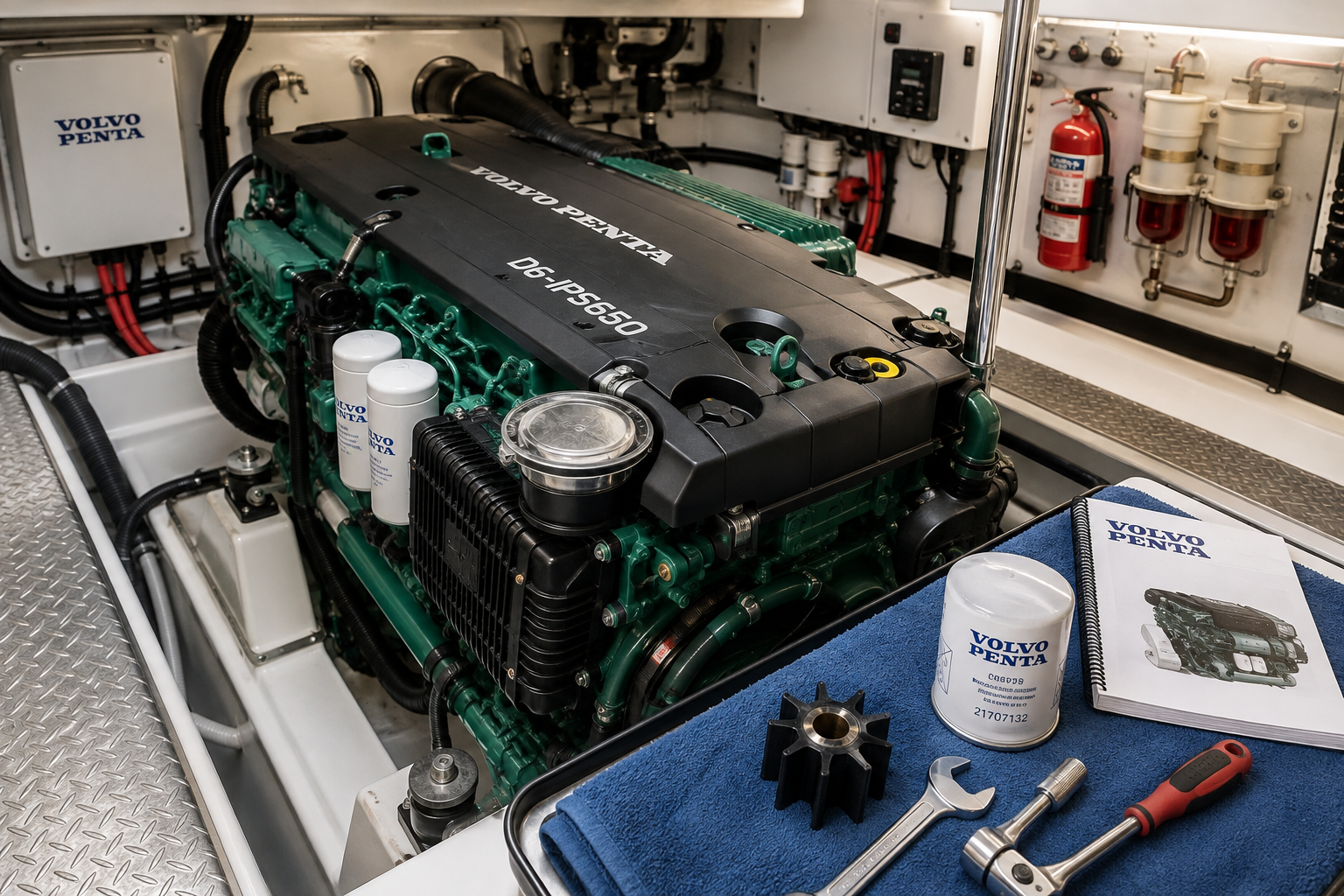
Volvo Penta Maintenance Schedule: The Complete Service Checklist Every Owner Needs
A boat owner once described marine engine maintenance to me in a way that perfectly captures why people get caught out:
“I thought maintenance started when the hour meter told me to do something.”
That mindset is understandable.
After all, when you think about wear, you naturally think about an engine running. Pistons moving. Bearings turning. Pumps working. Fuel burning.
So if your Volvo Penta only runs 30 or 40 hours in a season, it is tempting to look at that hour meter and think:
“Nothing has really happened yet.”
But something has happened.
An entire year has passed.
The engine may have spent that year sitting in a humid engine room. Saltwater may have circulated through the raw-water side of the cooling system. Fuel has remained in the tank. Electrical connections have been exposed to moisture. Belts, hoses, seals and batteries have continued aging. Coolant has continued doing its job protecting internal surfaces whether the crankshaft was turning or not.
The hour meter measures use.
It does not measure everything that can age a marine propulsion system.
That is one of the most important ideas behind a proper Volvo Penta maintenance schedule.
A good maintenance plan does not simply ask:
“How many hours have I run?”
It also asks:
“How much time has passed?”
and:
“What condition is the engine actually in?”
That distinction can be the difference between planned maintenance and an expensive breakdown.
There is a big difference between replacing a deteriorating raw-water impeller during scheduled Volvo Penta engine service and discovering a cooling problem only after the engine temperature starts climbing offshore.
There is a big difference between finding water in a fuel separator during inspection and waiting until contaminated fuel begins affecting the engine.
And there is a big difference between noticing a small coolant leak today and investigating an overheated engine later.
This is why Titan Marine Diesel approaches Volvo Penta marine engine maintenance as preventive risk management—not simply as a list of filters to buy.
Maintenance should protect:
- Reliable starting
- Correct operating temperature
- Fuel-system performance
- Lubrication
- Cooling efficiency
- Electrical reliability
- Fuel economy
- Drivetrain reliability
- Engine longevity
- Vessel resale value
But there is another benefit owners often underestimate:
confidence.
When you are maneuvering through a crowded marina, running home in deteriorating weather, or depending on the engine for hours instead of minutes, you want your attention on operating the boat.
You do not want to be wondering whether the belt you meant to inspect three months ago is finally going to give up.
That is what preventative maintenance buys you.
Not just parts.
Not just service history.
Confidence in the propulsion system when you actually need it.
This guide will therefore go much further than a generic “change the oil every X hours” article.
In fact, one of the first things we need to establish is that there is no single universal Volvo Penta service interval that applies to every marine engine.
Volvo Penta’s current support guidance says the service recommendations for an engine are found in its specific maintenance schedule, and that intervals are based on engine hours or elapsed time.
That matters because Volvo Penta marine propulsion covers very different engines and installations.
A smaller displacement sailboat diesel is not serviced exactly like a high-output common-rail engine.
A D4 with an inboard transmission does not create exactly the same complete propulsion-maintenance requirements as a D4 paired with an Aquamatic drive.
A D6 installed with IPS adds another set of drivetrain and control considerations beyond servicing the engine itself.
Even within an engine family, parts and procedures can vary by model, generation and serial number.
So this guide will explain the maintenance system rather than pretending one generic chart replaces the correct manual.
We will eventually cover:
- Volvo Penta engine oil changes
- Volvo Penta fuel filter replacement
- Raw-water and cooling-system maintenance
- Volvo Penta impeller replacement
- Coolant
- Heat exchangers and aftercoolers
- Belts and tensioners
- Batteries and electrical systems
- EVC maintenance awareness
- Gearboxes
- Aquamatic drives
- IPS systems
- Anodes and corrosion control
- Turbocharger and intake inspection
- Exhaust-system checks
- Annual service
- Seasonal storage
- D2, D4 and D6 maintenance considerations
- Maintenance records
- Parts identification
- Repair-versus-repower decisions
And throughout the guide, we will come back to one simple principle:
Hours + Time + Condition.
That is the foundation of a practical Volvo Penta maintenance checklist.
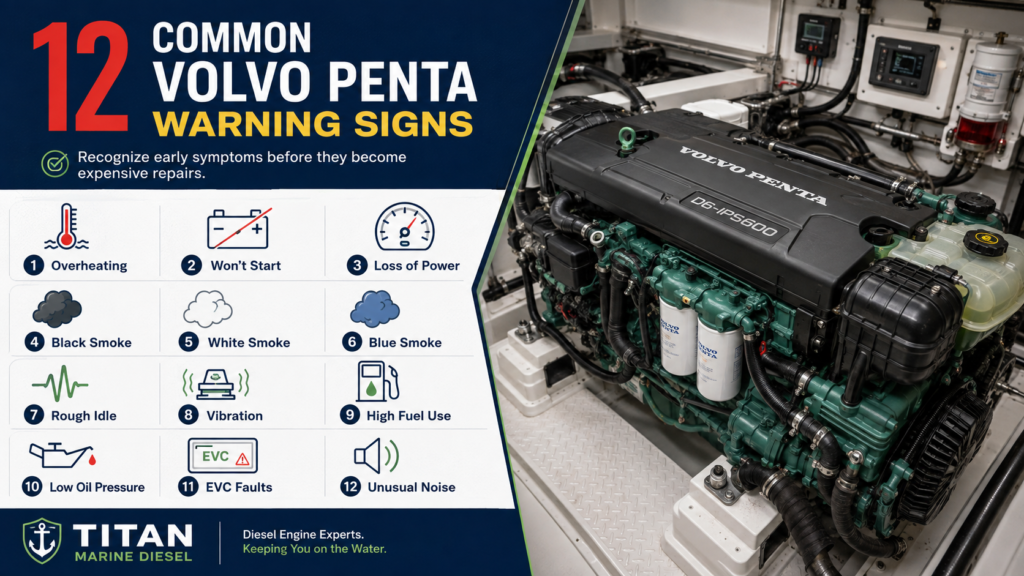
What Is the Volvo Penta Maintenance Schedule?
A Volvo Penta maintenance schedule is the model-specific service plan that identifies which engine and propulsion components require inspection, adjustment, servicing or replacement—and when those actions should take place.
In plain English:
It tells you what needs attention and when it needs attention.
Volvo Penta states that the service recommendations for each engine are contained in its maintenance schedule and that the intervals are based on operating hours or elapsed time.
That gives owners an important rule from the beginning:
A Volvo Penta maintenance schedule should be followed using both engine hours and calendar time—not the hour meter alone.
Engine Hours Measure Work
Operating hours tell you how much the engine has actually run.
As those hours accumulate:
- Oil experiences repeated heat cycles
- Filters accumulate contamination
- Pumps operate
- Belts rotate
- Bearings accumulate running time
- Fuel passes through filtration and injection systems
- The drivetrain transmits engine torque
A commercial vessel running hundreds of hours per year may therefore reach hour-based Volvo Penta service intervals very quickly.
That part is intuitive.
More use usually means scheduled service thresholds arrive sooner.
But hours do not tell the whole story.
Calendar Time Measures Aging
Now imagine another boat.
Same general engine.
Only 35 hours of use during the entire season.
Mechanically, the engine has done relatively little work.
But calendar time can still affect:
- Fluids
- Batteries
- Rubber components
- Electrical connections
- Corrosion protection
- Fuel quality
- Seals and hoses
That is precisely why Volvo Penta describes service intervals in terms of hours or time rather than hours alone.
This leads to one of the most useful answers in the entire article:
Does a Low-Hour Volvo Penta Still Need Maintenance?
Yes. A low-hour Volvo Penta can still require scheduled maintenance because some service requirements are time-based rather than purely hour-based. Please confirm the correct interval using the maintenance schedule for the exact engine.
Condition Can Require Earlier Attention
There is then a third factor: actual condition.
Suppose an item is not yet due for its normal scheduled replacement, but you discover:
- Water in the fuel separator
- A cracked belt
- A coolant leak
- A deteriorating hose
- Increasing corrosion
- Abnormal operating temperature
- An electrical connection getting hot
Do you wait simply because the maintenance interval has not arrived?
No.
This is where scheduled maintenance and inspection work together.
Scheduled maintenance establishes the planned interval. Condition determines whether intervention is needed earlier.
That distinction is especially important on boats because two engines with identical hours can experience very different environments.
One might operate in freshwater at moderate recreational load.
Another might operate year-round in warm saltwater.
The numbers on their hour meters may be identical.
Their condition may not be.
Why You Should Avoid Universal Online Service Charts
One of the easiest mistakes to make is finding a generic online table that says:
“Change this every 100 hours.”
and assuming it applies to every Volvo Penta diesel.
Sometimes the advice may happen to match a particular model.
The problem comes when a model-specific interval becomes universal advice.
Volvo Penta itself directs owners toward the maintenance schedule for their individual engine rather than one all-purpose marine-engine schedule.
Exact requirements can differ because Volvo Penta engines vary in:
- Engine design
- Fuel system
- Cooling architecture
- Power rating
- Application
- Electronic controls
- Transmission or drive configuration
For example, Volvo Penta’s current D4 documentation specifically describes the platform as designed for ease of maintenance and extended service intervals.
That does not mean a D4 interval should automatically be applied to a D2, D6, older TAMD engine, or another Volvo Penta product.
Model-specific information wins.
Your Serial Number Is Part of the Maintenance Process
Knowing your engine family is useful.
Knowing the serial number is much better.
Volvo Penta calls the serial number the product’s unique identifier and says it is key to efficient servicing and correct parts ordering.
Its engine-information database also lets owners access operator manuals, service protocols and other engine-related information.
That is why Titan Marine Diesel recommends recording your:
- Exact engine model
- Engine serial number
- Engine hours
- Transmission or drive model
- Drive serial number where applicable
before ordering Volvo Penta maintenance parts.
A simple rule is:
The model identifies the family. The serial number identifies your specific product.
That can make the difference between ordering something that looks right and ordering the component that actually belongs on the engine.
Engine Service Is Not Always Complete Propulsion Service
This is another maintenance gap worth fixing early.
An owner says:
“The Volvo Penta was fully serviced.”
The useful follow-up question is:
What exactly was serviced?
Perhaps the technician changed:
- Engine oil
- Oil filter
- Fuel filters
That may complete the scheduled engine service.
But the vessel may also have:
- Marine transmission
- Saildrive
- Aquamatic sterndrive
- IPS pod system
Those components can have separate lubrication, inspection, corrosion-protection and service requirements.
So a complete Volvo Penta service checklist should distinguish between:
Engine maintenance
and
complete propulsion-system maintenance.
Changing the engine oil does not automatically mean every drive-related maintenance requirement has been completed.
The Maintenance Schedule Is the Baseline—Not the Ceiling
The best way to think about the schedule is this:
The maintenance schedule tells you when planned service is due. Inspection tells you whether reality requires action sooner.
If everything is healthy, follow the correct engine-specific schedule.
If something is deteriorating, investigate it.
Do not wait for the calendar to authorize common sense.
And that is exactly why the next section of this guide will introduce Titan Marine Diesel’s maintenance framework:
Titan Marine Diesel’s Hours + Time + Condition Maintenance Framework
A maintenance schedule gives you dates and service points.
But dates and engine hours alone do not tell you everything you need to know about the health of a marine diesel.
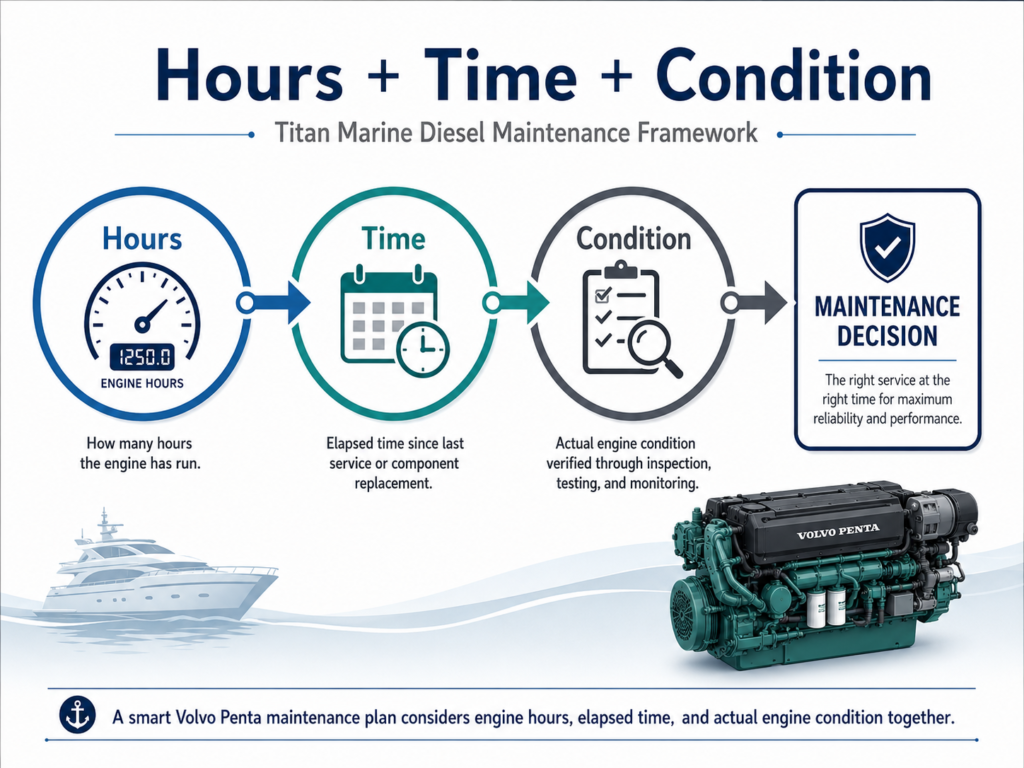
That is why Titan Marine Diesel recommends looking at Volvo Penta marine engine maintenance through three separate lenses:
Hours. Time. Condition.
Think of these as three clocks running at the same time.
One measures how much the engine works.
One measures how long the engine ages.
And one measures how hard the environment and operating conditions are treating it.
Ignore any one of those clocks and you can still end up maintaining the engine too late.
Hours: How Much Work Has the Engine Actually Done?
Operating hours are the most obvious maintenance measurement.
Every time the engine runs:
- Oil circulates
- Bearings rotate
- Pumps operate
- Belts turn
- Fuel passes through filters
- Combustion by-products enter the oil
- Heat cycles affect components
- The transmission or drive transfers torque
The more the engine runs, the faster hour-based Volvo Penta service intervals are reached.
A commercial fishing vessel operating 1,000 hours per year clearly has different maintenance demands from a recreational cruiser running 60 hours per year.
That sounds obvious.
But the important point is not simply:
More hours = more maintenance.
The better way to think about it is:
Hours measure mechanical exposure.
They tell you how much work the engine and propulsion system have actually performed.
Why Keeping Accurate Engine Hours Matters
Do not rely on statements such as:
“I think the engine was serviced about 100 hours ago.”
Record the actual number.
A useful maintenance entry looks more like this:
Engine oil and filter changed — 642 hours — May 18
rather than:
Oil changed sometime last spring.
That difference seems small until several years have passed.
Accurate hour records help you determine:
- When service was completed
- How quickly the engine is accumulating use
- When the next scheduled service is approaching
- Whether a component failed unusually early
- Whether operating patterns have changed
This becomes especially valuable when diagnosing problems later.
Time: Your Volvo Penta Ages While Sitting Still
This is the maintenance factor low-hour owners often underestimate.
A marine diesel does not stop aging when the ignition is turned off.
Consider what may continue happening while the boat sits:
- Moisture remains in the engine room
- Fuel remains in the tank
- Electrical terminals remain exposed to humidity
- Rubber hoses continue aging
- Batteries lose capacity
- Corrosion continues
- Coolant continues aging
- Raw-water components remain exposed to the marine environment
The engine may accumulate zero additional hours during storage.
Calendar time still moves forward.
That is why a proper Volvo Penta annual service should never be evaluated solely from the hour meter.
The Low-Hour Maintenance Trap
A very lightly used engine can sometimes create a false sense of security.
The owner thinks:
“It has only done 25 hours. It’s practically new.”
Mechanically, perhaps.
But imagine that those 25 hours were accumulated over two years while the boat spent most of its life:
- In saltwater
- Sitting unused
- With fuel stored in the tank
- With batteries repeatedly discharging
- With moisture inside the engine compartment
That engine has experienced little running wear.
It has still experienced two years of environmental exposure.
This leads to an important maintenance rule:
Low hours reduce running wear. They do not eliminate time-based maintenance.
Time-Based Problems Often Develop Quietly
Mechanical failures tend to get attention because they can be dramatic.
Time-related deterioration is often quieter.
A hose slowly hardens.
A battery slowly loses capacity.
A terminal slowly corrodes.
Fuel slowly deteriorates.
An anode slowly disappears.
Then one day, the owner notices the consequence.
Good marine diesel engine maintenance tries to identify those changes before they become failure points.
Condition: What Kind of Life Has the Engine Had?
Hours tell you how much the engine worked.
Time tells you how long it aged.
Condition tells you how difficult that life was.
Two identical engines with the same age and engine hours can require very different levels of attention.
Consider two D6 installations.
Both engines have 600 hours.
Both are four years old.
But Engine A operates primarily in clean freshwater and spends winters stored indoors.
Engine B operates year-round in warm saltwater, spends long periods at cruising load, and lives in a humid marina.
Their hour meters tell the same story.
Their environments do not.
That is why condition must be part of every serious Volvo Penta maintenance checklist.
Conditions That Deserve Closer Attention
Examples include:
- Saltwater operation
- Tropical climates
- Commercial duty
- Extended high-load operation
- Long idle periods
- Frequent short trips
- Questionable fuel quality
- Contaminated fuel
- Repeated overheating
- Persistent coolant loss
- Increased oil consumption
- Repeated EVC warnings
None of these automatically means the engine needs every component replaced early.
They mean the engine deserves closer inspection.
Saltwater Is a Good Example of Why Condition Matters
Saltwater introduces a completely different corrosion environment compared with freshwater.
That makes owners particularly attentive to:
- Raw-water components
- Heat exchangers
- Anodes
- Hose connections
- Metal fittings
- Drives and propellers
Suppose an anode is technically not at the end of a generic inspection period, but you discover that it has deteriorated substantially.
Would you leave it in place simply because the calendar says the service is not due?
Of course not.
Condition has overridden the planned interval.
The same principle applies throughout the engine.
The Formula: Hours + Time + Condition
This is the maintenance framework Titan Marine Diesel recommends remembering:
Hours + Time + Condition = a smarter Volvo Penta maintenance plan.
Here is what each part tells you:
| Factor | Question It Answers |
|---|---|
| Hours | How much has the engine worked? |
| Time | How long has the engine and its service items aged? |
| Condition | What has the engine actually experienced? |
The maintenance decision becomes stronger when you consider all three.
Why “Every X Hours” Is Sometimes Too Simplistic
Boat owners love simple rules.
We understand why.
Something like:
“Do this every 100 hours.”
is easy to remember.
But simplicity becomes dangerous when it removes context.
Consider three engines.
Engine A
Runs enough to reach the scheduled hour interval quickly.
Hours trigger the service.
Engine B
Runs very little but reaches the specified calendar interval.
Time triggers the service.
Engine C
Has not reached either threshold, but inspection reveals a damaged hose.
Condition triggers action.
All three engines need attention for different reasons.
That is why Volvo Penta service intervals should be used as maintenance triggers, not as an excuse to ignore obvious deterioration.
Condition Does Not Mean “Replace Everything Early”
There is another side to this.
Condition-based maintenance should not become:
“The boat is in saltwater, so let’s replace everything twice as often.”
That can waste money just as easily as delayed maintenance can cause problems.
The correct approach is:
Inspect intelligently.
Then act on evidence.
For example:
If a belt is:
- Properly tensioned
- Undamaged
- Free from cracking
- Operating normally
there is no benefit in declaring it defective because the boat had a difficult season—unless its specified replacement interval requires renewal.
Maintenance should be preventative.
It should not become indiscriminate parts replacement.
That distinction matters.
Track Trends, Not Just Failures
This is where maintenance becomes especially powerful.
Your engine does not need to fail before it gives you useful information.
Watch trends such as:
- Operating temperature
- Cold-start behavior
- Oil consumption
- Coolant consumption
- Fuel consumption
- Cruise RPM
- Maximum RPM
- Battery voltage
- Smoke
- Vibration
Suppose your engine normally reaches cruising temperature and stays there consistently.
Then, over several trips, you notice the temperature is slowly creeping upward.
It is not overheating yet.
No alarm has appeared.
But something has changed.
That change may justify inspecting:
- Raw-water flow
- Strainer
- Impeller
- Heat exchanger
- Coolant system
before an overheating problem develops.
This is condition-based maintenance working exactly as it should.
Build a Simple Maintenance Record
You do not need sophisticated fleet-management software for a recreational boat.
A simple maintenance log can record:
| Date | Engine Hours | Service/Observation | Next Action |
|---|---|---|---|
| May 18 | 642 | Oil + filter changed | Follow schedule |
| June 3 | 651 | Fuel separator checked, clean | Monitor |
| July 12 | 683 | Slight belt cracking noticed | Inspect/replace |
| Aug 6 | 701 | Coolant level unchanged | Normal |
Over time, this becomes incredibly useful.
It helps you see:
- What was actually serviced
- When it was serviced
- Which parts were used
- What changed
- Whether a recurring problem is developing
It also improves troubleshooting.
A technician can learn much more from:
“The engine started running 5°C warmer after approximately 40 hours of operation.”
than:
“It’s been running hot lately.”
The Maintenance Question to Ask Before Every Service
Before deciding what your Volvo Penta needs, ask:
How many hours have passed?
Check the hour meter.
How much calendar time has passed?
Check the actual service date.
What does inspection tell me?
Look at the current condition.
Then compare those answers with the schedule for your exact engine.
That gives you a much more complete maintenance decision.
Titan Marine Diesel’s Rule
If you remember only one sentence from this section, make it this:
Do not maintain your Volvo Penta only by what the hour meter says. Maintain it by Hours + Time + Condition.
That framework will guide everything we cover next—from engine oil and fuel filters to impellers, cooling systems, batteries, gearboxes, Aquamatic drives, and IPS propulsion.
Volvo Penta Maintenance Schedule at a Glance
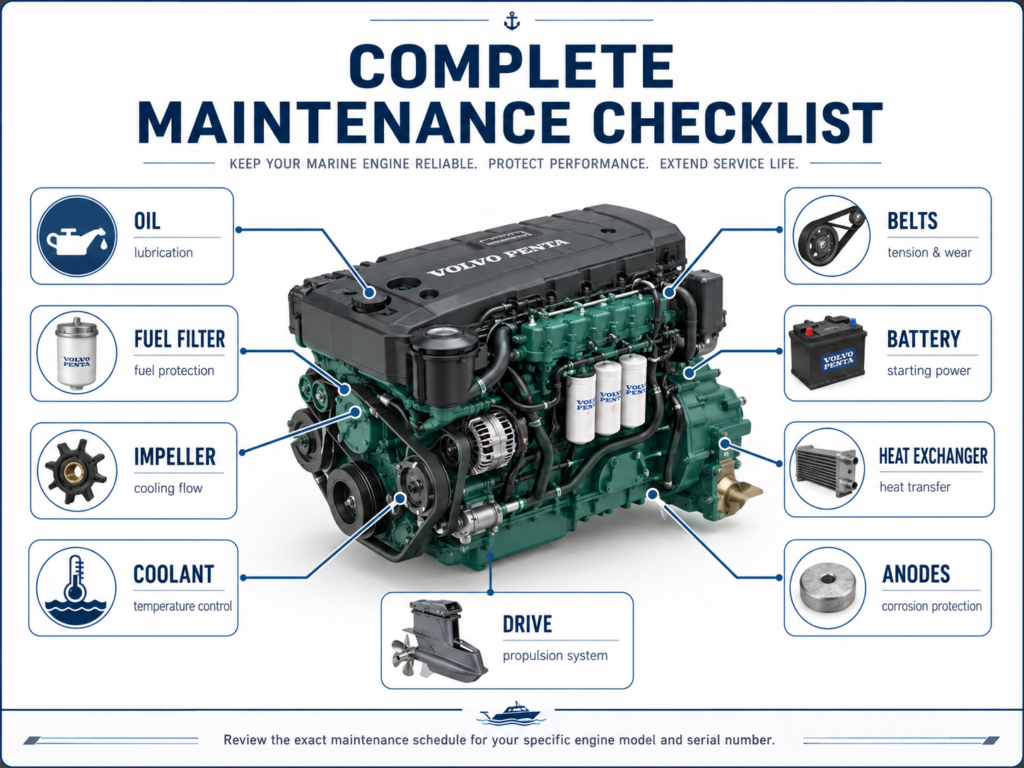
Before we break the maintenance plan down component by component, it helps to see the whole picture in one place.
Think of this section as your Volvo Penta service checklist overview.
It is not meant to replace the official maintenance schedule for your exact engine. Instead, it shows the systems that normally deserve attention and explains why each one matters.
The exact timing can vary according to:
- Engine model
- Serial number
- Engine generation
- Propulsion configuration
- Operating hours
- Calendar time
- Operating environment
So always verify the actual Volvo Penta service intervals against the documentation for your specific engine.
Quick Volvo Penta Maintenance Checklist
| Maintenance Area | What to Check | Typical Action | Why It Matters |
|---|---|---|---|
| Engine oil | Level, leaks, contamination | Inspect and replace per schedule | Protects bearings and internal engine components |
| Oil filter | Leaks, service history | Replace with scheduled oil service | Removes contaminants from lubricating oil |
| Fuel-water separator | Water, sediment, contamination | Inspect, drain, service as needed | Helps protect the fuel system |
| Engine fuel filter | Restriction, contamination, leaks | Replace per schedule | Protects injection components |
| Coolant | Level, condition, leaks | Inspect and renew as specified | Controls temperature and corrosion |
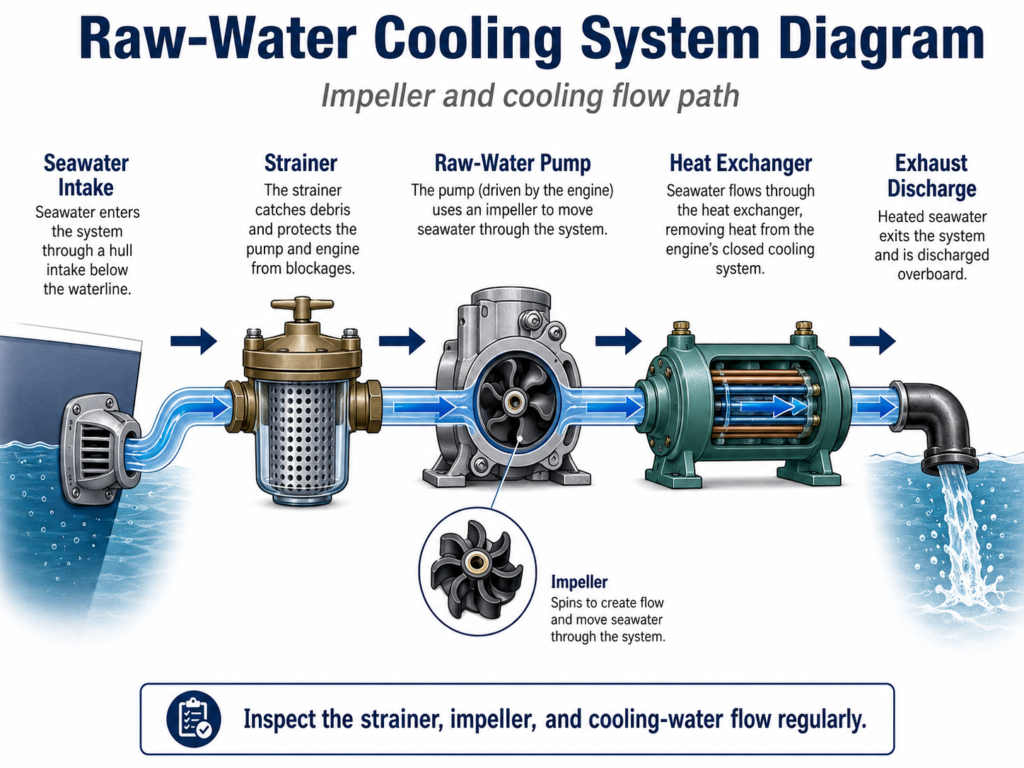
| Raw-water intake | Blockage, leaks, seacock position | Inspect regularly | Maintains seawater supply to cooling system |
| Seawater strainer | Debris, restriction | Clean as required | Helps preserve cooling-water flow |
| Raw-water impeller | Blade condition, cooling performance | Inspect/replace according to schedule | Circulates seawater through the cooling circuit |
| Drive belts | Cracks, glazing, fraying, tension | Inspect and replace as needed | Supports charging and other belt-driven systems |
| Hoses and clamps | Cracks, swelling, leaks, corrosion | Inspect regularly | Reduces risk of fuel, coolant, and seawater leaks |
| Battery system | Voltage, terminals, corrosion | Test and maintain | Supports starting and electronic controls |
| Heat exchanger | Leakage, restriction, temperature trends | Inspect/service as required | Transfers engine heat efficiently |
| Aftercooler | Leaks, contamination, performance | Inspect/service as applicable | Helps cool compressed intake air |
| Anodes | Wear and corrosion | Inspect and replace when required | Helps protect submerged and cooling-system metals |
| Air intake | Restriction, hose condition | Inspect/service | Supports correct combustion |
| Turbocharger | Noise, oil leakage, performance | Inspect if symptoms develop | Supports power and airflow |
| Gearbox/drive oil | Level, condition, leakage | Replace per propulsion schedule | Protects gears and bearings |
| Propeller/drivetrain | Damage, fouling, vibration | Inspect regularly | Affects engine load and performance |
| EVC/electrical system | Faults, warnings, voltage | Diagnose when necessary | Supports monitoring and engine control |
The Four Layers of a Good Maintenance Plan
One of the easiest ways to make Volvo Penta marine engine maintenance manageable is to divide the work into four layers.
You do not need to treat every maintenance task as though it happens at the same time.
Some things should be checked frequently.
Some are scheduled replacements.
Some require deeper periodic servicing.
Others happen because the engine is telling you something has changed.
Layer 1: Frequent Owner Checks
These are the simple observations that can catch small problems early.
Examples include:
- Engine oil level
- Coolant level
- Visible leaks
- Belt condition
- Battery terminals
- Fuel-water separator
- Seawater strainer
- Hose condition
These checks often take only a few minutes.
Yet they can tell you a surprising amount about what is happening inside the engine room.
A maintenance program that ignores basic inspection until the next scheduled service leaves a lot of useful information on the table.
Layer 2: Routine Scheduled Service
This is what most people picture when they hear:
Volvo Penta engine service.
It commonly includes tasks such as:
- Engine oil replacement
- Oil filter replacement
- Fuel filter service
- Basic inspections
The exact work and interval should be taken from the schedule for the specific engine.
This is where maintenance records become especially valuable.
Instead of saying:
“I think the oil was changed sometime last year.”
you should ideally know:
“Oil and filter were changed at 712 hours on April 16.”
That single line gives you far better information.
Layer 3: Periodic System Maintenance
Some components do not necessarily require replacement every time you perform a basic oil-and-filter service.
That makes them easier to forget.
Examples may include:
- Volvo Penta impeller replacement
- Coolant renewal
- Heat exchanger servicing
- Aftercooler maintenance
- Belt replacement
- Anode replacement
- Gearbox service
- Sterndrive service
- IPS maintenance
These systems deserve their own place in the maintenance log.
Otherwise, an engine can receive perfect oil changes for years while another critical system quietly goes overdue.
Layer 4: Condition-Based Maintenance
This is where the Hours + Time + Condition framework becomes practical.
You may not be at a scheduled maintenance interval yet.
But if you find:
- A cracked hose
- Water in the fuel
- Coolant leakage
- Corroded terminals
- Increasing engine temperature
- An abnormal EVC warning
- Excessive vibration
- Changed exhaust smoke
the condition itself becomes a reason to investigate.
This is why good maintenance is not simply calendar-based.
It is observational.
Inspection Does Not Always Mean Replacement
This is an important distinction.
When a component appears on a Volvo Penta maintenance checklist, that does not automatically mean:
“Replace it every time.”
The required action may be:
- Inspect
- Clean
- Drain
- Test
- Adjust
- Lubricate
- Replace
The maintenance schedule and component condition determine which action is appropriate.
For example, a technician may inspect a belt and find:
- Correct alignment
- Good tension
- No cracking
- No glazing
That does not automatically mean the belt needs replacement that day unless its specified service requirement says otherwise.
Maintenance should be preventative.
It should not become wasteful.
Engine Service Is Only One Part of the Propulsion System
This point deserves repeating because it creates confusion in real-world ownership.
A boat owner may say:
“The engine was serviced.”
But the vessel may also have:
- Marine gearbox
- Shaft system
- Saildrive
- Aquamatic sterndrive
- IPS pod system
Those components may have their own lubrication, corrosion-protection, inspection, and maintenance requirements.
So when reviewing your Volvo Penta maintenance schedule, think in terms of:
Engine + transmission or drive + controls + propeller system.
Not just the engine block.
Why the Propeller Belongs in a Maintenance Guide
The propeller is outside the engine, but it can dramatically affect how the engine operates.
A damaged, fouled, or incorrectly matched propeller can contribute to:
- Reduced maximum RPM
- Poor acceleration
- Higher fuel consumption
- Increased engine loading
- Vibration
- Reduced boat speed
This matters because an engine can be mechanically healthy and still perform badly if the propulsion system is creating excessive load.
A maintenance-minded owner therefore looks beyond the engine compartment.
Performance Should Be Part of the Maintenance Record
Do not track only the parts you replace.
Track how the boat performs.
Useful observations can include:
- Cold-start behavior
- Idle quality
- Operating temperature
- Normal cruise RPM
- Maximum RPM
- Boat speed at cruise
- Fuel consumption
- Oil consumption
- Smoke
- Vibration
- EVC warnings
These become your baseline.
Then, if something changes, you have evidence.
For example:
Normal:
2,800 RPM at 24 knots.
Later:
2,800 RPM at 20 knots.
Now you have a measurable performance change to investigate.
That is much more useful than saying:
“The boat feels slower.”
A Simple Four-Question Maintenance Test
Whenever you review any item on your Volvo Penta service schedule, ask:
- When was it last serviced?
- How many engine hours have passed?
- What condition is it currently in?
- What does the schedule for my exact engine require?
Those four questions dramatically reduce guesswork.
They also reinforce the central idea behind this guide:
Maintenance is not just about replacing parts on a timetable. It is about understanding the engine well enough to know when something is changing.
The next step is turning that understanding into a habit—starting with the simple checks that should happen before you even leave the dock.
Final Takeaway: Follow the Maintenance Schedule Before the Engine Creates One for You
A good Volvo Penta maintenance schedule is not about replacing parts unnecessarily.
It is about knowing what needs attention before a small maintenance issue becomes an expensive repair.
If there is one principle to remember from this guide, make it this:
Maintain your Volvo Penta by Hours + Time + Condition—not engine hours alone.
Hours tell you how much the engine has worked.
Time tells you how long fluids, rubber components, batteries, fuel, seals, and other service items have been aging.
Condition tells you what the engine and propulsion system are actually experiencing right now.
Those three factors should work together.
A low-hour engine may still need time-based maintenance.
A high-hour commercial engine may reach its scheduled service requirements quickly.
And an engine showing a leak, damaged belt, contaminated fuel, rising temperature, unusual vibration, or warning alarm may need attention before either scheduled interval arrives.
The Essential Volvo Penta Maintenance Checklist
At a minimum, your maintenance planning should account for:
- Engine oil and oil filter
- Fuel filters and fuel-water separator
- Coolant condition and level
- Raw-water intake and seawater strainer
- Raw-water pump and impeller
- Belts, hoses, and clamps
- Battery and electrical connections
- Heat exchanger and aftercooler where applicable
- Anodes and corrosion protection
- Air intake and turbocharger condition
- Exhaust system
- Gearbox, Aquamatic drive, saildrive, or IPS system
- Propeller and drivetrain condition
- EVC warnings and electronic-system health
Just as importantly, keep a record of:
- Service date
- Engine hours
- Parts replaced
- Fluids used
- Faults or observations
- Work performed
- Next scheduled service
A maintenance record turns guesswork into evidence.
Do Not Guess Your Exact Service Interval
This deserves one final reminder.
There is no single maintenance interval that should be blindly applied to every Volvo Penta marine engine.
Your exact requirements can vary according to:
- Engine model
- Serial number
- Engine generation
- Drive or transmission
- Application
- Operating environment
That is why the maintenance schedule for your specific engine should remain the final reference for exact Volvo Penta service intervals.
Generic online advice can be useful for understanding maintenance.
It should not replace the documentation for the engine actually installed in your boat.
Maintain the Complete Propulsion System
Do not make the mistake of servicing the engine while forgetting everything connected to it.
A reliable propulsion package includes more than the engine block.
Depending on your installation, that may include:
Engine + gearbox + shaft system
or
Engine + Aquamatic sterndrive
or
Engine + IPS propulsion system.
The controls, electrical system, cooling circuit, propeller, fuel supply, and exhaust installation all influence how well the engine performs.
A perfectly serviced engine can still run poorly if the propeller is overloaded, the fuel supply is restricted, the cooling system cannot move enough water, or the drivetrain has been neglected.
Think in systems—not isolated components.
Pay Attention Before the Alarm Appears
The best maintenance information often comes from noticing change.
Maybe:
- The engine takes slightly longer to start
- Operating temperature begins creeping upward
- Maximum RPM falls
- Fuel consumption increases
- A new vibration appears
- Coolant needs topping up more often
- The exhaust looks different
- Battery voltage becomes inconsistent
None of those automatically tells you exactly what has failed.
But they tell you something has changed.
And that is usually the right time to investigate.
Do not wait for an EVC alarm, an overheating event, or a no-start condition before paying attention.
Preventive maintenance is almost always easier when the engine is still operating normally.
Know When Maintenance Becomes Repair
Routine maintenance can handle predictable service items.
But some symptoms deserve proper diagnosis.
Seek qualified technical assistance when you are dealing with issues such as:
- Persistent overheating
- Low oil pressure
- Repeated EVC faults
- High-pressure fuel-system problems
- Turbocharger concerns
- Significant oil or coolant loss
- Internal mechanical noise
- Persistent smoke
- IPS or sterndrive faults
- Repeated loss of power
Replacing service parts without diagnosing the underlying cause can become an expensive guessing game.
The goal is not to replace the greatest number of parts.
The goal is to identify the actual problem.
When Maintenance Starts Revealing a Bigger Decision
There also comes a point in the life of some marine engines where the question changes.
It is no longer:
“What service does this engine need?”
It becomes:
“Does continuing to repair this engine still make financial sense?”
That conversation may become relevant when an older engine begins requiring:
- Repeated major repairs
- Significant cooling-system work
- Turbocharger replacement
- Injector or fuel-system work
- Internal engine repairs
- Multiple aging ancillary systems
- Hard-to-source parts
One repair alone does not automatically justify repowering.
But several major systems approaching the end of their useful lives at the same time can change the economics.
A useful question is:
After paying for this repair, what major component is likely to require money next?
Sometimes repairing the existing engine is absolutely the right decision.
Sometimes a replacement or Volvo Penta repower provides a better long-term result.
The important thing is to compare the complete picture rather than looking only at today’s repair invoice.
Volvo Penta Maintenance FAQs
How often should a Volvo Penta marine engine be serviced?
Follow the Volvo Penta maintenance schedule for your exact engine. Service requirements can be triggered by operating hours, elapsed time, or engine condition, so the hour meter should not be used as the only maintenance indicator.
Does a low-hour Volvo Penta still need maintenance?
Yes. Low operating hours reduce mechanical use but do not stop time-based deterioration. Fluids, batteries, rubber components, fuel systems, corrosion protection, and other components can still require attention based on calendar time and condition.
How often should Volvo Penta engine oil be changed?
The correct Volvo Penta engine oil change interval depends on the specific engine and maintenance schedule. Do not apply a generic hour interval to every Volvo Penta model.
How often should a Volvo Penta impeller be replaced?
The correct Volvo Penta impeller replacement interval should be confirmed using the maintenance schedule for the exact engine and raw-water system. Condition also matters: damaged, deteriorated, or poorly performing impellers should be investigated before the scheduled interval.
What maintenance does a Volvo Penta D4 require?
Volvo Penta D4 maintenance can include engine oil and filters, fuel filtration, cooling-system service, impeller inspection, belts, electrical checks, anodes, air and charge-air systems, plus maintenance for the connected transmission, Aquamatic drive, or IPS system where applicable. Exact intervals should be confirmed using the D4 model and serial number.
What maintenance does a Volvo Penta D6 require?
Volvo Penta D6 maintenance follows the same systems-based principle but should use the maintenance schedule for the exact D6 model and propulsion configuration. Engine, fuel, cooling, electrical, drive, and corrosion-protection systems all need to be considered.
How do I find the correct Volvo Penta maintenance schedule?
Start with your exact engine model and serial number. The serial number helps identify the correct engine documentation and compatible Volvo Penta maintenance parts rather than relying only on the general engine family.
Need Help With Volvo Penta Maintenance, Parts or Repowering?
If you are planning a service and are unsure which components belong to your engine, Titan Marine Diesel can help you identify the correct configuration before you begin ordering parts.
For the most accurate assistance, provide:
- Volvo Penta engine model
- Engine serial number
- Current engine hours
- Gearbox, sterndrive, saildrive, or IPS model
- Drive serial number where applicable
- Vessel type
- Service or problem you are addressing
- Delivery location if parts or an engine are required
That information helps reduce guesswork and makes it easier to determine the correct maintenance parts, replacement components, or repower options.
The objective is simple:
Keep your Volvo Penta reliable before reliability becomes the problem.
Follow the correct schedule.
Inspect the engine regularly.
Watch for changes.
Keep accurate records.
And remember the Titan Marine Diesel maintenance rule:
Hours + Time + Condition.
Because maintenance spends money on your schedule.
Breakdowns spend it on the engine.


Leave a Reply