
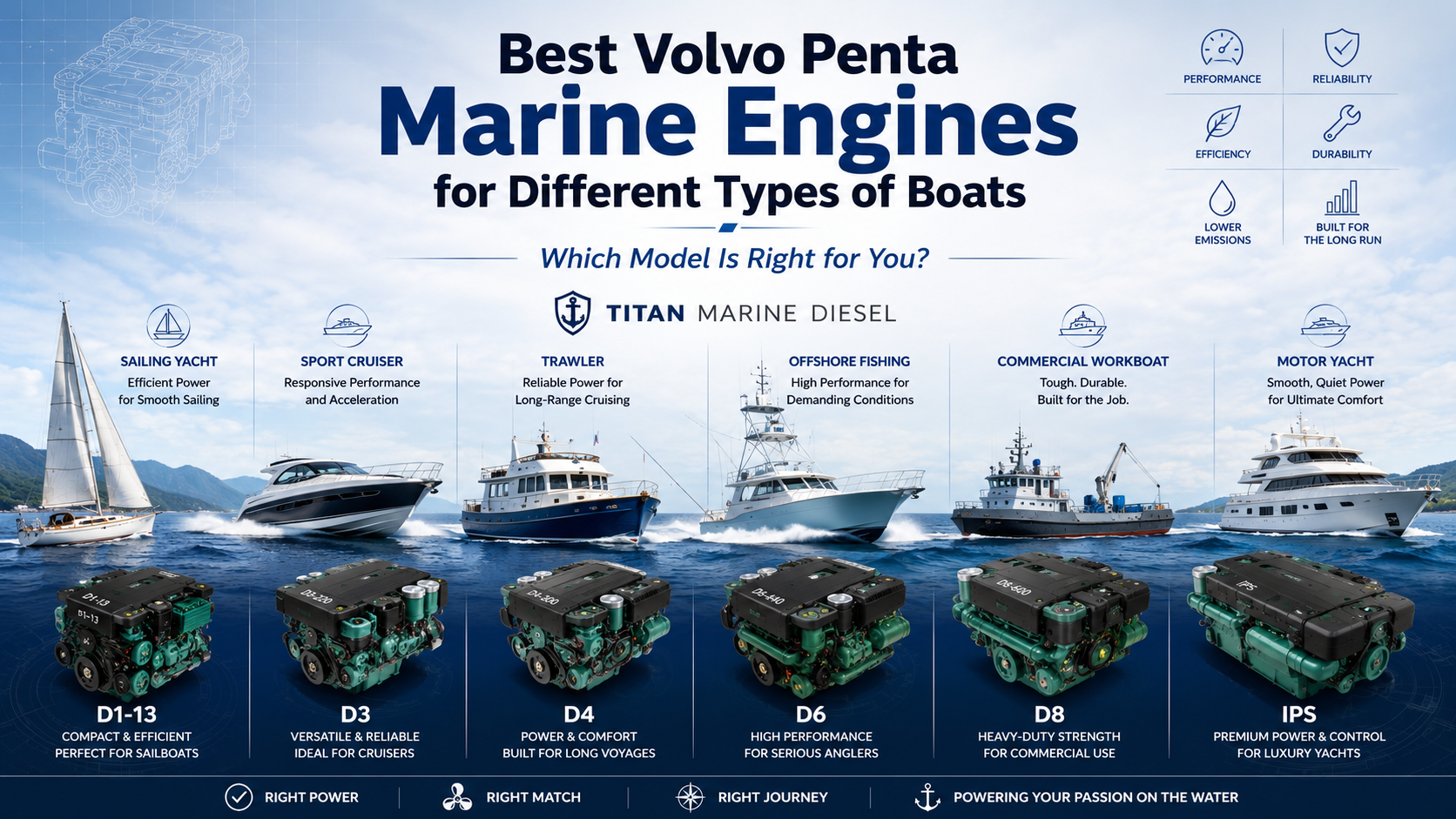
Best Volvo Penta Marine Engines for Different Types of Boats: Which Model Is Right for You?
“What is the best Volvo Penta marine engines?”
It sounds like a simple question. But from a marine-engine specialist’s perspective, it is similar to asking, “What is the best vehicle?”
A sports car, delivery truck and off-road vehicle may all be excellent, but each is built for a different job.
The same principle applies to marine propulsion.
The best Volvo Penta marine engine for your boat depends on the vessel’s hull, fully loaded displacement, intended cruising speed, operating hours, propulsion arrangement and duty cycle.
A compact sailing yacht does not need the same engine as a fast sport cruiser. An offshore fishing boat carrying fuel, ice, equipment and crew requires a different propulsion package from a displacement trawler travelling at eight knots. A commercial workboat operating every day must also be evaluated differently from a recreational yacht used occasionally.
At Titan Marine Diesel, many enquiries begin with a model number or horsepower figure. Sometimes the requested engine is suitable. In other cases, reviewing the boat reveals that the buyer needs:
- A different engine family
- A lower commercial-duty rating
- Another gearbox ratio
- A larger propeller
- A different drive system
- More engine-room ventilation
- A complete propulsion package rather than an engine alone
That is why this guide is organised by boat type instead of simply listing Volvo Penta models.
The central principle is straightforward:
The best Volvo Penta engine is not the most powerful model available. It is the engine that matches the vessel’s loaded weight, hull resistance, driveline, operating profile and required performance.
This article provides practical guidance, but it does not replace a propulsion calculation. Final engine, gearbox, shaft, propeller and structural decisions should be confirmed by the responsible installer, naval architect or qualified marine engineer.
Quick Guide: Best Volvo Penta Engines by Boat Type
| Boat type | Engine families to consider | Common propulsion | Main priority |
|---|---|---|---|
| Small sailing yacht | D1 | Shaft or saildrive | Compact auxiliary propulsion |
| Larger sailing yacht | D2 | Shaft or saildrive | Loaded displacement and reserve power |
| Displacement cruiser | D2, D4 or D6 | Shaft drive | Torque and cruising efficiency |
| Recreational trawler | D4, D6 or D8 | Shaft drive | Range and continuous cruising |
| Sport cruiser | D4 or D6 | Aquamatic or IPS | Planing performance |
| Offshore fishing boat | D6, D8 or D11 | Shaft or IPS | Loaded performance and offshore range |
| Commercial fishing vessel | D6, D8, D11 or D13 | Shaft or waterjet | Duty rating and uptime |
| Workboat | D4 through D13 | Shaft, IPS or waterjet | Annual hours and operating load |
| Passenger vessel | D6, D8, D11 or D13 | Shaft or IPS | Reliability and redundancy |
| Patrol or rescue boat | D6, D8, D11 or D13 | Shaft, IPS or waterjet | Acceleration and sustained speed |
| Large motor yacht | D8, D11 or D13 | Shaft or IPS | Refinement, range and maneuverability |
| Sailing catamaran | D1 or D2 | Twin shaft or saildrive | Compact twin-engine installation |
| Power catamaran | D4, D6, D8 or D11 | Shaft or IPS | Weight, hull geometry and redundancy |
These are starting points, not final specifications. Volvo Penta currently offers integrated inboard, Aquamatic and IPS propulsion solutions across leisure and commercial applications, but exact ratings and compatible configurations vary by model, duty, production generation and market.
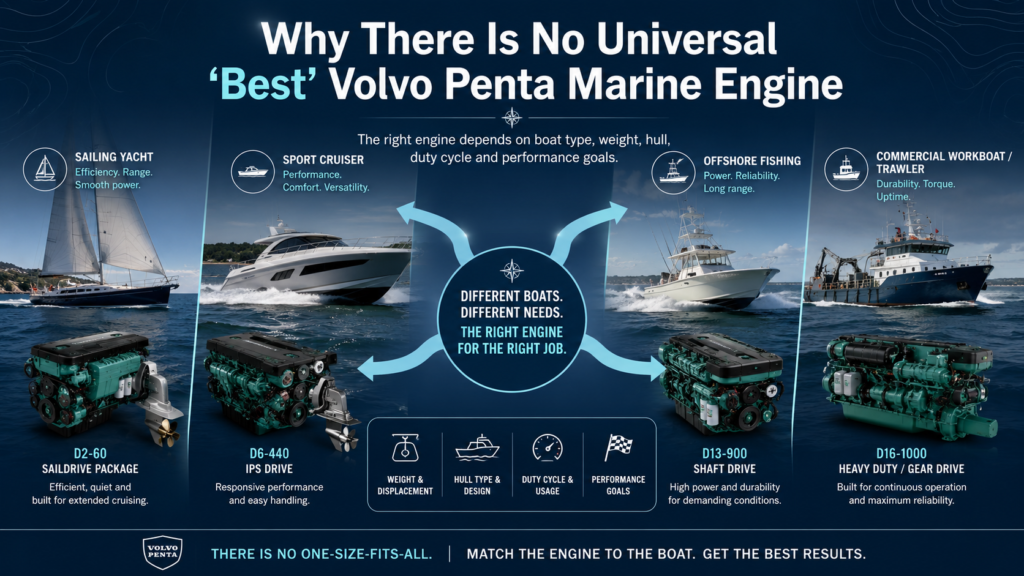
Why There Is No Universal – Best Volvo Penta Marine Engines
The best engine is the one that can do the required job without being overloaded or unnecessarily oversized.
Before recommending a Volvo Penta marine diesel engine, the following information should be reviewed:
- Vessel make and model
- Hull type
- Length and beam
- Fully loaded displacement
- Current engine and gearbox
- Reduction ratio
- Propeller dimensions
- Required cruising speed
- Maximum-speed target
- Annual operating hours
- Recreational or commercial use
- Single- or twin-engine arrangement
- Freshwater or saltwater operation
- Engine-room dimensions and airflow
A good engine installed in the wrong vessel is still the wrong engine.
Start With Fully Loaded Displacement
A boat’s published dry weight often excludes much of what it carries in real operation.
The true operating weight may include:
- Fuel
- Fresh water
- Passengers
- Crew
- Generator
- Batteries
- Tender
- Fishing gear
- Ice
- Safety equipment
- Optional accessories
- Commercial cargo
This difference can be substantial.
An offshore fishing boat may look correctly powered during a light demonstration run. Add full fuel tanks, water, bait wells, a tower, generator, fishing equipment and several passengers, and the engine load can change significantly.
For responsible Volvo Penta engine selection, use the boat’s realistic loaded displacement rather than only its brochure weight.
Hull Type Changes the Recommendation
Displacement hulls
Displacement vessels move through the water instead of rising onto its surface.
Examples include:
- Sailing yachts
- Traditional trawlers
- Heavy cruisers
- Many commercial workboats
Their main priorities are normally:
- Low-speed torque
- Fuel efficiency
- Proper propeller matching
- Ability to maintain speed in adverse conditions
- Correct gearbox reduction
- Suitable operating duty
Once a displacement hull approaches its practical hull-speed limit, adding significantly more horsepower may increase fuel consumption and wake without producing a useful speed improvement.
Semi-displacement hulls
Semi-displacement boats operate between displacement and full planing behaviour.
Examples include:
- Fast trawlers
- Pilot boats
- Passenger launches
- Patrol vessels
Their resistance can rise quickly as speed increases. This makes professional hull-resistance and propulsion calculations particularly important.
Planing hulls
Planing boats need sufficient power to accelerate, overcome hull resistance and lift more of the hull above the water.
Examples include:
- Sport cruisers
- Offshore fishing boats
- Day boats
- Fast patrol craft
- Performance yachts
For these boats, buyers should evaluate:
- Time to plane
- Loaded acceleration
- Cruise RPM
- Full-load engine RPM
- Propeller selection
- Trim performance
- Fuel per nautical mile
A lightly loaded boat may perform well while a fully equipped version struggles. The engine must be selected for the vessel’s normal operating condition.
Best Volvo Penta Engines for Sailing Yachts
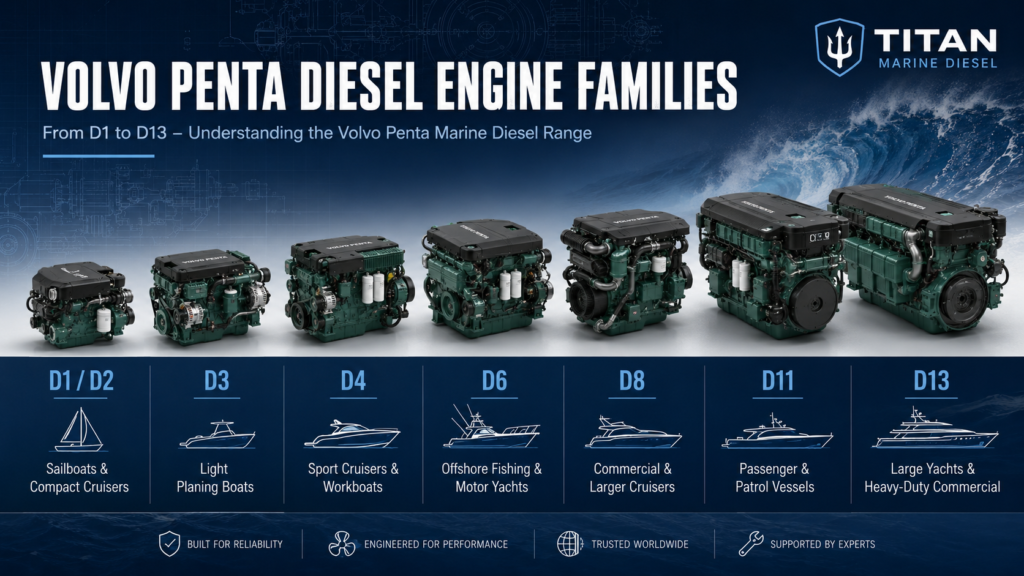
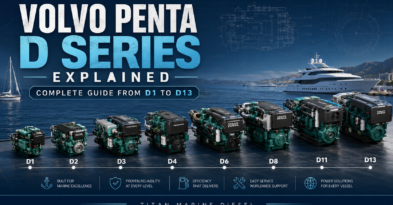
The main starting points for sailing yachts are the Volvo Penta D1 and D2 marine engines.
Choose a Volvo Penta D1 when:
- The yacht is relatively small
- Engine-room space is restricted
- Auxiliary propulsion requirements are modest
- Low installed weight matters
- A compatible shaft or saildrive installation is used
The D1 represents the compact end of Volvo Penta’s inboard diesel range and is designed around smaller sailing and displacement applications.
Choose a Volvo Penta D2 when:
- The yacht has greater displacement
- More reserve power is required
- Offshore motoring is expected
- The boat carries substantial onboard electrical systems
- A larger shaft-drive or saildrive package is appropriate
The current D2 is a 2.2-litre, inline four-cylinder, naturally aspirated marine diesel platform. Representative models include the Volvo Penta D2-50, D2-60 and D2-75.
Do not select a sailboat engine from yacht length alone.
Two yachts of the same length can differ considerably in displacement, keel design, windage, propeller arrangement and onboard electrical demand.
Before buying, confirm:
- Fully loaded displacement
- Existing engine output
- Shaft or saildrive model
- Propeller size
- Alternator requirements
- Exhaust diameter
- Mounting centres
- Installation access
Best Volvo Penta Engines for Displacement Cruisers
Depending on vessel size, the main options may include the D2, D4, D6 or D8.
The key objective is not maximum horsepower. It is dependable, efficient cruising at the vessel’s intended speed.
Choose a D2 when:
- The cruiser is compact
- Power demand is modest
- The hull operates fully at displacement speed
Choose a D4 when:
- More torque is required
- A compact four-cylinder package is preferred
- The vessel is too heavy for a smaller auxiliary diesel
- Moderate shaft-drive power is sufficient
Choose a D6 when:
- The boat is heavier
- More reserve power is needed
- Six-cylinder smoothness is preferred
- The vessel carries significant fuel, water and onboard systems
Choose a D8 when:
- The boat moves into a larger displacement class
- Higher commercial or cruising loads are expected
- The gearbox, shaft and propeller can accept the additional torque
- The machinery space can support the larger engine
Volvo Penta’s D4 platform is a 3.7-litre inline-four, while the D6 uses a 5.5-litre inline-six. Current D6-DPI packages range from 300 to 480 hp and integrate the engine, electronic controls and Duoprop drive.
More horsepower is not automatically more economical. A properly geared engine operating in an appropriate load range may provide better long-term value than an oversized unit operating lightly.
Best Volvo Penta Engines for Trawlers
Trawlers range from slow displacement vessels to relatively fast semi-displacement cruisers.
Recreational displacement trawlers
The Volvo Penta D4 Marine Engine or D6 may suit many medium-sized trawlers.
Selection priorities include:
- Fuel per nautical mile
- Engine load at cruise
- Low-speed torque
- Propeller efficiency
- Service access
- Noise and vibration
- Range between refuelling stops
Fast trawlers
Fast-trawler designs may require much more power because resistance rises rapidly as the vessel is pushed beyond normal displacement speeds.
Depending on the vessel, the D6, D8 or D11 may deserve consideration.
A fast trawler cruising at 18 knots presents a different propulsion problem from a full-displacement trawler cruising at eight knots—even when both vessels have similar overall lengths.
For long-range cruising, compare:
- Fuel burned per hour
- Boat speed
- Fuel per nautical mile
- Engine-load percentage
- Tank capacity
- Practical range
- Required reserve
The best Volvo Penta engine for a trawler is the one that achieves the intended cruising speed without operating continuously too close to its maximum load.
Best Volvo Penta Engines for Sport Cruisers
For sport cruisers, the D4 and D6 are usually the most relevant engine families.
Choose a D4 when:
- The cruiser is medium-sized
- A compact engine is advantageous
- The vessel falls comfortably within the D4’s power capability
- Aquamatic propulsion is preferred
- The required output is available without moving to a larger six-cylinder platform
Choose a D6 when:
- The vessel is heavier
- Faster acceleration is needed
- Higher cruising performance is expected
- Six-cylinder refinement matters
- A higher-output Aquamatic or IPS package is required
The D6-DPI combines a 5.5-litre inline-six diesel with an integrated Aquamatic Duoprop drive and Electronic Vessel Control. Volvo Penta also offers matched D6-IPS configurations for compatible hulls.
Aquamatic or IPS?
Volvo Penta Aquamatic may be appropriate when the buyer wants:
- Trim adjustment
- Strong planing performance
- Responsive steering
- A transom-mounted drive
- Duoprop propulsion
Volvo Penta IPS may be considered when the boat is designed for:
- Steerable pods
- Integrated electronic steering
- Joystick maneuvering
- Counter-rotating propellers
- A different machinery-space layout
Neither system is automatically better.
The choice depends on hull compatibility, intended performance, maintenance support, underwater operating conditions and total ownership cost.
Best Volvo Penta Engines for Offshore Fishing Boats
Common starting points include:
- D4
- D6
- D8
- D11
Loaded displacement is particularly important for offshore fishing vessels.
A properly equipped boat may carry:
- Large fuel capacity
- Fresh water
- Ice
- Bait tanks
- Generator
- Tower
- Fishing equipment
- Crew and passengers
Choose a D4 when:
- The boat is relatively compact
- A medium-power package meets the fully loaded requirement
- Inboard or Aquamatic propulsion is appropriate
Choose a D6 when:
- Stronger planing performance is needed
- The boat carries more load
- Twin engines are preferred
- More output is needed without moving into the D8 class
Choose a D8 when:
- The vessel enters a larger weight category
- Higher sustained power is required
- Shaft or IPS propulsion is suitable
- The engine room can support a 7.7-litre platform
Current D8-IPS packages pair a 7.7-litre inline-six engine with matched IPS15 pods. Published crankshaft outputs range from 450 to 600 hp across commercial and leisure configurations.
Choose a D11 when:
- The boat is a substantial sport-fishing yacht
- High cruise loads are expected
- Larger shaft or IPS systems are required
- The driveline has been designed for the engine’s torque and weight
Offshore buyers should also evaluate:
- Trolling performance
- Fuel range
- Propulsion redundancy
- Corrosion protection
- Service access
- Rated RPM at full operating load
Best Volvo Penta Engines for Commercial Fishing Vessels
Commercial engines must be selected by operating profile—not peak horsepower alone.
Relevant engine families may include:
- D6
- D8
- D11
- D13
The proper choice depends on:
- Annual operating hours
- Average engine load
- Time at maximum power
- Fishing method
- Cargo and gear weight
- Towing or trawling demand
- Propeller or waterjet requirements
- Fuel economy
- Downtime cost
A high-output recreational rating may not be appropriate for a fishing vessel operating every day under sustained load.
Volvo Penta defines separate warranty and operating conditions for marine commercial use. Current warranty documents distinguish among engine families, duty ratings and operating-hour limits, so the exact model and application must be confirmed before purchase.
Commercial buyers should provide accurate information about:
- Expected annual hours
- Average cruise load
- Percentage of time at full power
- Towing or carrying requirements
- Required cruising speed
- Classification obligations
Misclassifying a commercial vessel as recreational can create reliability and warranty problems.
Best Volvo Penta Engines for Workboats
Workboat applications include:
- Harbour-service boats
- Survey boats
- Crew vessels
- Construction-support craft
- Utility boats
- Offshore-service vessels
- Tug-support boats
The suitable engine may range from D4 to D13.
Smaller and medium workboats
A D4 or D6 may be suitable when:
- Machinery space is restricted
- Moderate power is sufficient
- The vessel uses shaft, Aquamatic or waterjet propulsion
- Annual operating hours fit the selected rating
Larger workboats
A D8 or D11 may be more appropriate when:
- Passenger or cargo load increases
- Sustained speed is required
- Annual operating hours are substantial
- More torque reserve is needed
High-output commercial applications
The D13 may be considered where the vessel requires:
- High sustained output
- A substantial marine transmission
- Larger shafting and propeller capacity
- Professional system integration
- Demanding commercial service
Volvo Penta markets its workboat propulsion around performance, durability, maintenance access and operating uptime.
For a commercial operator, the best engine is often the one that reduces avoidable downtime—not the one with the highest advertised horsepower.
Best Volvo Penta Engines for Passenger Vessels
Passenger vessels require close attention to:
- Reliability
- Propulsion redundancy
- Scheduled operating hours
- Fuel economy
- Noise and vibration
- Service intervals
- Regulatory requirements
- Passenger comfort
Potential engine families include:
- D6
- D8
- D11
- D13
Twin-engine arrangements are often considered because they can improve maneuverability and provide redundancy, although the precise requirement depends on the vessel design and applicable regulations.
IPS can provide integrated steering, pod propulsion and optional functions such as Joystick Docking and Dynamic Positioning on compatible packages. Traditional shaft drive may still be preferable where simplicity, local service familiarity or existing hull design makes it the stronger solution.
Best Volvo Penta Engines for Patrol, Pilot and Rescue Boats
These vessels can be difficult to specify because they may operate slowly for long periods and then require maximum performance without warning.
Possible engine families include:
- D6
- D8
- D11
- D13
Propulsion arrangements may include:
- Shaft drive
- Aquamatic
- IPS
- Waterjet
Important requirements include:
- Rapid acceleration
- Sustained high-speed operation
- Rough-water performance
- Precise low-speed control
- Reliability during emergency service
- Propulsion redundancy
A waterjet may suit shallow-draft or high-speed applications, but the jet unit and engine must be matched according to the jet manufacturer’s power-absorption requirements.
This is not an application where a generic horsepower recommendation is responsible.
Best Volvo Penta Engines for Catamarans
The first distinction is whether the vessel is a sailing or power catamaran.
Sailing catamarans
D1 and D2 engines are common starting points for twin-engine installations.
Important factors include:
- Narrow engine compartments
- Saildrive or shaft geometry
- Propeller clearance
- Ventilation in each hull
- Weight sensitivity
- Electrical charging requirements
- Safe operation on one engine
Power catamarans
Depending on vessel size and intended speed, possible engines include:
- D4
- D6
- D8
- D11
A power catamaran requires vessel-specific evaluation of:
- Twin-hull resistance
- Tunnel geometry
- Weight distribution
- Propeller clearance
- Shaft angles
- IPS compatibility
- Asymmetric operation
An engine that works in a monohull of similar length should not automatically be assumed suitable for a catamaran.
Best Volvo Penta Engines for Large Motor Yachts
The D8, D11 and D13 are the main families to consider for larger motor yachts.
Choose a D8 when:
- The yacht fits within its power and load capability
- A compact 7.7-litre platform is preferred
- Shaft or IPS propulsion is appropriate
- Twin-engine installation is planned
Choose a D11 when:
- More torque and power are needed
- The yacht carries significant fuel, water and hotel loads
- Larger shaft or IPS systems are required
- High cruising performance is expected
Choose a D13 when:
- The yacht enters a high-output class
- The propulsion system has been professionally engineered
- Shafting, gearbox, cooling and exhaust can support the engine
- The vessel’s loaded resistance justifies the larger platform
Volvo Penta continues to expand IPS technology into larger professional and superyacht applications, including a modular IPS Professional Platform.
Shaft drive may remain preferable where the owner values:
- Mechanical familiarity
- Conventional hull design
- Existing shaft geometry
- Long-range simplicity
- Wider local serviceability
Best Volvo Penta Engine for a Repower
Repowering is not simply replacing one horsepower number with another.
Begin by recording:
- Existing engine model
- Current horsepower
- Rated RPM
- Gearbox
- Reduction ratio
- Propeller
- Cruise speed
- Maximum speed
- Fuel consumption
- Existing performance issues
Before ordering, measure:
- Engine length, width and height
- Mounting centres
- Gearbox output position
- Shaft angle
- Exhaust diameter
- Cooling-water connections
- Fuel-system capacity
- Electrical voltage
- Installation-hatch opening
- Maintenance clearance
Volvo Penta presents repowering as an opportunity to assess and upgrade the complete propulsion system, rather than treating the project as an engine-only exchange.
Increasing horsepower may require changes to:
- Marine gearbox
- Shaft and coupling
- Propeller
- Engine beds
- Exhaust system
- Cooling circuit
- Fuel supply
- Ventilation
- Electronic controls
An engine may fit inside the engine room but still be too large to pass through the access hatch. That is the type of problem that should be discovered before payment.
New Engine, Used Engine or Complete Package?
New Volvo Penta engine
A new engine normally provides:
- Known condition
- Current documentation
- Warranty eligibility
- Predictable service life
- Easier project planning
Volvo Penta announced expanded global three-year marine warranty coverage for products delivered from 2025 onward, but exact terms remain dependent on model, application, operating hours, region and registration. Buyers should obtain the applicable written warranty before ordering.
Used Volvo Penta engine
Before purchasing a used engine, request:
- Full model and serial number
- Production year
- Operating hours
- Service history
- Diagnostic report
- Fault-code history
- Cooling-system inspection
- Turbocharger condition
- Oil analysis where appropriate
- Loaded sea-trial results
Fresh paint improves appearance. It does not prove internal mechanical condition.
Bobtail engine or complete propulsion package
A bobtail-engine quotation may exclude:
- Gearbox
- Sterndrive or IPS pod
- Controls
- Displays
- Harnesses
- Steering
- Propellers
- Installation components
A complete written quotation should identify:
- Exact engine model
- Power and duty rating
- Gearbox or drive
- Reduction ratio
- Controls
- Displays
- Propellers
- Included accessories
- Exclusions
- Warranty
- Availability
- Freight terms
Do not compare an engine-only price with a complete propulsion-package price.
Common Mistakes When Choosing a Volvo Penta Engine
The mistakes we see most frequently include:
- Choosing by boat length alone
- Using dry weight instead of loaded displacement
- Selecting the highest horsepower automatically
- Ignoring recreational versus commercial duty
- Reusing an unsuitable gearbox
- Failing to confirm the reduction ratio
- Assuming old controls will be compatible
- Selecting IPS or Aquamatic before checking hull suitability
- Comparing engine-only and complete-package prices
- Ignoring service access
- Ordering before confirming installation and freight costs
The most expensive approach is purchasing the engine first and trying to solve the technical problems afterwards.
Frequently Asked Questions
Which Volvo Penta engine is best for a sailboat?
The D1 and D2 are the main starting points. The correct model depends on loaded displacement, shaft or saildrive configuration, propeller, onboard electrical demand and expected motoring conditions.
Which Volvo Penta engine is best for a sport cruiser?
The D4 and D6 are commonly considered. A medium cruiser may suit a D4 Aquamatic package, while a heavier or faster boat may require a D6 Aquamatic or compatible IPS system.
Which Volvo Penta engine is best for a trawler?
A D4, D6 or D8 may be suitable depending on displacement, hull type, cruise speed and annual hours. A full-displacement trawler and fast trawler of the same length may need very different power.
Which Volvo Penta engine is best for an offshore fishing boat?
The D6, D8 and D11 are common starting points for larger offshore boats. Selection should be based on full operating weight, including fuel, ice, equipment and crew.
Which Volvo Penta engine is best for a workboat?
Depending on vessel size and duty, the appropriate engine may range from D4 to D13. Annual hours, average load, commercial rating and downtime cost should guide the decision.
Which Volvo Penta engine is best for a large yacht?
The D8, D11 and D13 are the main families to consider. Final selection depends on displacement, speed, shaft or IPS configuration, machinery-space design and range.
Is Volvo Penta IPS better than shaft drive?
Neither is universally better. IPS can provide integrated steering and excellent low-speed maneuverability, while shaft drive may offer greater mechanical simplicity and service familiarity. Hull compatibility should determine the choice.
Can I install a larger Volvo Penta engine during a repower?
Possibly, but increasing power may require changes to the gearbox, shaft, propeller, engine beds, exhaust, cooling, ventilation, fuel system and controls.
Does a Volvo Penta engine include the gearbox?
Not necessarily. Some packages are engine-only, while others include a transmission, Aquamatic drive or complete IPS system. Every inclusion should be stated in the quotation.
How long is the Volvo Penta warranty?
Warranty coverage depends on the product, delivery date, use, region and operating hours. Volvo Penta currently advertises expanded three-year marine coverage for qualifying products delivered from 2025 onward, but the exact written terms should always be confirmed for the specific engine and application.
Can Titan Marine Diesel recommend the correct engine?
Titan Marine Diesel can review the vessel information and prepare a suitable package recommendation. Final structural, installation, propeller and driveline decisions must be verified by the responsible qualified marine professional.
Information Titan Marine Diesel Needs
To prepare a responsible engine recommendation, provide:
- Vessel make and model
- Length and beam
- Fully loaded displacement
- Hull type
- Existing engine model
- Current horsepower and rated RPM
- Gearbox or drive model
- Reduction ratio
- Propeller details
- Required cruising speed
- Expected maximum speed
- Recreational or commercial use
- Annual operating hours
- Single- or twin-engine configuration
- Freshwater or saltwater operation
- Delivery destination
- Required lead time
Photographs of the engine identification plate, gearbox plate, engine room, mounts, controls and exhaust arrangement are also useful.
Final Thoughts: Which Volvo Penta Model Is Right for You?
Choose a Volvo Penta D1 or D2 for many sailing-yacht and compact displacement applications.
Choose a Volvo Penta D4 or D6 for sport cruisers, medium fishing boats, trawlers and smaller workboats.
Choose a Volvo Penta D8 for larger yachts and more demanding commercial vessels.
Choose a Volvo Penta D11 or D13 for substantial yachts, passenger vessels and high-load professional craft.
Consider Volvo Penta Aquamatic for compatible planing boats, Volvo Penta IPS propulsion for suitable yachts and professional vessels, and conventional shaft drive where simplicity and hull design make it the stronger solution.
The best engine is not the model with the largest number.
It is the engine that matches:
- The boat’s actual operating weight
- Hull design
- Required performance
- Duty cycle
- Gearbox or drive
- Propeller
- Installation environment
- Maintenance support
We support recreational and commercial buyers with Best Engines for Boats – Volvo Penta Marine Buyer Guide selection, new marine diesel engines, complete propulsion packages, repower guidance, and international shipping coordination.
To request a Volvo Penta marine engine recommendation, provide your vessel specifications, current propulsion details, operating profile, delivery destination and required lead time.

Leave a Reply